Represent two-variable inequalities as regions
By UK GCSE Mathematics · independent study · myAudience
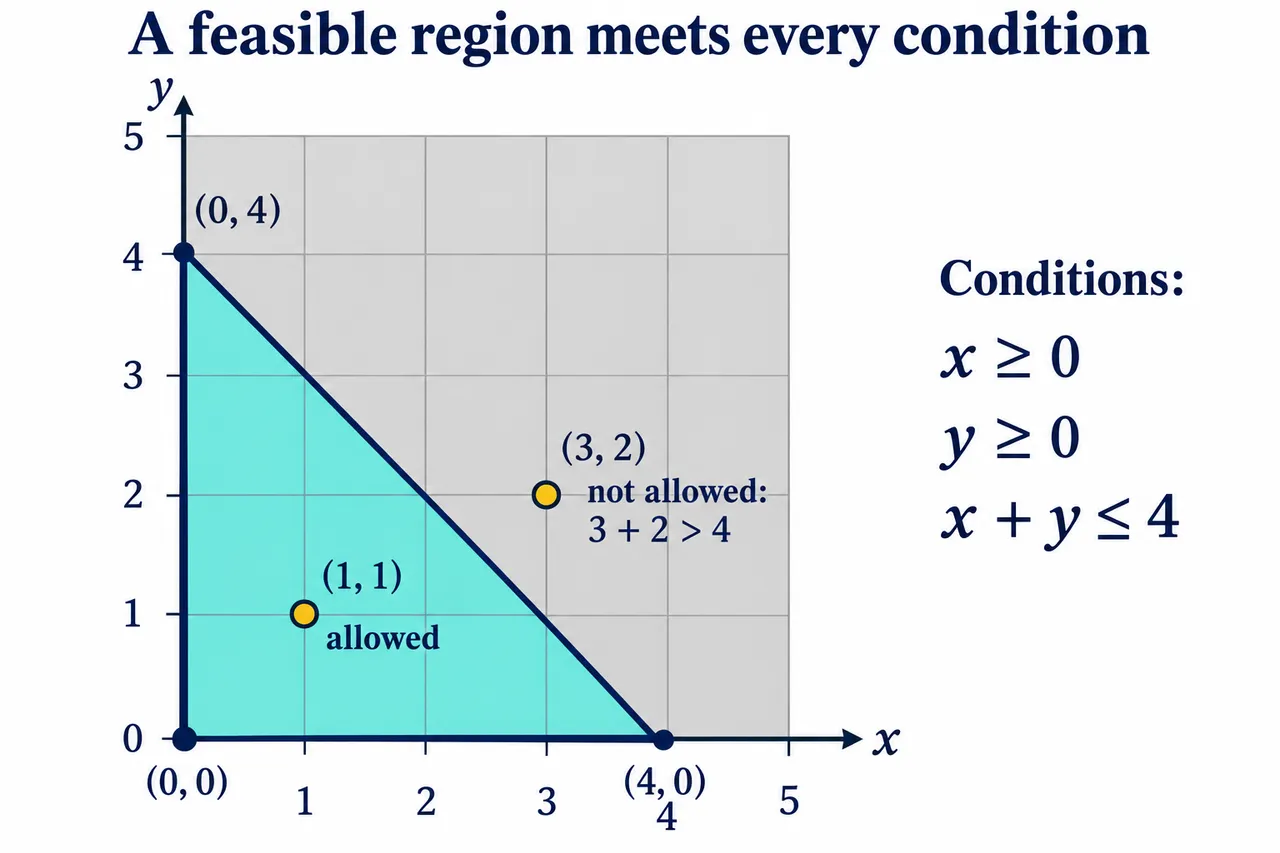
Original myAudience mathematics teaching illustration; labels, relationships and lesson calculations independently checked. · Original project artwork; no exam-board figures or textbook illustrations reused.
Represent two-variable inequalities as regions
A two-variable inequality describes points in a region. Its boundary is the corresponding equation. Use a solid boundary where equality is included and a dashed boundary where it is excluded.
Test a point away from the boundary to choose the correct side. For y > x + 1, the point (0, 0) fails, so shade the opposite side of the line. Multiple inequalities require the intersection of their permitted regions.
An answer may have no feasible region, a bounded region or an unbounded region. Keep the boundaries and inclusion rules visible. A shading convention that marks the unwanted region can also work, but it must be stated consistently.
Worked example: Describe the region x ≥ 0, y ≥ 0, x + y ≤ 4.
Use the coordinate axes and x + y = 4 as solid boundaries.
Keep the first quadrant.
Keep the points at or below the line.
Answer: The closed triangular region with vertices (0, 0), (4, 0), (0, 4).
Check your understanding: Is (3, 2) in this region?
Answer: No.
Why: Although both coordinates are nonnegative, their sum 5 exceeds 4.