Find intervals where a quadratic has the required sign
By UK GCSE Mathematics · independent study · myAudience
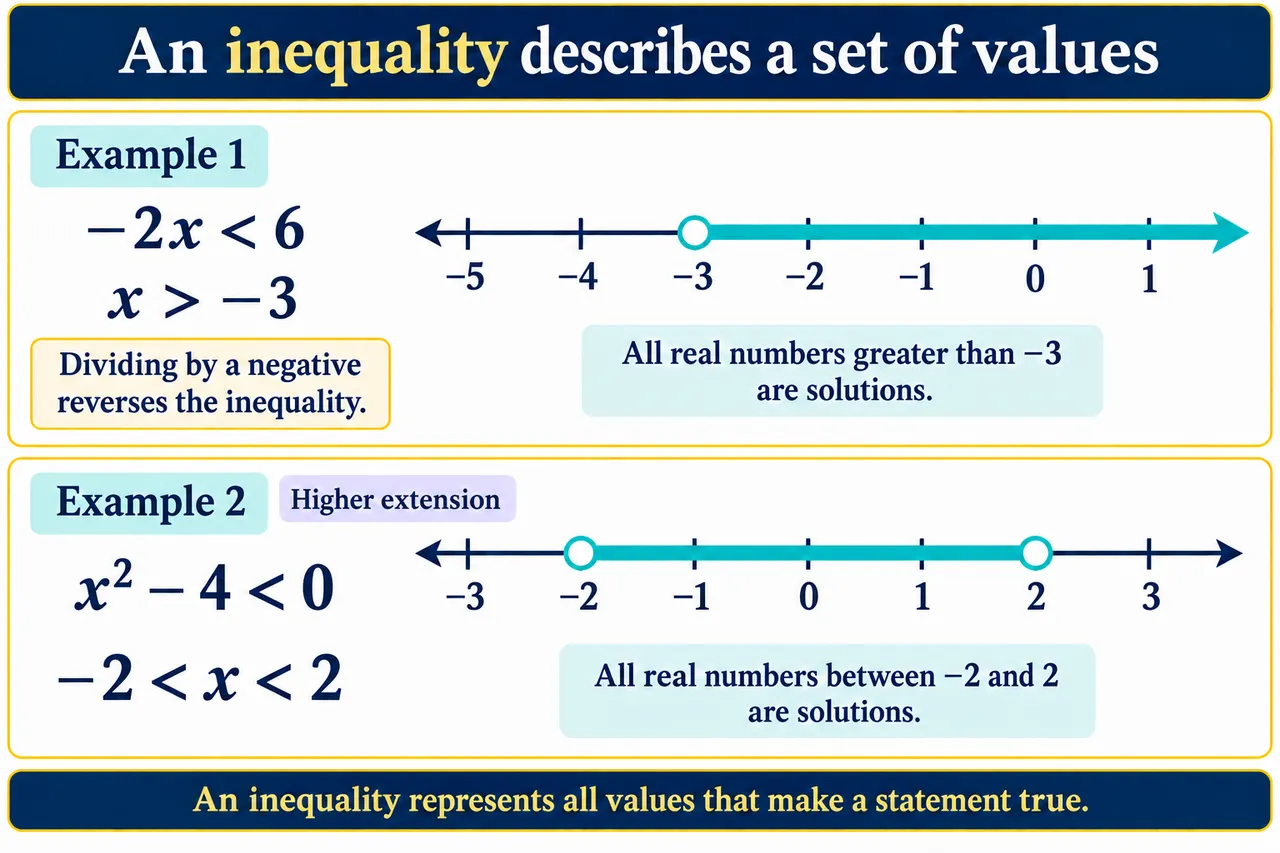
Original myAudience mathematics teaching illustration; labels, relationships and lesson calculations independently checked. · Original project artwork; no exam-board figures or textbook illustrations reused.
Find intervals where a quadratic has the required sign
First find the roots of the corresponding quadratic equation. These divide the number line into intervals on which the sign can be tested. For x² − 4, the roots −2 and 2 separate three regions.
The upward-opening graph is negative between its roots and positive outside them. Thus x² − 4 < 0 gives −2 < x < 2. Including equality changes the endpoint circles, while reversing the inequality changes the chosen intervals.
Do not assume every quadratic has two distinct real roots. A repeated root or no real roots requires checking the sign of the whole expression. Set notation and a number-line diagram should describe the same solution set.
Worked example: Solve x² − 4 < 0.
Factorise (x − 2)(x + 2).
Find roots −2 and 2.
Test x = 0 between the roots: output −4.
Answer: −2 < x < 2.
Check your understanding: What changes for x² − 4 ≤ 0?
Answer: Both endpoints are included.
Why: At either root the expression equals zero.