Recognise square, cube, triangular and Fibonacci-type patterns
By UK GCSE Mathematics · independent study · myAudience
Original myAudience mathematics teaching illustration; labels, relationships and lesson calculations independently checked. · Original project artwork; no exam-board figures or textbook illustrations reused.
Recognise square, cube, triangular and Fibonacci-type patterns
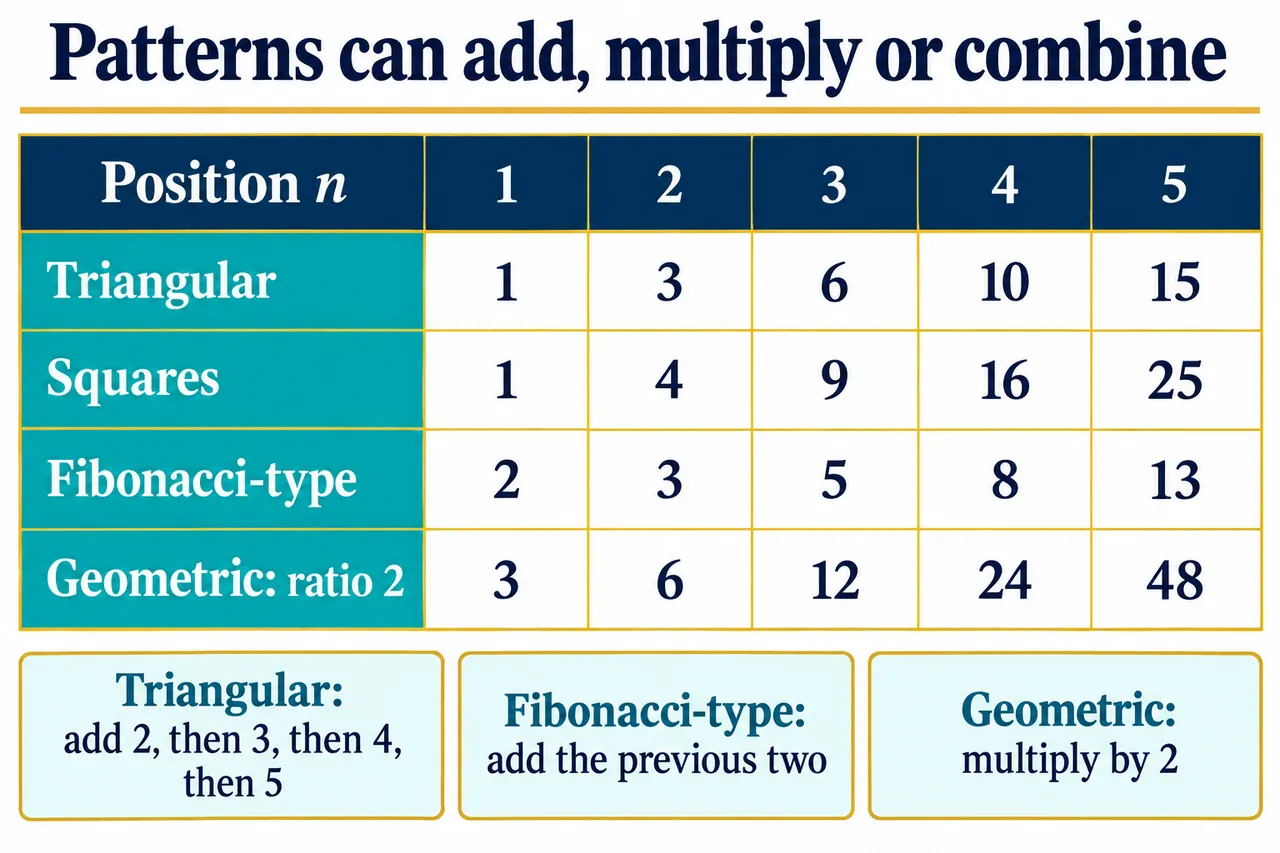
Square and cube sequences use n² and n³. Triangular numbers count totals 1, 1 + 2, 1 + 2 + 3 and so on, giving 1, 3, 6, 10, 15. Their increasing first differences distinguish them from constant-difference arithmetic sequences.
A Fibonacci-type sequence forms each new term by adding the previous two. With starting values 2 and 3 it gives 2, 3, 5, 8, 13. Other starting pairs follow the same recurrence but produce different sequences.
Quadratic sequences have constant second differences when their terms are sampled at consecutive integer positions. Recognising a pattern suggests a rule; it does not establish uniqueness from an arbitrary finite list. Check the rule against all given terms.
Worked example: Continue the Fibonacci-type sequence 2, 3, 5, 8.
Add the last two terms: 5 + 8.
Then use the new final pair: 8 + 13.
Answer: 13, 21.
Check your understanding: What is the next triangular number after 10?
Answer: 15.
Why: The next increment is 5.