Recognise a constant multiplicative step
By UK GCSE Mathematics · independent study · myAudience
Original myAudience mathematics teaching illustration; labels, relationships and lesson calculations independently checked. · Original project artwork; no exam-board figures or textbook illustrations reused.
Recognise a constant multiplicative step
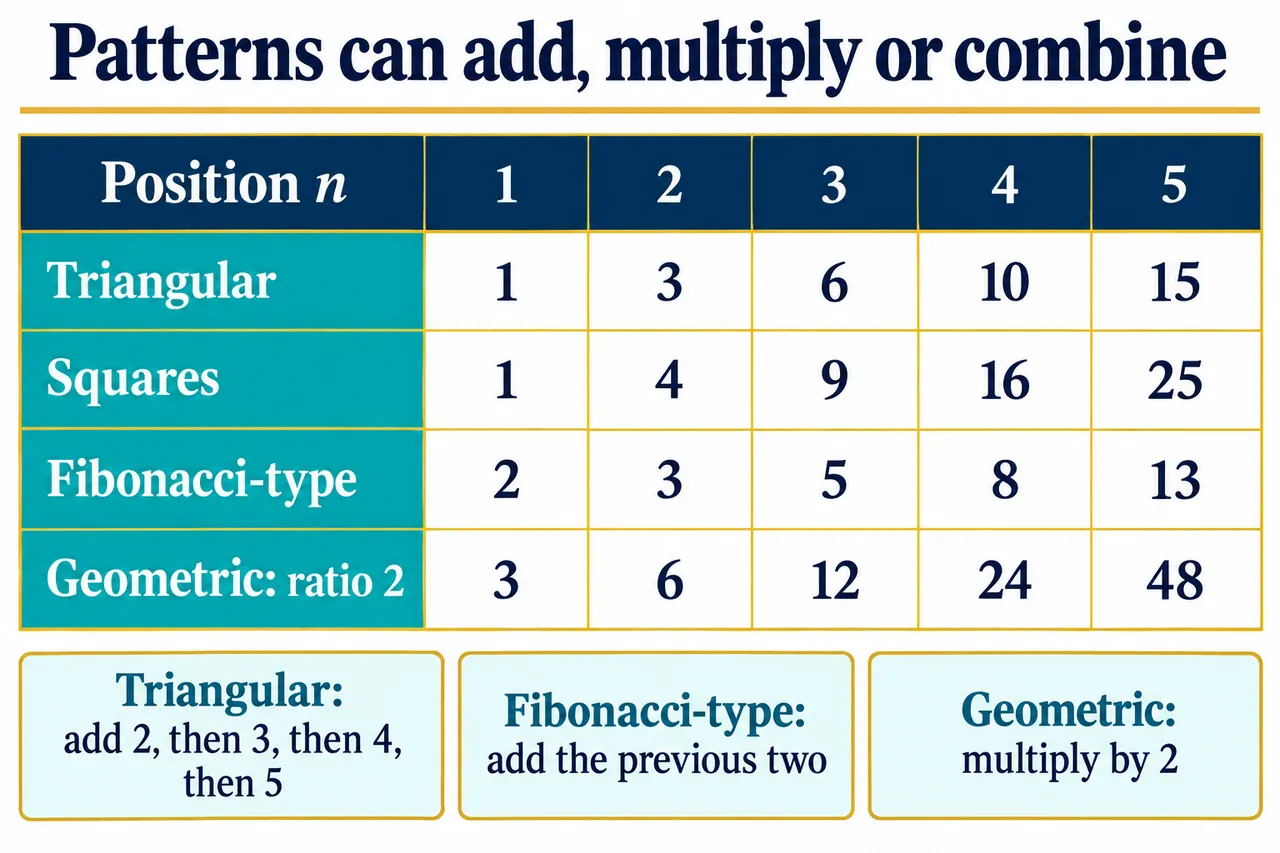
A geometric sequence multiplies by a fixed ratio rather than adding a fixed difference. Starting at 3 with ratio 2 gives 3, 6, 12, 24. Starting at 16 with ratio 1/2 gives 16, 8, 4, 2.
For first term a at position 1, the rule is a × rⁿ⁻¹. The exponent is n − 1 because reaching the first term requires zero multiplications. For a positive starting amount, a rational ratio above one gives growth; a ratio between zero and one gives decay.
Divide a term by its nonzero predecessor to test the ratio. A sequence containing zeros needs separate reasoning before division. Equal differences and equal ratios are different structures, so compare both when identifying a pattern.
Worked example: Find the fifth term starting at 3 and doubling each time.
There are four multiplications from term one to term five.
Calculate 3 × 2⁴.
Answer: 48.
Check your understanding: For 16, 8, 4, 2, what is the ratio?
Answer: 1/2.
Why: Every term is half its predecessor.