Deduce the position rule of a linear sequence
By UK GCSE Mathematics · independent study · myAudience
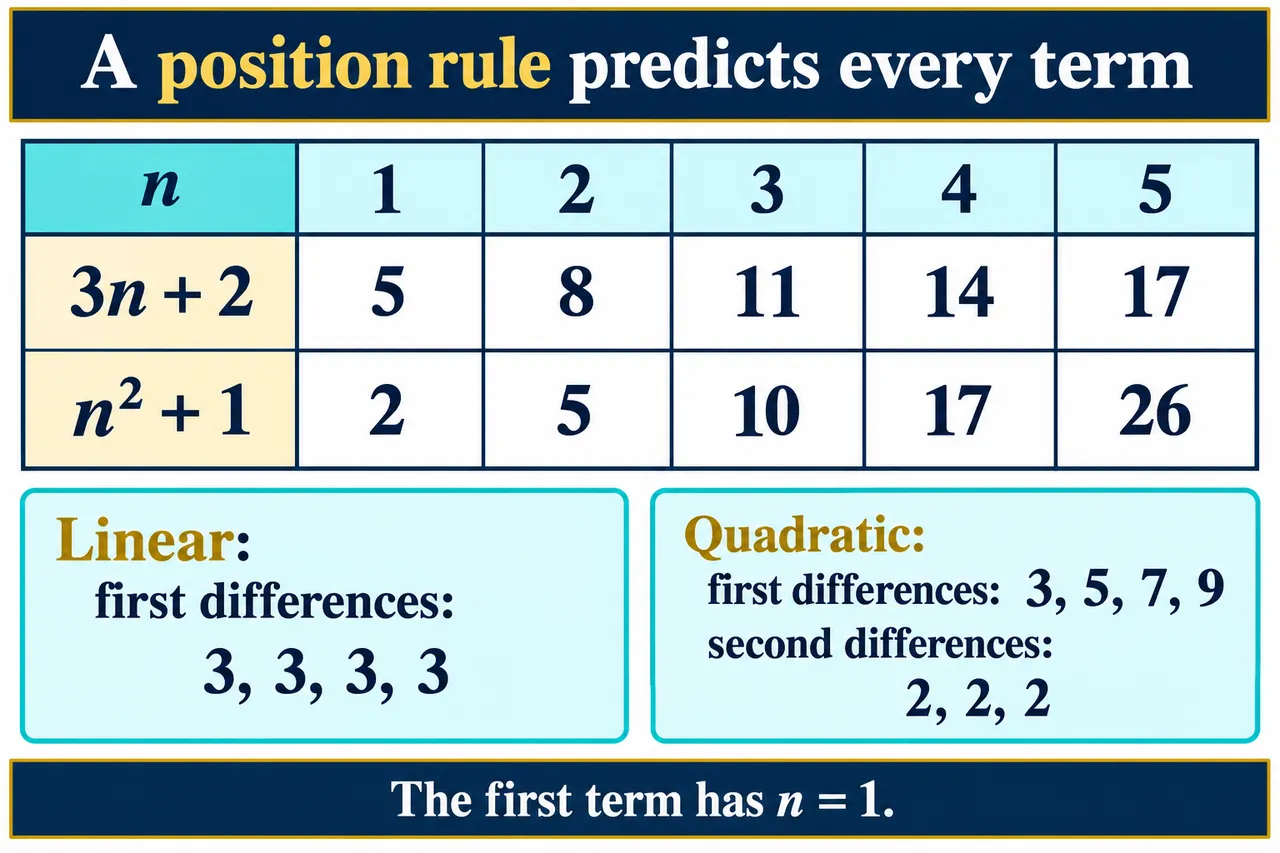
Original myAudience mathematics teaching illustration; labels, relationships and lesson calculations independently checked. · Original project artwork; no exam-board figures or textbook illustrations reused.
Deduce the position rule of a linear sequence
A linear sequence has constant first difference d. Its nth term has form dn + c. Compare the given terms with multiples of d to find the constant adjustment; then verify more than one term.
For 5, 8, 11, 14, the difference is 3. Multiples 3, 6, 9, 12 are two less than the corresponding terms, giving 3n + 2. The rule can test whether a value belongs to the sequence by solving for n and requiring an allowed integer position.
A noninteger or nonpositive position is not automatically a sequence member when indexing starts at 1. The formula describes an algebraic relationship, but the position domain selects the actual terms.
Worked example: Find the nth term of 5, 8, 11, 14, ….
The common difference is 3.
Compare the first term with 3 × 1.
Add the constant difference 2.
Answer: 3n + 2.
Check your understanding: Is 50 a term of this sequence?
Answer: Yes, the 16th.
Why: Solve 3n + 2 = 50 to obtain n = 16.