Deduce a quadratic position rule from differences
By UK GCSE Mathematics · independent study · myAudience
Original myAudience mathematics teaching illustration; labels, relationships and lesson calculations independently checked. · Original project artwork; no exam-board figures or textbook illustrations reused.
Deduce a quadratic position rule from differences
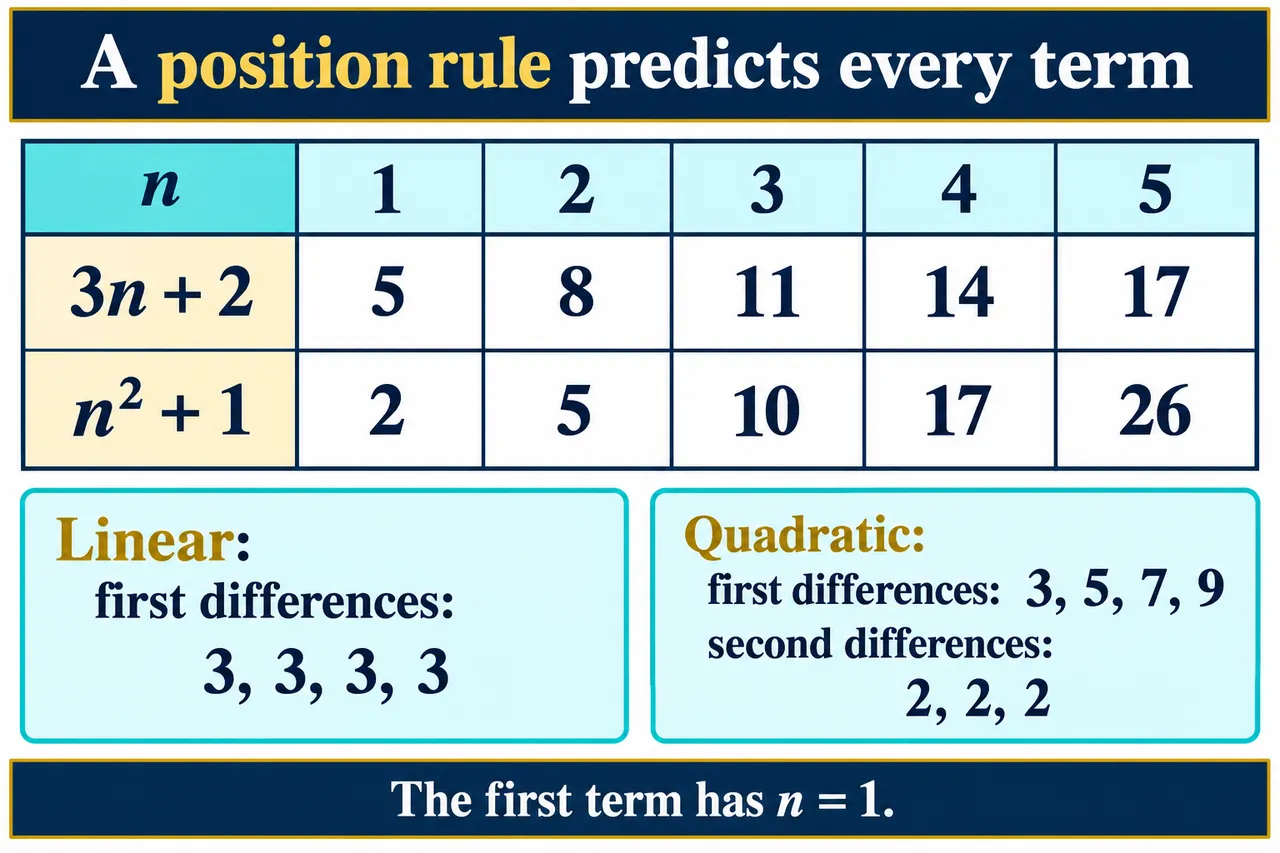
A quadratic sequence has nth term an² + bn + c and constant second difference 2a. For 2, 5, 10, 17, 26, the first differences are 3, 5, 7, 9 and the second differences are 2, 2, 2, so a = 1.
Subtract n² from each original term. Here the remainder is always 1, giving n² + 1. If the remainder were linear, deduce its bn + c rule and add it back. Verify the completed formula against every supplied term.
The difference method assumes the proposed sequence is quadratic over consecutive integer positions. A short list can be extended in many ways, so explain the model assumption. The lesson identifies and checks a quadratic rule rather than proving that no other rule could match the same initial data.
Worked example: Find a quadratic rule for 2, 5, 10, 17, 26.
Calculate first and second differences.
Second difference 2 gives coefficient 1 for n².
Subtract n² and observe remainder 1.
Answer: n² + 1, for n starting at 1.
Check your understanding: What would a constant second difference of 6 imply about a?
Answer: a = 3.
Why: For an² + bn + c the second difference is 2a.