Use a scale only after matching the units
By UK GCSE Mathematics · independent study · myAudience
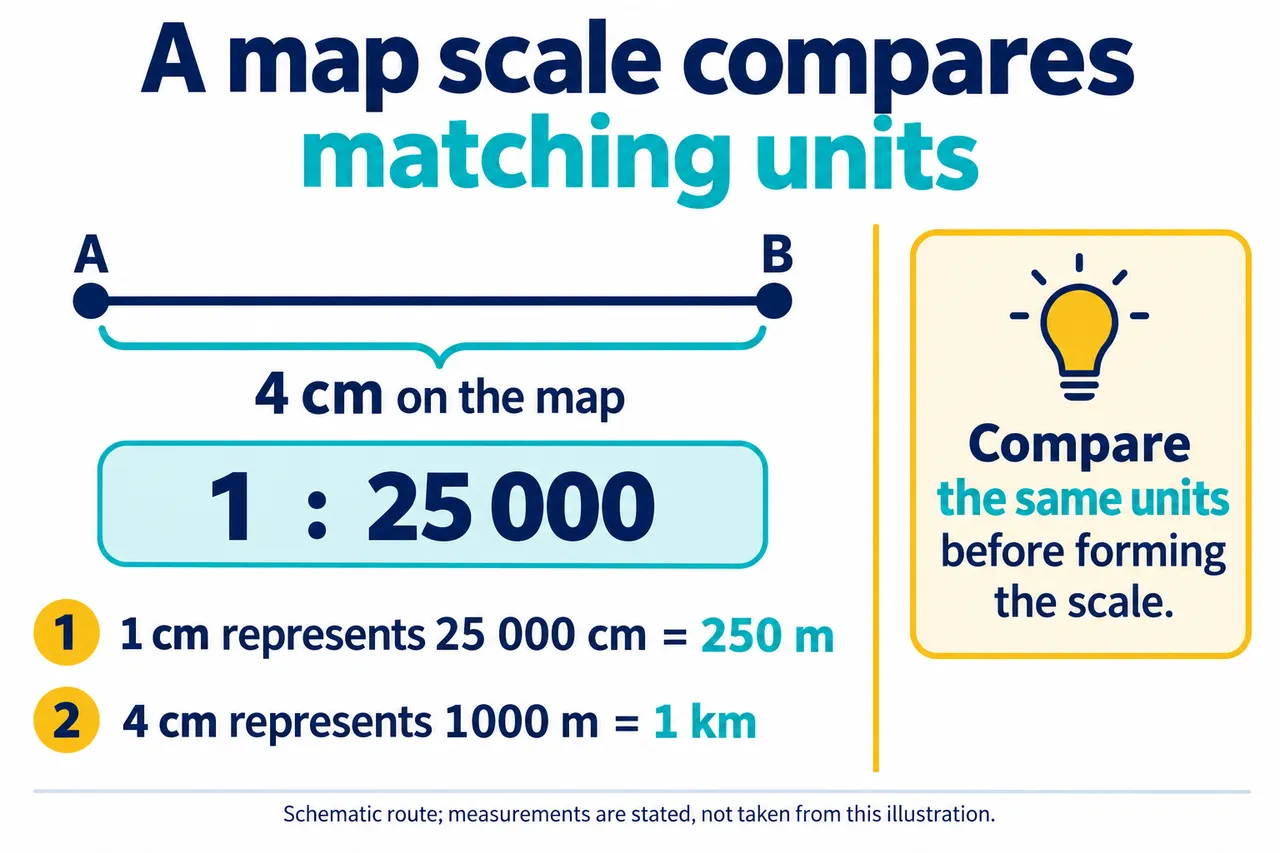
Original myAudience mathematics teaching illustration; labels, relationships and lesson calculations independently checked. · Original project artwork; no exam-board figures or textbook illustrations reused.
Use a scale only after matching the units
A scale of 1: 25 000 compares map length with real length in the same units. Thus one centimetre on the map represents 25 000 centimetres in reality, which is 250 metres. The scale does not mean that a centimetre represents 25 000 metres.
Multiply the map measurement by the scale factor, then convert to useful real units. For the reverse problem, express the real distance in the map unit and divide by the scale factor. A scale bar can remain useful after resizing only if it is resized with the map.
A scale diagram is a model. Stated distances or accurately measured printed lengths can be used, but a schematic illustration is not a ruler. Check that the assumed scale applies to the particular map or drawing being used.
Worked example: A 1: 25 000 map shows a 4 cm route. Find its real length.
Each centimetre represents 250 m.
Multiply by 4.
Convert 1000 m to kilometres.
Answer: 1 km.
Check your understanding: What map length represents 2 km at this scale?
Answer: 8 cm.
Why: 2000 m divided by 250 m per centimetre gives 8 cm.