Reduce a ratio while preserving the comparison
By UK GCSE Mathematics · independent study · myAudience
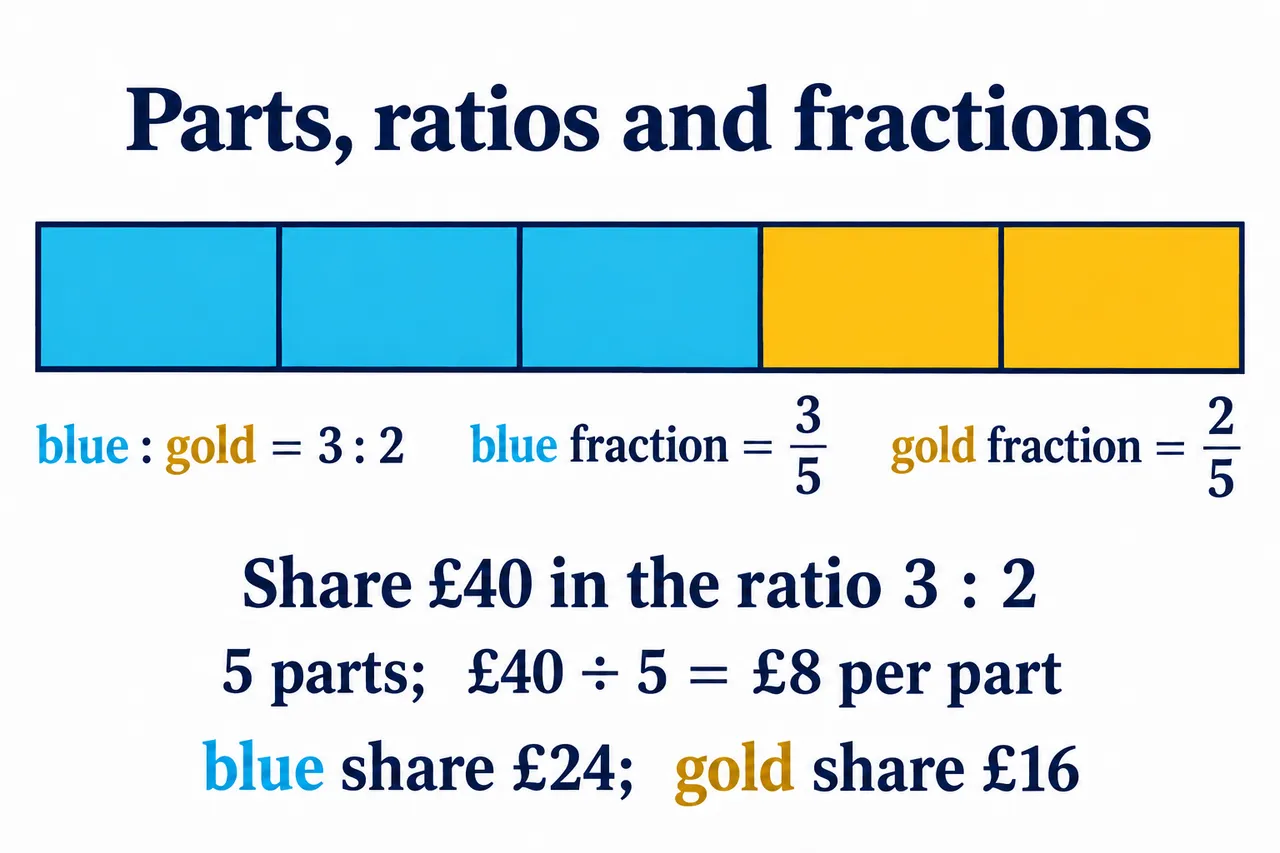
Original myAudience mathematics teaching illustration; labels, relationships and lesson calculations independently checked. · Original project artwork; no exam-board figures or textbook illustrations reused.
Reduce a ratio while preserving the comparison
A ratio compares corresponding quantities by their multiplicative relationship. Dividing every entry by the same nonzero factor preserves that relationship. The ratio 12: 8 becomes 3: 2 after dividing both entries by 4.
Ratios can begin with decimals or fractions. Multiply all entries by a common factor to obtain convenient whole numbers, then simplify. A common factor must act on every entry; changing just one changes the comparison.
When entries describe the same type of quantity, convert units before simplifying. For 1.5 m: 50 cm, write 150 cm: 50 cm, giving 3: 1. State the order of the quantities so a reversed ratio is not mistaken for the same relationship.
Worked example: Simplify 0.6: 0.4.
Multiply both entries by 10 to get 6: 4.
Divide both by 2.
Answer: 3: 2.
Check your understanding: Simplify 2 hours: 30 minutes.
Answer: 4: 1.
Why: Use 120 minutes: 30 minutes before dividing.