Divide a total into part-to-part shares
By UK GCSE Mathematics · independent study · myAudience
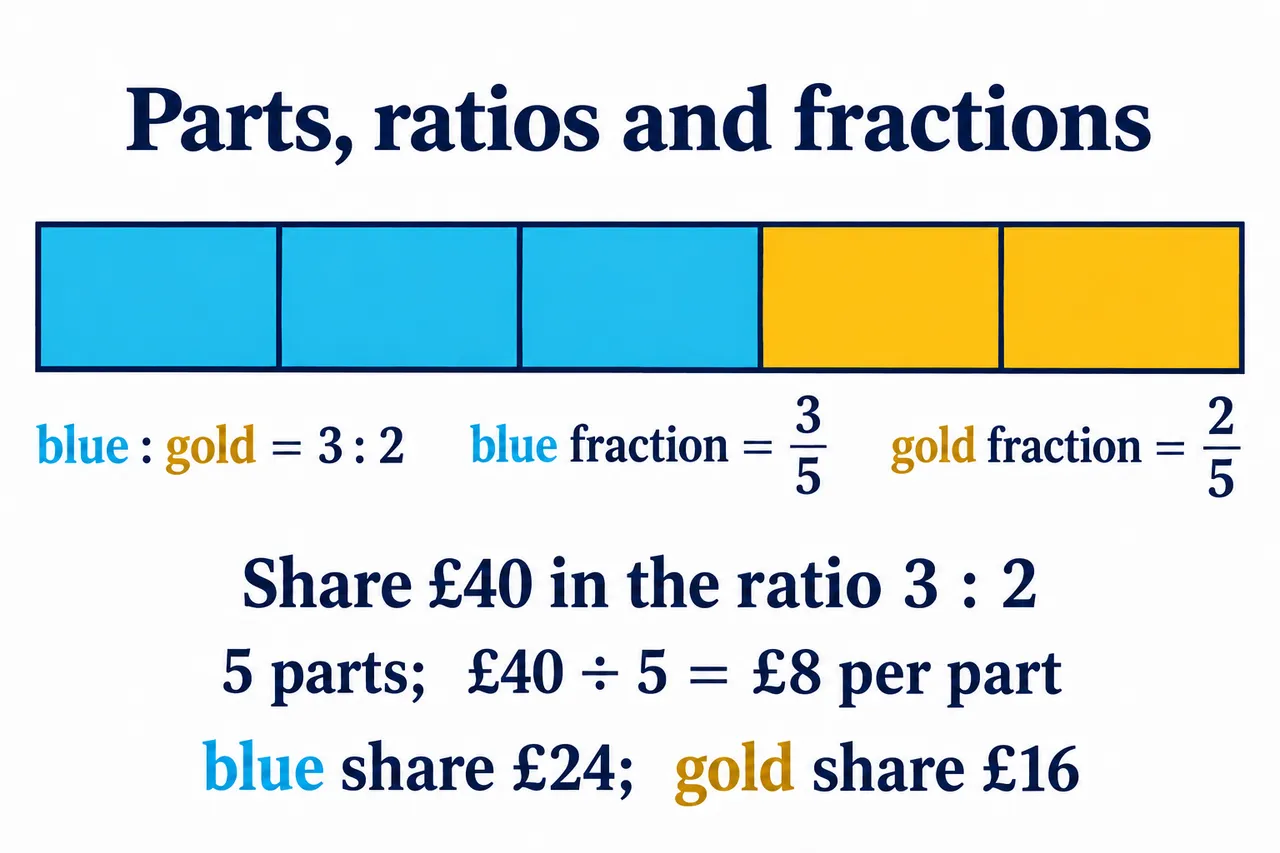
Original myAudience mathematics teaching illustration; labels, relationships and lesson calculations independently checked. · Original project artwork; no exam-board figures or textbook illustrations reused.
Divide a total into part-to-part shares
The entries of a part-to-part ratio count equal shares. For 3: 2 there are five shares in total. Divide the available quantity by five, then multiply one share by each ratio entry.
The two results must add to the original total and preserve the ratio. These independent checks catch using the difference of the entries instead of their sum. A larger ratio entry gets a larger share when the total and entries are positive.
The method applies to money, lengths and mixtures, provided the total has the meaning assumed. A mixture example is a numerical model, not an instruction to combine real chemicals; practical safety and physical effects need separate information.
Worked example: Share £40 in the ratio 3: 2.
There are 3 + 2 = 5 equal parts.
One part is £40/5 = £8.
Multiply by 3 and 2.
Answer: £24 and £16.
Check your understanding: What total checks the answer?
Answer: £24 + £16 = £40.
Why: A valid division conserves the supplied total.