Distinguish a part-to-whole ratio from a part-to-part ratio
By UK GCSE Mathematics · independent study · myAudience
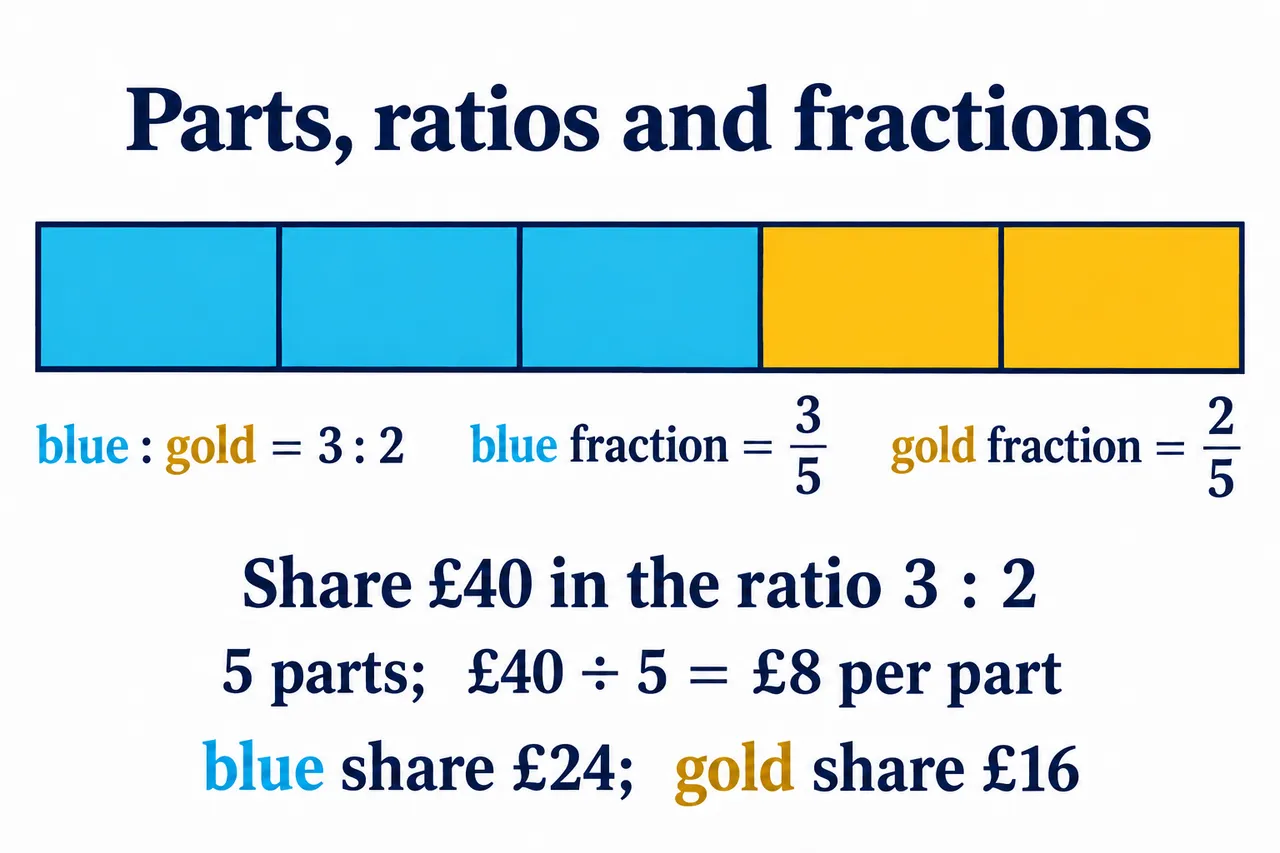
Original myAudience mathematics teaching illustration; labels, relationships and lesson calculations independently checked. · Original project artwork; no exam-board figures or textbook illustrations reused.
Distinguish a part-to-whole ratio from a part-to-part ratio
If blue: whole = 3: 5, the unlisted gold part represents the remaining two shares. This is equivalent to blue: gold = 3: 2. Adding 3 and 5 would incorrectly count the blue part twice.
A given amount for one part can determine the total. If the three blue shares equal 24, one share is 8 and the five-share whole is 40. State whether each ratio entry is a part or the whole before calculating.
Concentration and composition descriptions often use this distinction. A stated part-to-whole fraction gives the amount relative to the total; it is not automatically the same as a ratio between two ingredients.
Worked example: Blue: whole is 3: 5 and blue equals 24 units. Find the whole.
Divide 24 by 3 to find one share.
Multiply that share by 5.
Answer: 40 units.
Check your understanding: What is blue: gold here?
Answer: 3: 2.
Why: Gold is the whole minus the blue share.