Explain how many times one quantity is another
By UK GCSE Mathematics · independent study · myAudience
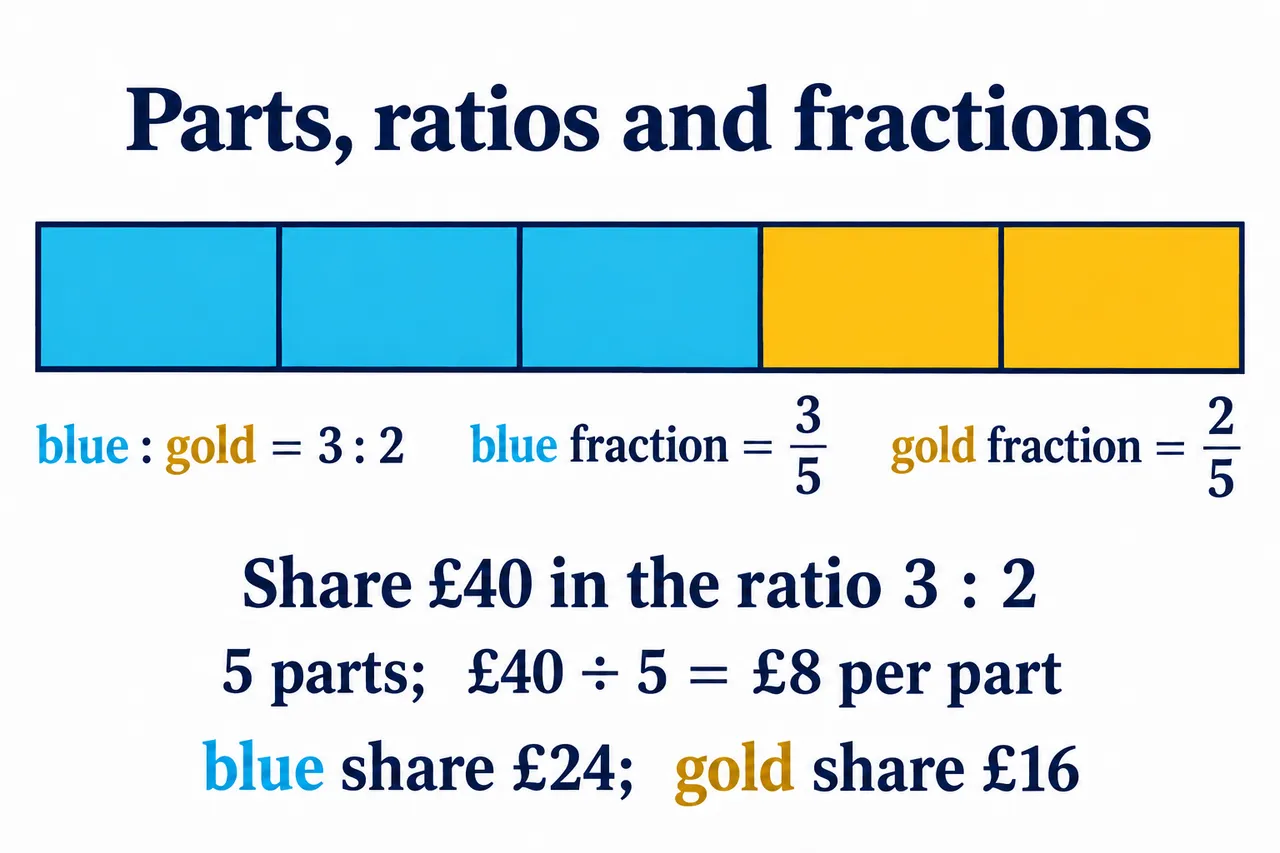
Original myAudience mathematics teaching illustration; labels, relationships and lesson calculations independently checked. · Original project artwork; no exam-board figures or textbook illustrations reused.
Explain how many times one quantity is another
If A: B = 3: 2, then A = (3/2)B and B = (2/3)A. The multiplier depends on which direction the comparison is made. A verbal description such as “A is one and a half times B” expresses the first relationship.
A difference describes an additive relationship, while a ratio describes a multiplicative one. For positive quantities with ratio 3: 2, the difference changes as the overall scale changes even though the ratio remains fixed.
Use the multiplier to move from a known value to its corresponding value. Check by forming the ratio again. Avoid translating “three times as much” into “three more”, which changes the model.
Worked example: A: B = 3: 2 and B = 10. Find A.
A is 3/2 times B.
Calculate (3/2) × 10.
Answer: 15.
Check your understanding: If both quantities double, does their ratio change?
Answer: No.
Why: The common multiplier cancels from the comparison.