Recognise proportion as equality of ratios
By UK GCSE Mathematics · independent study · myAudience
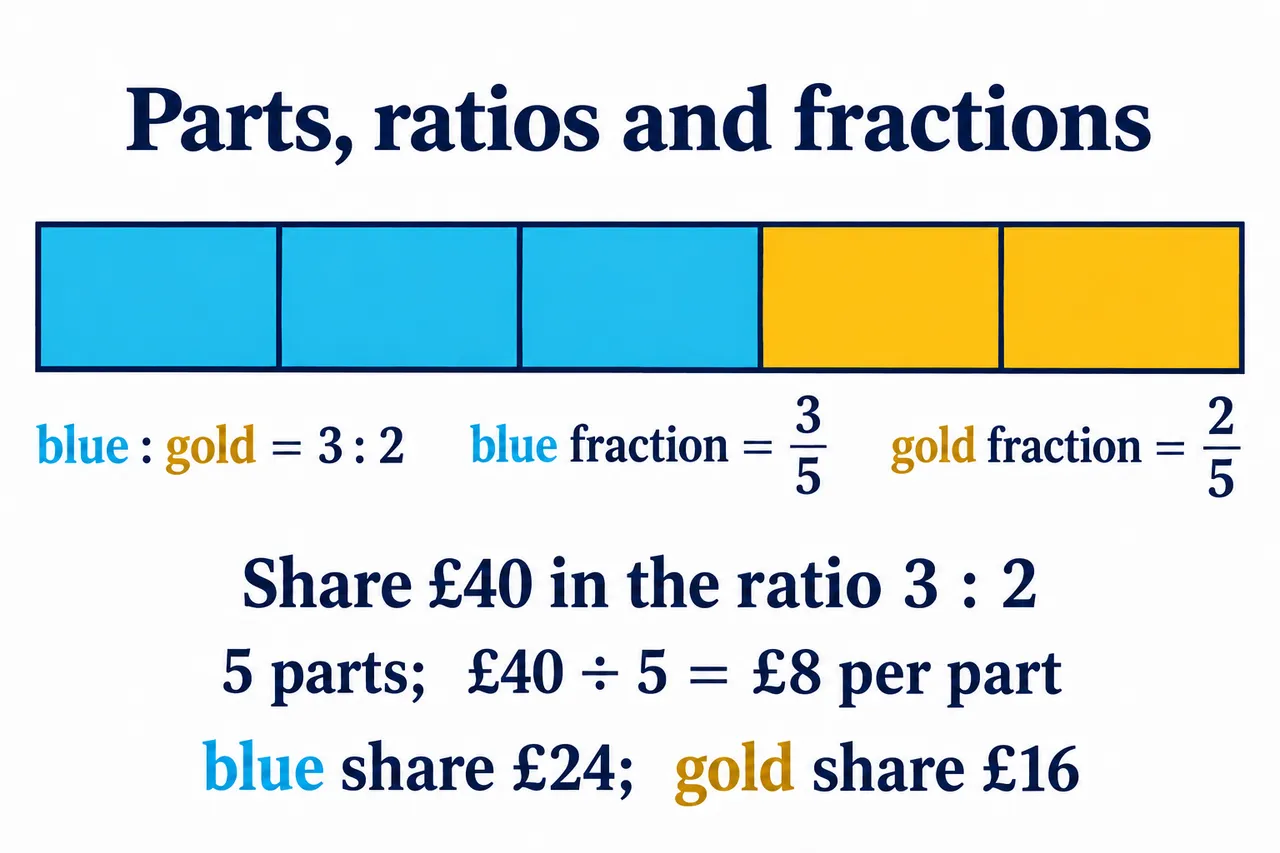
Original myAudience mathematics teaching illustration; labels, relationships and lesson calculations independently checked. · Original project artwork; no exam-board figures or textbook illustrations reused.
Recognise proportion as equality of ratios
Two pairs are in the same proportion when their corresponding ratios are equal. The pairs (3, 2) and (15, 10) have the same ratio because both entries in the second pair are five times their counterparts.
An equation of fractions can express that equality. For a/ b = c/ d with nonzero denominators, multiplying both sides by bd gives ad = bc. This cross-product test is a consequence of equality, not a separate permission to mix units or reverse one ratio.
The unitary method first finds a value for one unit, then scales to the required amount. It is especially useful where a fixed per-unit rate is justified. A fixed charge or changing rate breaks a simple proportional model.
Worked example: Three notebooks cost £6 at a fixed unit price. What do five cost?
One notebook costs £6/3 = £2.
Multiply the unit price by 5.
Answer: £10.
Check your understanding: Are 3: 2 and 9: 8 equal ratios?
Answer: No.
Why: Cross-products 3 × 8 and 2 × 9 are 24 and 18.