Connect a ratio, a fraction and a linear rule
By UK GCSE Mathematics · independent study · myAudience
Original myAudience mathematics teaching illustration; labels, relationships and lesson calculations independently checked. · Original project artwork; no exam-board figures or textbook illustrations reused.
Connect a ratio, a fraction and a linear rule
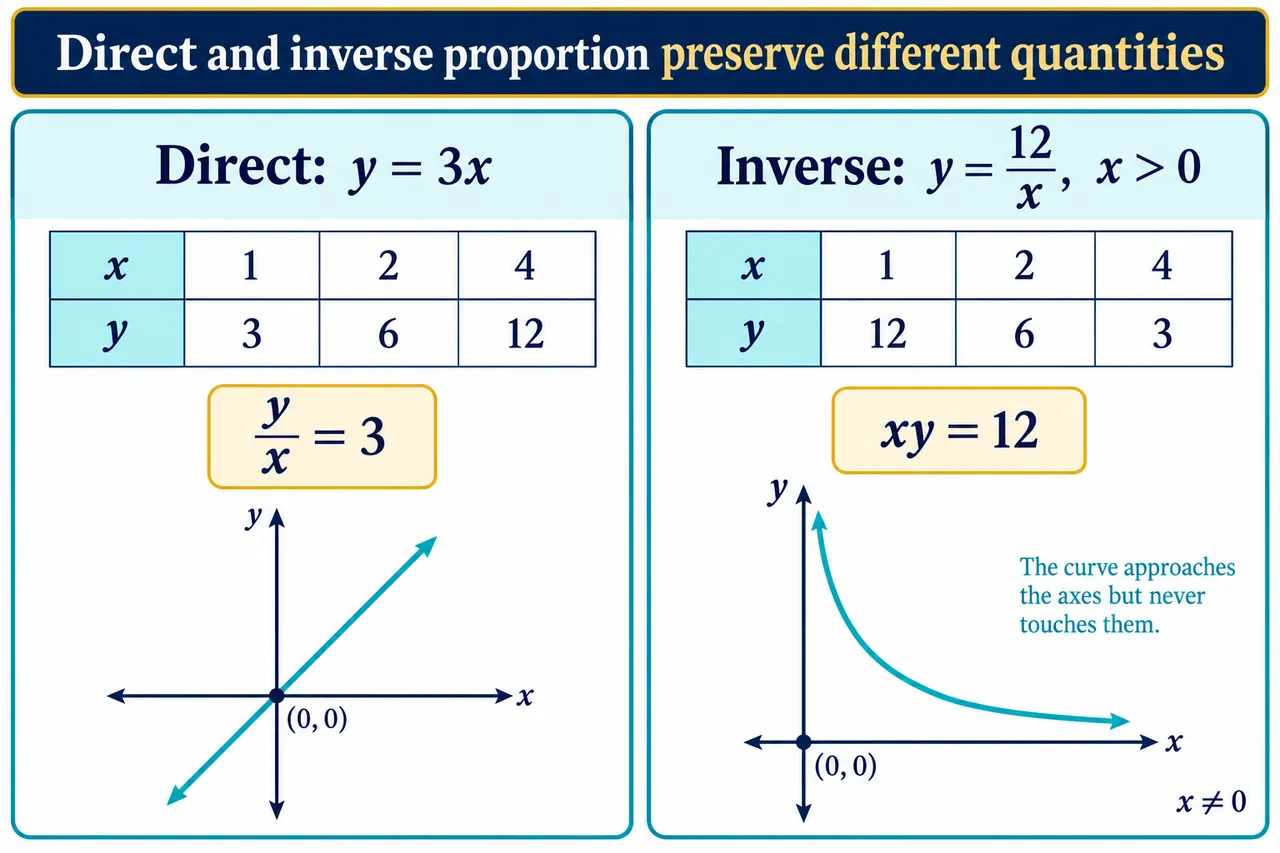
A fixed ratio y: x = 3: 1 gives y/x = 3 for nonzero x, or y = 3x. This is a direct-proportion rule whose graph passes through the origin. The value of y triples the value of x.
A part-to-whole fraction also creates a linear relationship. If blue is 3/5 of a varying total T, then B = (3/5)T. The coefficient belongs to the comparison with the total, not to the 3: 2 comparison between blue and gold.
Not every straight line represents a fixed ratio. The rule y = 3x + 2 has the same gradient as y = 3x but a nonzero intercept. Its ratio y/x varies with x, so the fixed-ratio interpretation fails.
Worked example: Blue is 3/5 of a total of 50. Find B.
Use B = (3/5)T.
Substitute T = 50.
Answer: 30.
Check your understanding: Does y = 3x + 2 describe y directly proportional to x?
Answer: No.
Why: The additional constant prevents a constant y/x ratio.