Choose the reference amount for a percentage
By UK GCSE Mathematics · independent study · myAudience
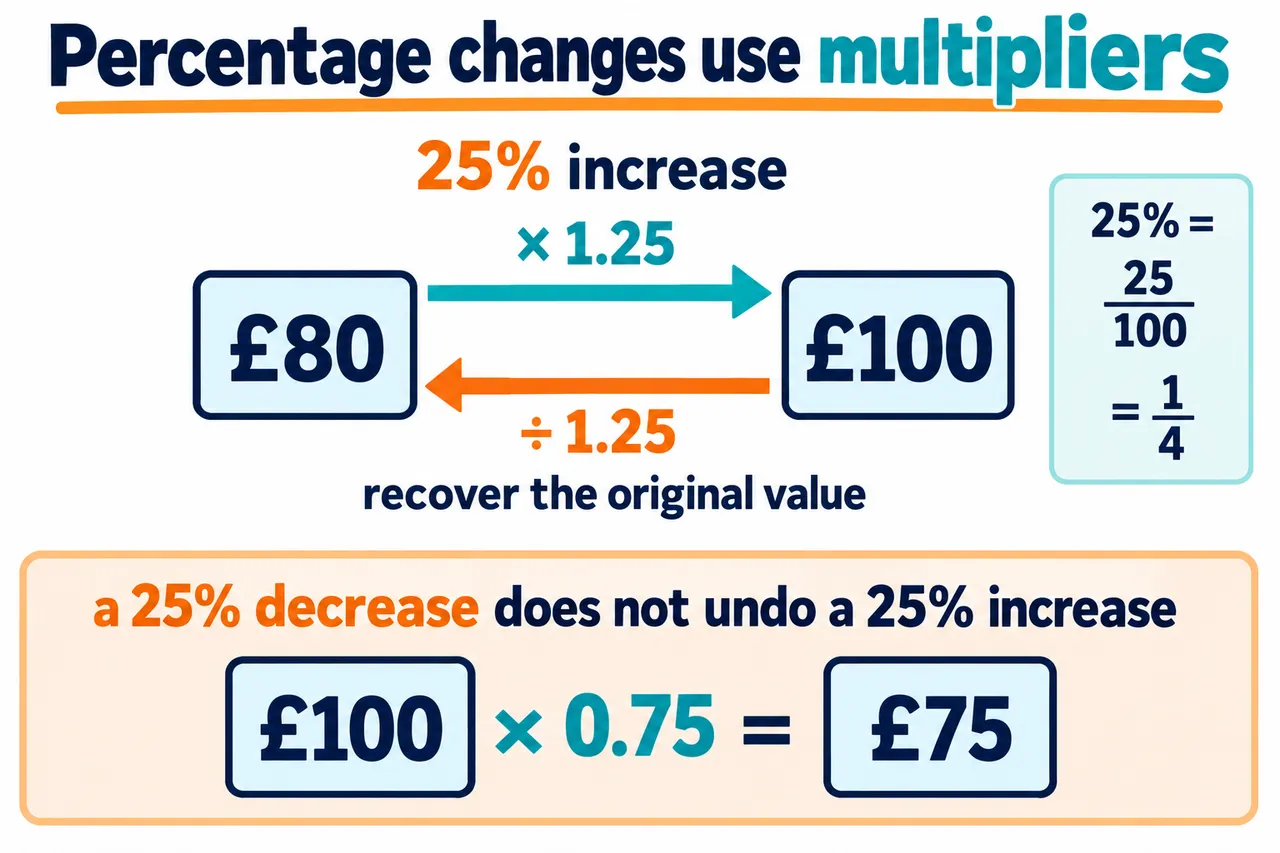
Original myAudience mathematics teaching illustration; labels, relationships and lesson calculations independently checked. · Original project artwork; no exam-board figures or textbook illustrations reused.
Choose the reference amount for a percentage
A percentage means a fraction out of one hundred. To express A as a percentage of B, calculate 100A/B with nonzero B as the stated reference. Swapping the reference changes the question and usually changes the answer.
A percentage can exceed 100 when the compared quantity is greater than the reference. If 150 is compared with 100, it is 150% of the reference, but the increase is 50%. The final proportion and the change proportion are distinct.
For the conventional percentage change from a positive original amount, divide the signed change by the original amount. A decrease can be described by a negative signed change or a positive decrease percentage, provided the wording is clear.
Worked example: A value increases from 80 to 100. Find the percentage increase.
The increase is 20.
Use the original 80 as reference.
Calculate (20/80) × 100.
Answer: 25%.
Check your understanding: What percentage of 80 is 100?
Answer: 125%.
Why: This compares the final value itself with the original.