Apply a percentage change to the current amount
By UK GCSE Mathematics · independent study · myAudience
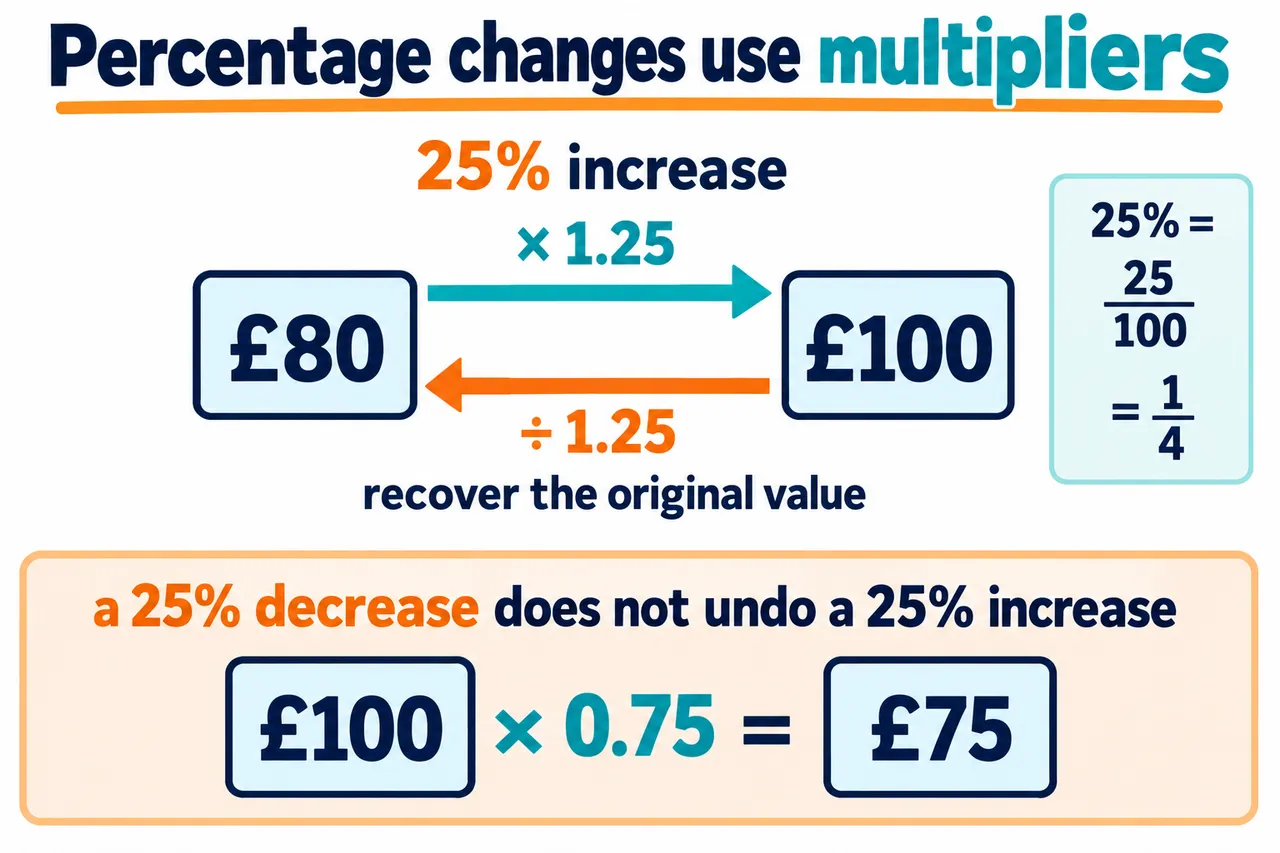
Original myAudience mathematics teaching illustration; labels, relationships and lesson calculations independently checked. · Original project artwork; no exam-board figures or textbook illustrations reused.
Apply a percentage change to the current amount
A percentage increase keeps the original whole and adds a fraction of it. A 25% increase therefore uses multiplier 1.25. A 25% decrease keeps 75% and uses 0.75.
Successive changes act on successive amounts. Increasing 80 by 25% gives 100; decreasing that new amount by 25% gives 75. The same percentage in opposite directions does not cancel because the reference amounts differ.
Multipliers can combine by multiplication. State the order and meaning of each change, and postpone rounding until the required final result where the model permits. In a real payment process, an explicit per-step rounding rule can change the numerical total.
Worked example: Increase £80 by 25%, then decrease the new amount by 25%.
Calculate £80 × 1.25 = £100.
Calculate £100 × 0.75.
Answer: £75.
Check your understanding: What multiplier represents a 12% decrease?
Answer: 0.88.
Why: 100% − 12% leaves 88% of the current value.