Recover an original value by undoing its multiplier
By UK GCSE Mathematics · independent study · myAudience
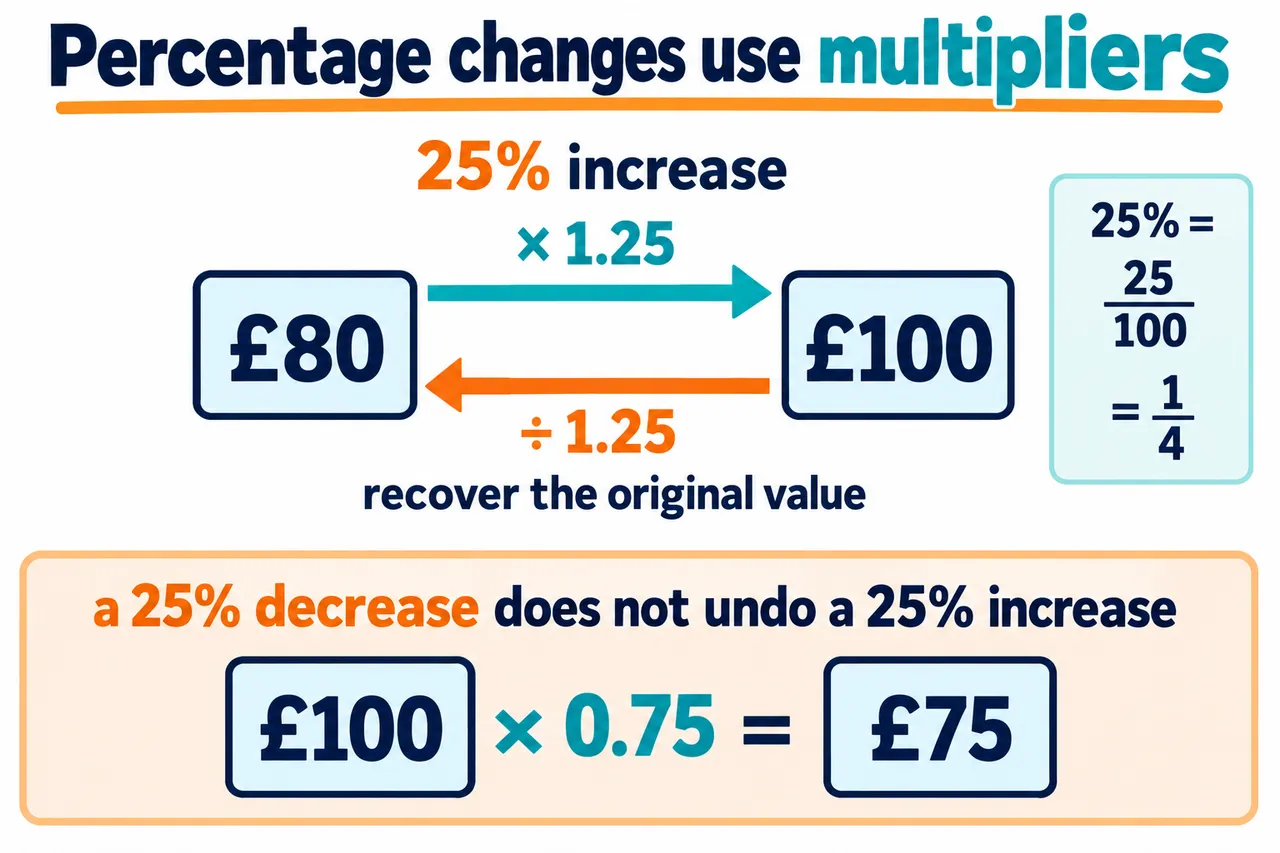
Original myAudience mathematics teaching illustration; labels, relationships and lesson calculations independently checked. · Original project artwork; no exam-board figures or textbook illustrations reused.
Recover an original value by undoing its multiplier
If a changed value equals the original multiplied by m, the original equals the changed value divided by m, provided m is nonzero. Recovering a price after a 25% increase requires division by 1.25, not a 25% decrease.
Identify which amount represents 100%. A final price after a 20% discount represents 80% of the original, so dividing it by 0.8 recovers the original. A percentage difference relative to a different reference cannot be substituted into the same formula.
Check the recovered amount by applying the original change again. This check also helps detect whether a question describes a markup, a discount or a percentage of a total.
Worked example: A price after a 25% increase is £100. Find the original.
The final amount is 1.25 times the original.
Divide £100 by 1.25.
Check £80 × 1.25.
Answer: £80.
Check your understanding: A discounted price is £72 after 10% off. What was the original?
Answer: £80.
Why: £72 is 90% of the original; 72/0.9 = 80.