Calculate interest from the original principal
By UK GCSE Mathematics · independent study · myAudience
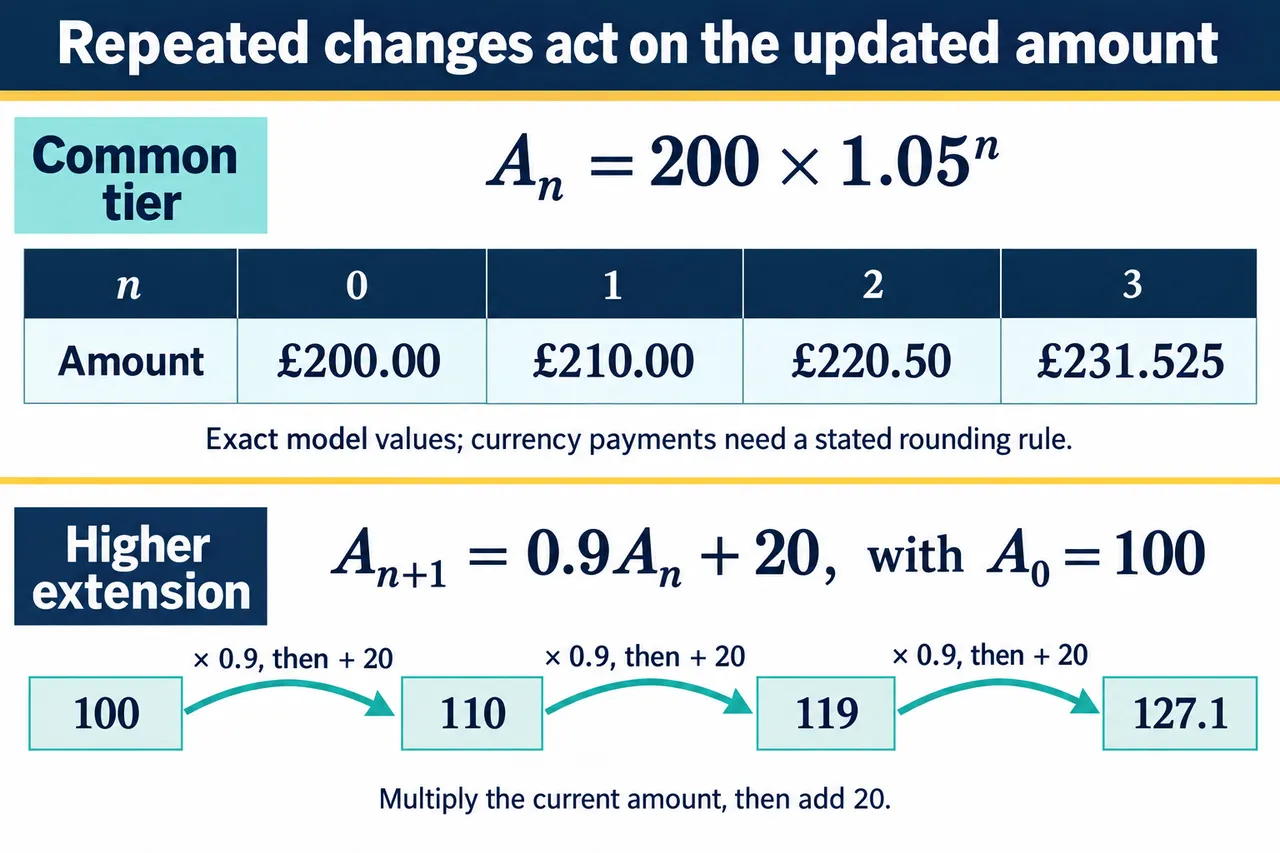
Original myAudience mathematics teaching illustration; labels, relationships and lesson calculations independently checked. · Original project artwork; no exam-board figures or textbook illustrations reused.
Calculate interest from the original principal
Simple interest calculates each period’s interest from the original principal. With principal P, rate r as a decimal and n matching periods, the model gives interest Prn and total P(1 + rn).
The rate period must match the duration. A yearly rate used for a fraction of a year assumes the stated simple-interest model applies proportionally over that time. Fees, tax and real account terms are not included unless supplied.
Compound interest instead updates the base amount each period. Comparing the two models requires the same principal, rate and duration. A calculation is a mathematical illustration, not a forecast or recommendation for a financial product.
Worked example: Find simple interest on £200 at 5% per year for three years.
One year’s interest is £200 × 0.05 = £10.
Multiply by three.
Add the interest to the principal.
Answer: £30 interest; total £230.
Check your understanding: Is the interest in year three based on £220 in this model?
Answer: No.
Why: Simple interest continues to use the original £200.