Identify a constant ratio and its proportionality coefficient
By UK GCSE Mathematics · independent study · myAudience
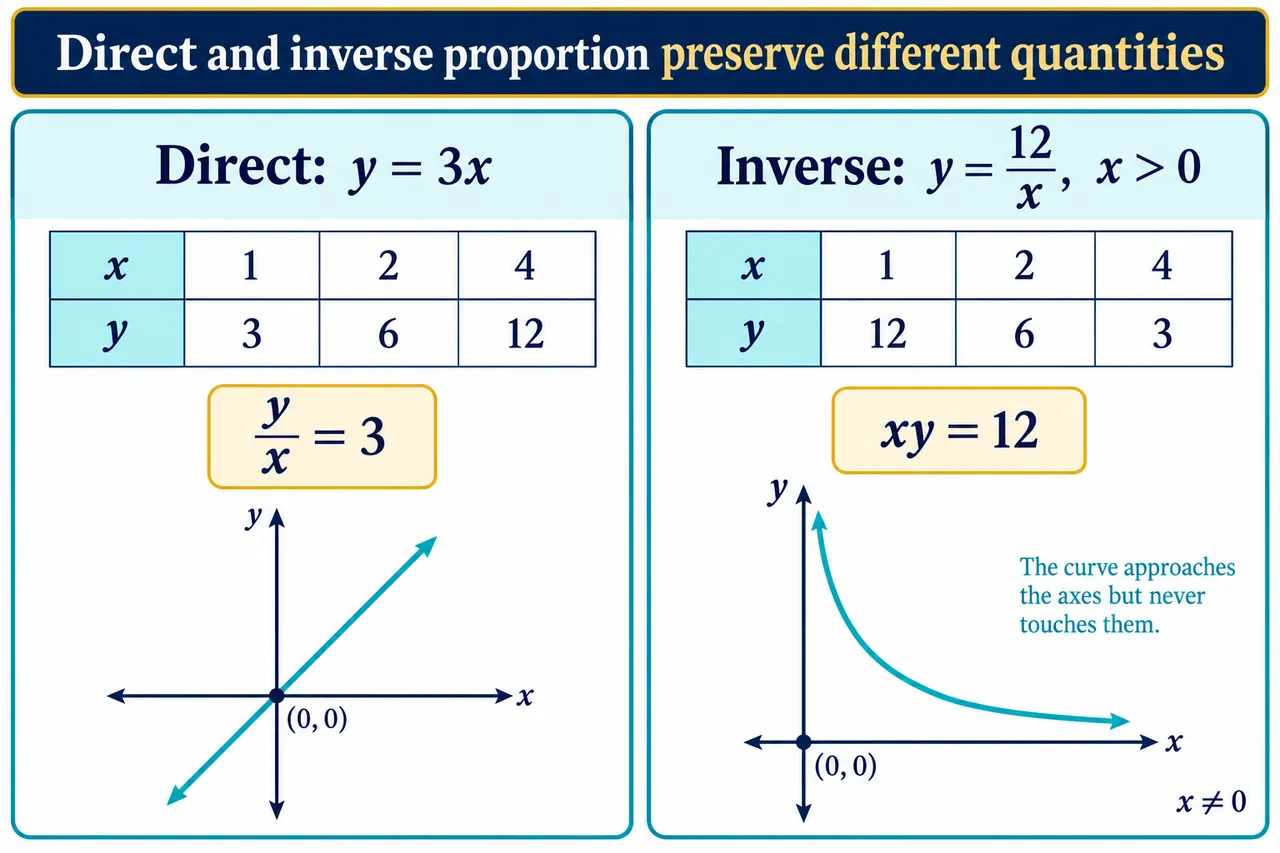
Original myAudience mathematics teaching illustration; labels, relationships and lesson calculations independently checked. · Original project artwork; no exam-board figures or textbook illustrations reused.
Identify a constant ratio and its proportionality coefficient
If y is directly proportional to x, write y = kx. The constant k is found from a corresponding nonzero input by y/x. Doubling x doubles y; multiplying x by any permitted factor multiplies y by the same factor.
The graph is a straight line through the origin when the relevant domain includes zero. A model restricted to positive inputs can show only part of that line. The constant’s units depend on the two quantities being compared.
A straight line with a fixed initial charge is not direct proportion. Check the constant ratio rather than judging a relationship only by a straight appearance on a diagram.
Worked example: y is directly proportional to x; y = 12 when x = 4. Find y at x = 7.
Calculate k = 12/4 = 3.
Use y = 3x.
Substitute x = 7.
Answer: 21.
Check your understanding: Does doubling x always add 3 to y in this model?
Answer: No; it doubles y.
Why: Direct proportion preserves a ratio, not a fixed increment.