Identify a constant product in inverse proportion
By UK GCSE Mathematics · independent study · myAudience
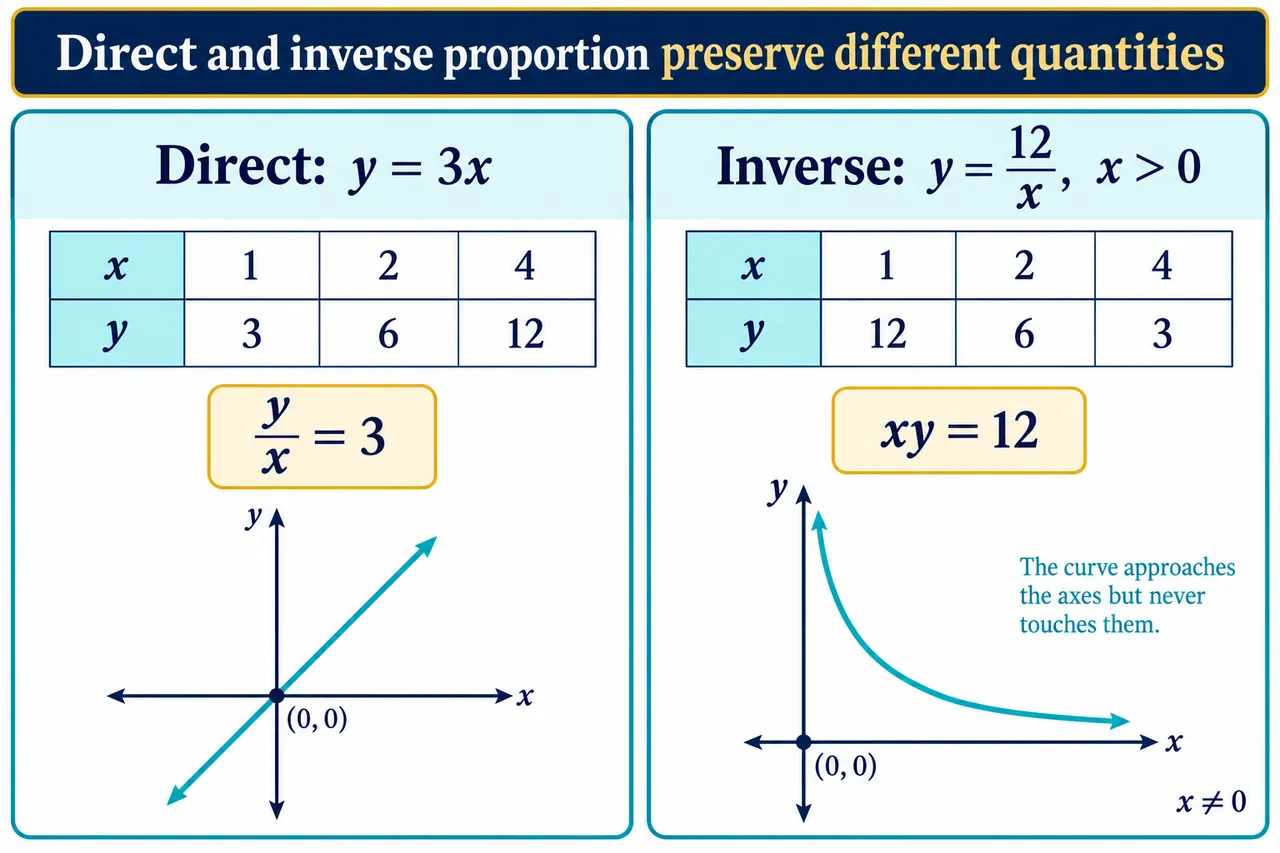
Original myAudience mathematics teaching illustration; labels, relationships and lesson calculations independently checked. · Original project artwork; no exam-board figures or textbook illustrations reused.
Identify a constant product in inverse proportion
If y is inversely proportional to x, write y = k/x with x nonzero. The product xy is constant. For positive quantities, doubling x halves y rather than subtracting a fixed amount.
The illustrated rule y = 12/x gives outputs 12, 6 and 3 for inputs 1, 2 and 4. Its curve is not a straight decreasing line. It approaches the axes without including the forbidden input zero.
A real inverse model needs justification. A fixed job divided among workers might follow this model only if equal work rates, independent contributions and no additional overhead are assumed. More workers alone does not establish an exact inverse law.
Worked example: y is inversely proportional to x and y = 6 when x = 2. Find y when x = 4.
Find the constant product k = 2 × 6 = 12.
Use y = 12/x.
Substitute x = 4.
Answer: 3.
Check your understanding: What happens to y if positive x triples?
Answer: It becomes one third as large.
Why: The product xy must remain fixed.