Use compound units to compare rates fairly
By UK GCSE Mathematics · independent study · myAudience
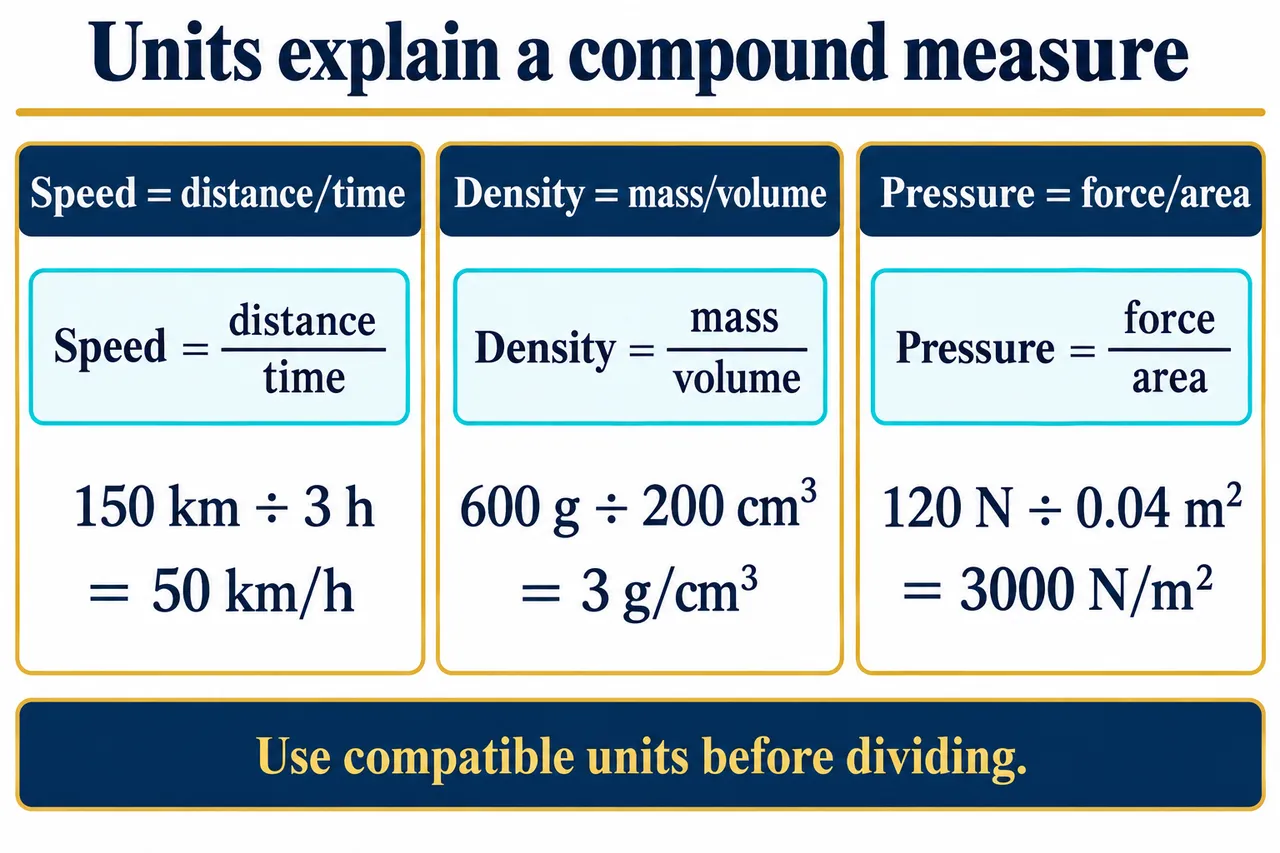
Original myAudience mathematics teaching illustration; labels, relationships and lesson calculations independently checked. · Original project artwork; no exam-board figures or textbook illustrations reused.
Use compound units to compare rates fairly
A rate divides one quantity by another: speed is distance per time, pay can be money per hour and a unit price can be money per kilogram. Match the units before comparing rates.
An average speed for a whole journey is total distance divided by total time. It is not generally the simple average of segment speeds, because the segments may have different durations. Stops belong in the total time if the question includes the full journey.
For a unit-price comparison, a lower price per kilogram can represent better quantity value, but pack size and suitability remain contextual considerations. The mathematics compares the supplied amounts, not overall product quality.
Worked example: A journey covers 150 km in 3 h. Find average speed.
Use distance/time.
Divide 150 by 3 and retain the units.
Answer: 50 km/h.
Check your understanding: Which has lower unit price: £3 for 500 g or £5 for 1 kg?
Answer: The 1 kg pack.
Why: The first costs £6/kg; the second costs £5/kg.