Connect mass, volume and density
By UK GCSE Mathematics · independent study · myAudience
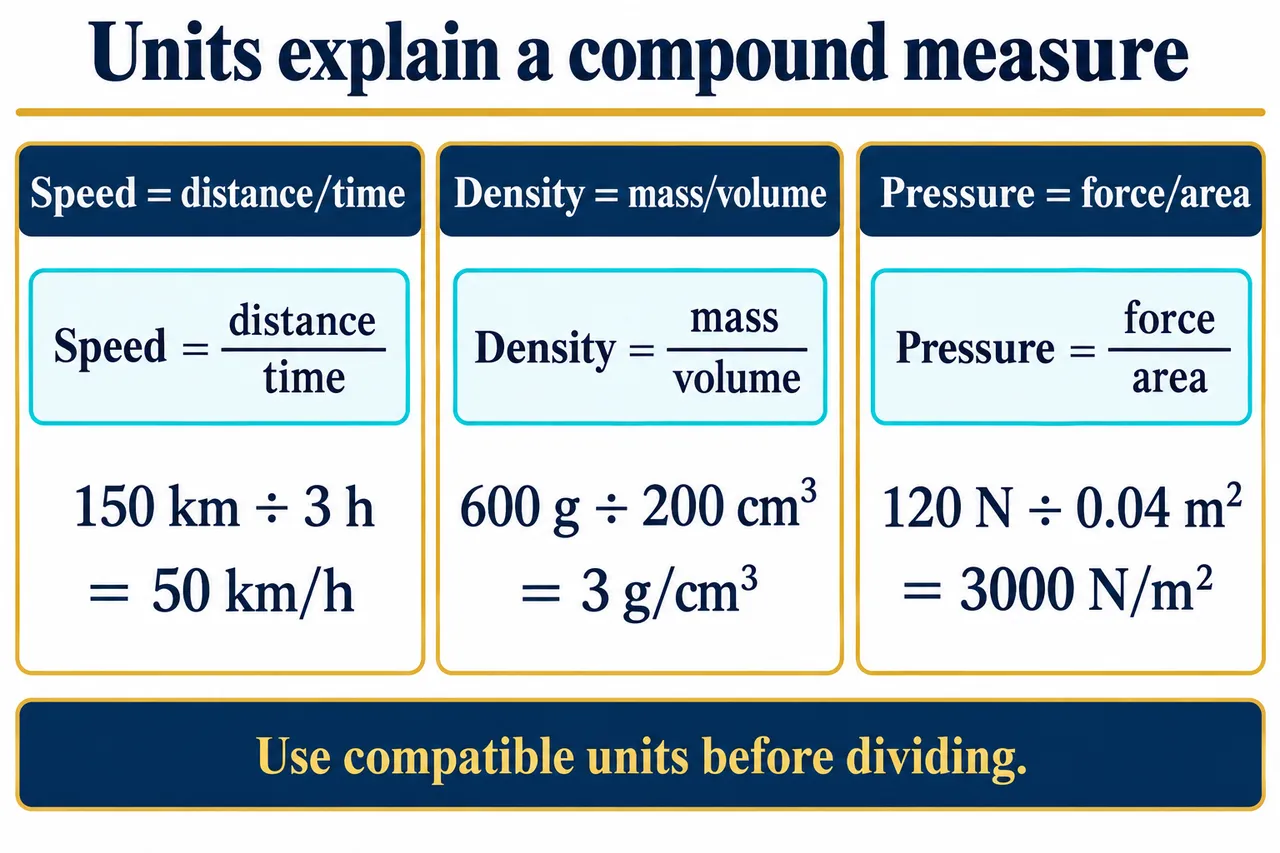
Original myAudience mathematics teaching illustration; labels, relationships and lesson calculations independently checked. · Original project artwork; no exam-board figures or textbook illustrations reused.
Connect mass, volume and density
Density is mass divided by volume. In a consistent model, mass = density × volume. A density of 3 g/cm³ means each cubic centimetre has mass 3 g when the material is treated as uniform.
Keep units compatible. Grams per cubic centimetre and kilograms per cubic metre use different numerical values for the same density. Since 1 g = 0.001 kg and 1 cm³ = 0.000001 m³, 1 g/cm³ equals 1000 kg/m³.
The formula does not by itself establish that density remains constant under changing temperature or composition. A GCSE numerical problem may supply a uniform-density assumption; explain and use that assumption rather than inventing missing physical information.
Worked example: A uniform sample has mass 600 g and volume 200 cm³. Find density.
Divide mass by volume.
Retain grams per cubic centimetre.
Answer: 3 g/cm³.
Check your understanding: At this density, what mass has volume 50 cm³?
Answer: 150 g.
Why: Use mass = 3 × 50.