Interpret force per unit area
By UK GCSE Mathematics · independent study · myAudience
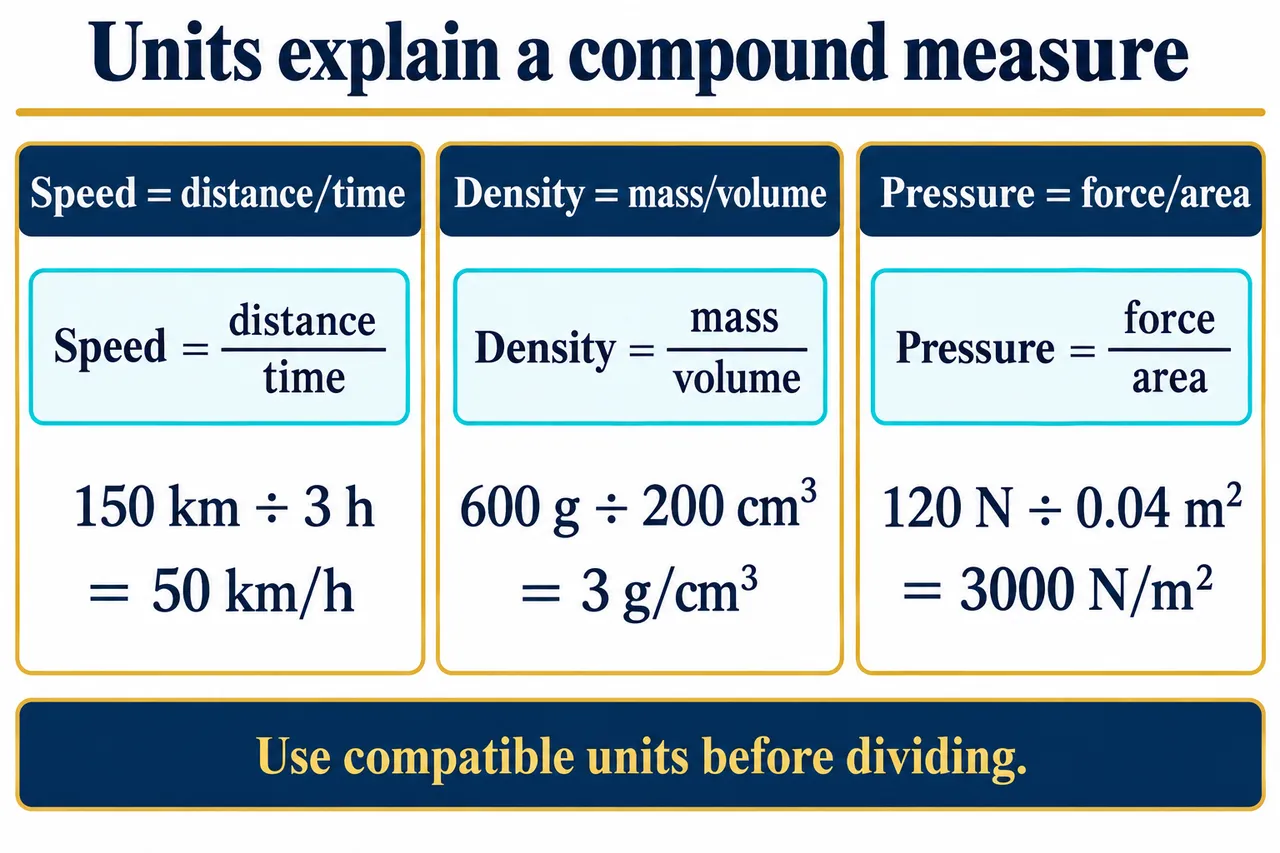
Original myAudience mathematics teaching illustration; labels, relationships and lesson calculations independently checked. · Original project artwork; no exam-board figures or textbook illustrations reused.
Interpret force per unit area
Pressure in the supplied numerical model is force divided by area. With force in newtons and area in square metres, the unit is N/m², also called the pascal. The area conversion is squared, so centimetres and square centimetres cannot be converted with the same factor.
For a fixed force, spreading it over a larger area reduces pressure. For a fixed area, increasing force increases pressure. These statements connect one formula with inverse and direct proportional relationships.
Use the relevant contact area and force specified by the model. This mathematics does not claim that pressure is uniform in every real contact situation; a uniform average pressure may be an approximation.
Worked example: A force of 120 N acts over 0.04 m². Find average pressure.
Use force/area.
Calculate 120/0.04.
Answer: 3000 N/m², or 3000 Pa.
Check your understanding: What happens if the area doubles while force stays fixed?
Answer: Pressure halves.
Why: The denominator doubles.