Apply the correct scale factor to length, area and volume
By UK GCSE Mathematics · independent study · myAudience
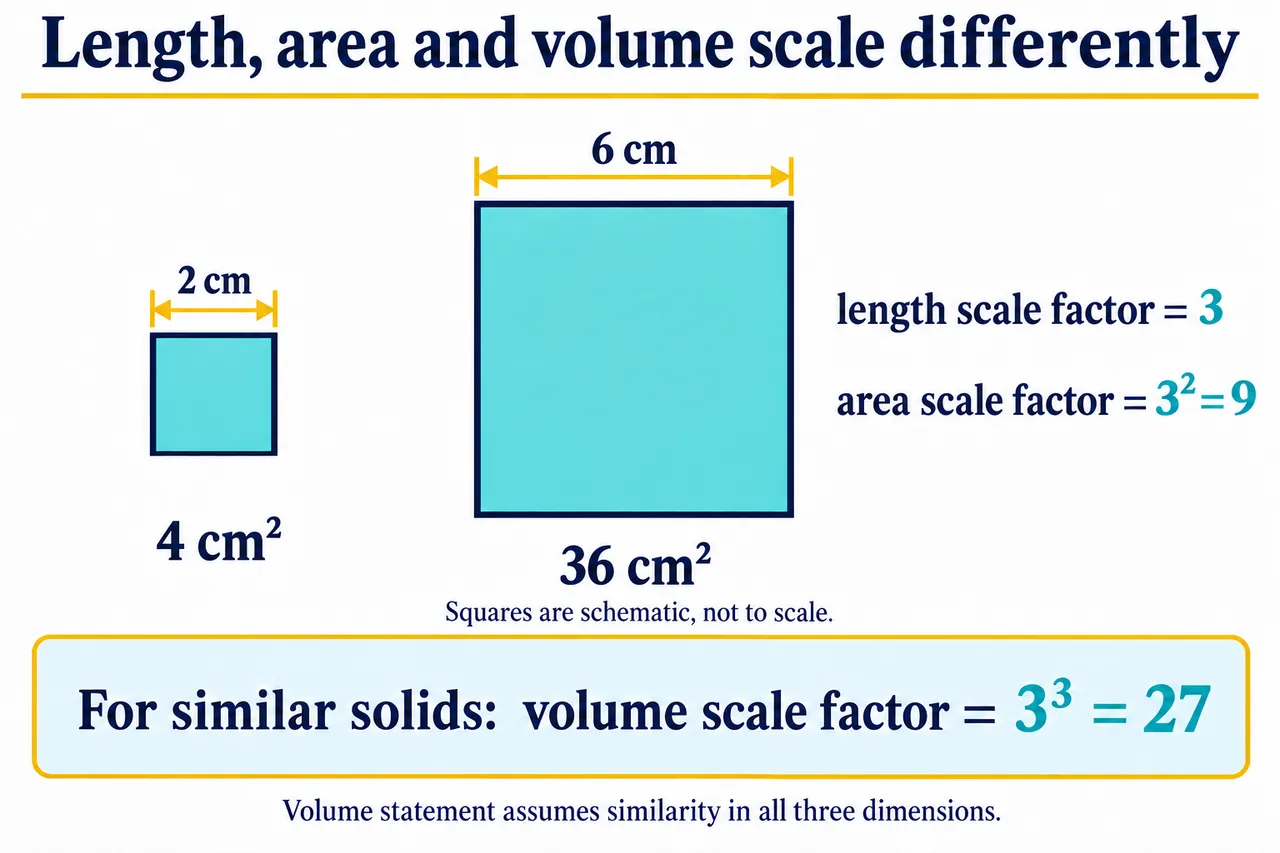
Original myAudience mathematics teaching illustration; labels, relationships and lesson calculations independently checked. · Original project artwork; no exam-board figures or textbook illustrations reused.
Apply the correct scale factor to length, area and volume
Similar figures have the same shape, with corresponding lengths multiplied by one scale factor k. Areas scale by k² because two dimensions change; volumes of similar solids scale by k³ because three dimensions change.
In the illustration, square sides change from 2 cm to 6 cm, giving k = 3. Their areas change from 4 cm² to 36 cm², a factor of 9. A corresponding similar solid would have volume factor 27, not 3 or 9.
Same-angle right triangles illustrate why trigonometric side ratios are constant: corresponding sides scale together, so their quotient is unchanged. Identifying corresponding sides matters; similarity does not mean that any two lengths within different figures have the same ratio.
Worked example: Similar solids have length ratio 2: 3. Find their volume ratio.
Cube each length-ratio entry.
Use corresponding volumes.
Answer: 8: 27.
Check your understanding: If the area factor is 16, what is the positive length factor?
Answer: 4.
Why: Take the square root, not the cube root.