Interpret equations involving a reciprocal
By UK GCSE Mathematics · independent study · myAudience
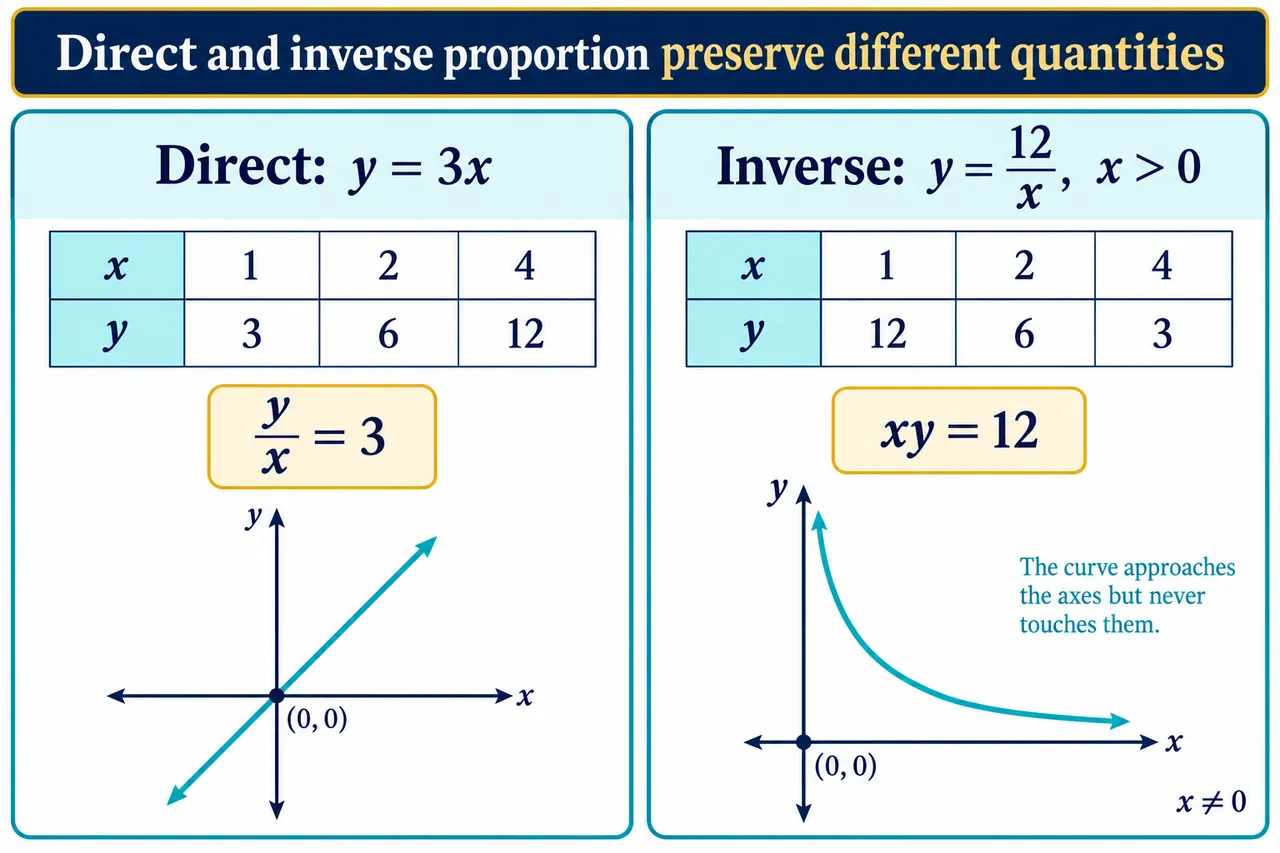
Original myAudience mathematics teaching illustration; labels, relationships and lesson calculations independently checked. · Original project artwork; no exam-board figures or textbook illustrations reused.
Interpret equations involving a reciprocal
The statement X is inversely proportional to Y means X = k/Y, or X is directly proportional to 1/Y. The same relationship can be written XY = k, with the relevant nonzero-domain restriction retained.
To interpret a supplied equation, identify what stays constant and how one quantity responds to a change in the other. For X = 12/Y, doubling a positive Y halves X. The rule describes one fixed product, not any arbitrary downward trend.
Units and domain belong to the model. If X and Y are measured quantities, k has the units of their product. A division-based formula must not be evaluated at a zero denominator.
Worked example: Interpret X = 12/Y when Y changes from 2 to 4.
At Y = 2, X = 6.
At Y = 4, X = 3.
Compare the products XY.
Answer: X halves; the product remains 12.
Check your understanding: Is X = 12 − Y an inverse-proportion rule?
Answer: No.
Why: Its product XY is not constant.