Build a model for repeated percentage changes
By UK GCSE Mathematics · independent study · myAudience
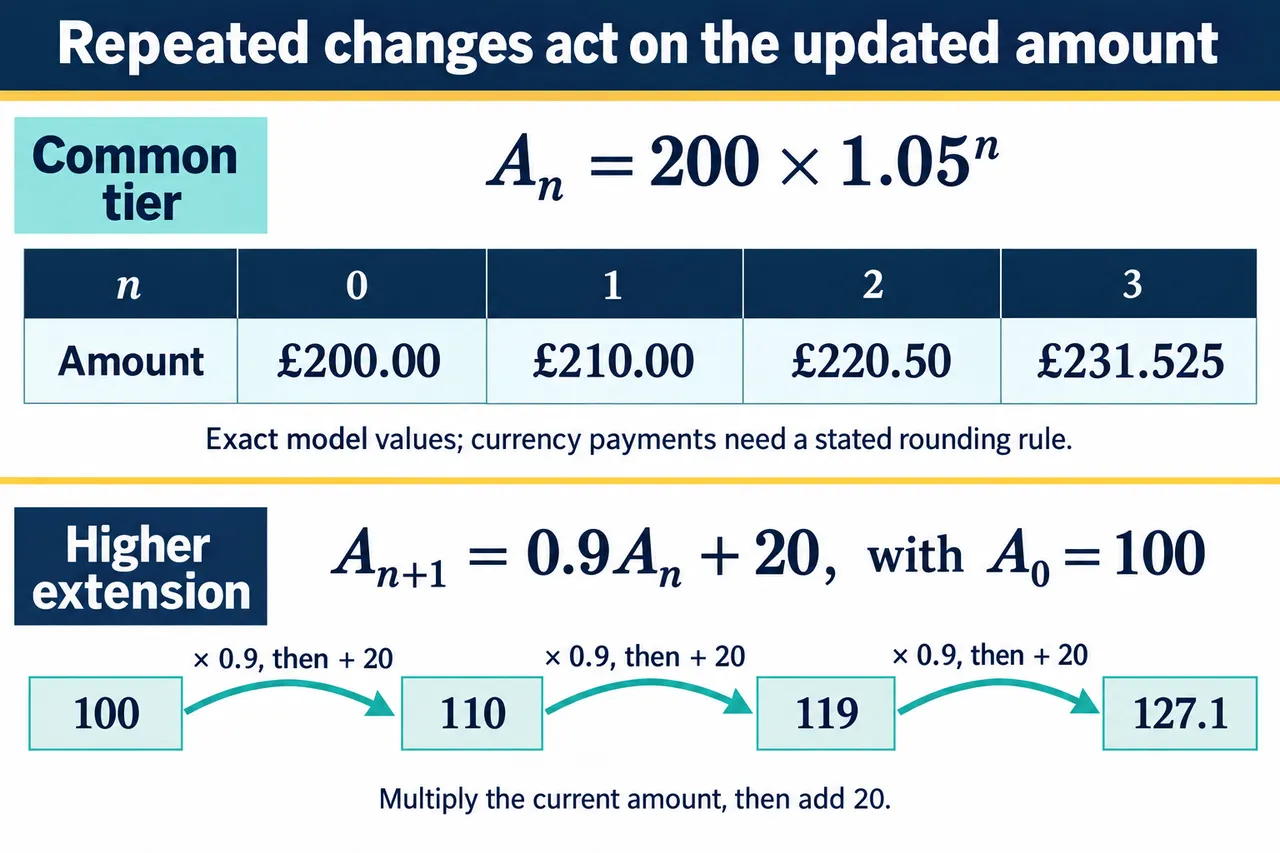
Original myAudience mathematics teaching illustration; labels, relationships and lesson calculations independently checked. · Original project artwork; no exam-board figures or textbook illustrations reused.
Build a model for repeated percentage changes
With a fixed per-period percentage change, each new amount is a multiplier times the current amount. Starting from P with growth rate r as a decimal, the model after n periods is P(1 + r)ⁿ. For decay rate d, use P(1 − d)ⁿ.
At £200 with 5% growth per period, the exact model gives 200, 210, 220.5 and 231.525 through period three. The added amount grows because the percentage acts on an updated base. This differs from simple interest based on the original principal.
Match the rate period with n and state rounding assumptions. The exact value £231.525 is a model result, not a payable currency amount until a rounding rule is specified. Real financial charges, deductions and changing rates require additional supplied information.
Worked example: Model £200 growing by 5% for three periods.
Use multiplier 1.05.
Calculate 200 × 1.05³.
Round only if the question specifies a precision.
Answer: Exact model value 231.525; £231.53 if rounded to the nearest penny.
Check your understanding: What multiplier models a 7% loss per period?
Answer: 0.93.
Why: The remaining amount is 93% of the current amount.