Construct a direct or inverse proportional model
By UK GCSE Mathematics · independent study · myAudience
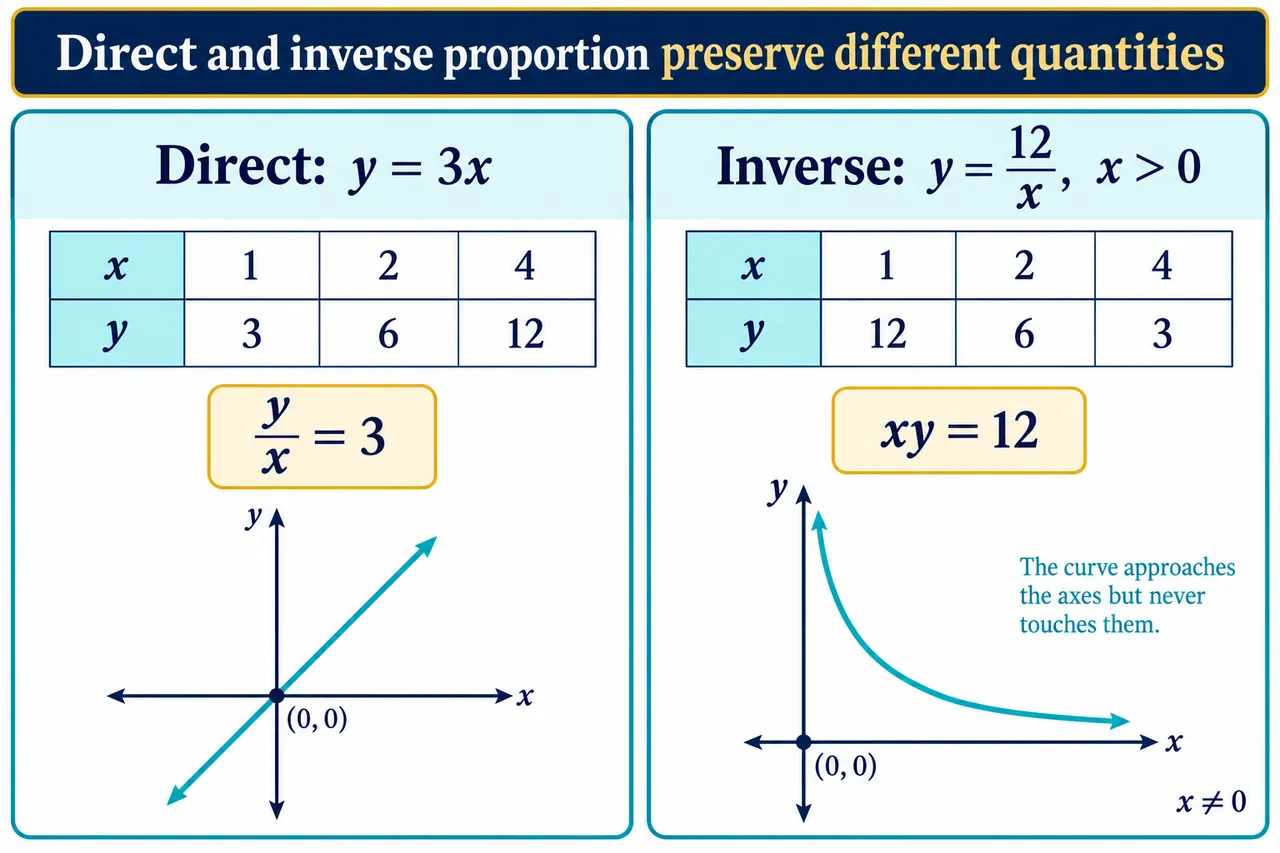
Original myAudience mathematics teaching illustration; labels, relationships and lesson calculations independently checked. · Original project artwork; no exam-board figures or textbook illustrations reused.
Construct a direct or inverse proportional model
To construct an equation, first choose the relationship justified by the statement. Direct proportion to a quantity gives a constant times that quantity. Inverse proportion gives a constant divided by it; the constant is fitted from a supplied matching pair.
If y is directly proportional to x², write y = kx² and find k using y/x². If y is inversely proportional to x², use y = k/x² and find k from yx². The phrase identifies the proportional quantity, not necessarily x itself.
After finding the constant, check the supplied data and state excluded inputs. Do not fit a model from one pair without an explicit proportionality assumption: many different rules can pass through that pair.
Worked example: y is directly proportional to x²; y = 18 when x = 3. Find y when x = 5.
Write y = kx².
Use 18 = 9k, so k = 2.
Substitute x = 5.
Answer: y = 2x²; required value 50.
Check your understanding: If y = 12/x², what happens when a positive x doubles?
Answer: y becomes one quarter as large.
Why: The squared denominator becomes four times as large.