Separate interval averages from a rate at one point
By UK GCSE Mathematics · independent study · myAudience
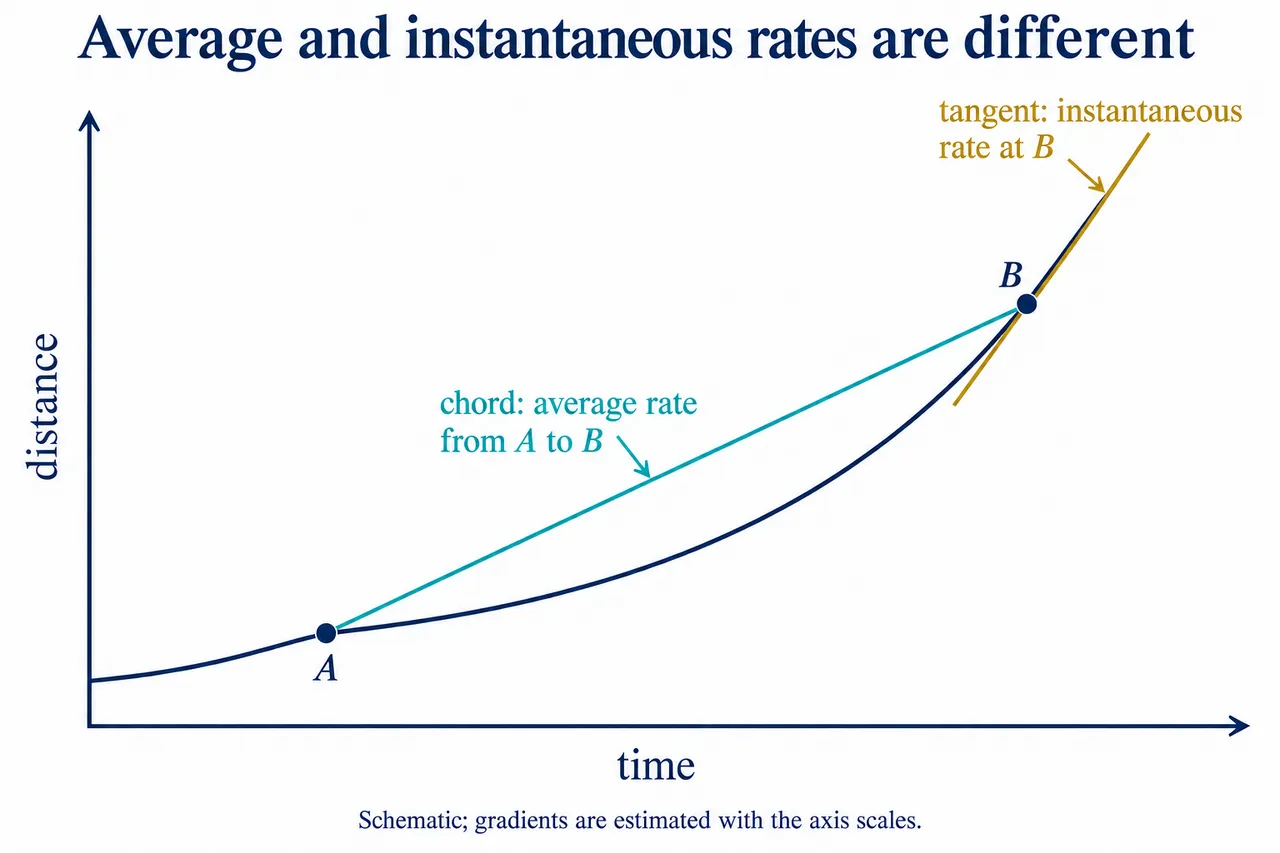
Original myAudience mathematics teaching illustration; labels, relationships and lesson calculations independently checked. · Original project artwork; no exam-board figures or textbook illustrations reused.
Separate interval averages from a rate at one point
A chord joins two points on a curve and gives the average rate over that interval: output change divided by input change. A tangent follows the curve locally at one point, so its gradient estimates an instantaneous rate.
Use points on the chord for its gradient and points on the drawn tangent for the tangent estimate. They need not be the same points. On a curved distance-time graph, the average speed over an interval need not equal the instantaneous speed at either end.
The estimate depends on axis units, scale and drawing precision. This GCSE graphical method does not require calculus. A time interval of zero cannot be used as the denominator of the ordinary average-rate calculation.
Worked example: Distance changes from 5 m at 2 s to 17 m at 6 s. Find the average rate.
Distance change is 12 m.
Time change is 4 s.
Divide the changes.
Answer: 3 m/s.
Check your understanding: Does that result establish instantaneous speed at 6 s?
Answer: No.
Why: A changing rate requires a local tangent estimate or additional model information.