Model a repeated multiplier and fixed addition
By UK GCSE Mathematics · independent study · myAudience
Original myAudience mathematics teaching illustration; labels, relationships and lesson calculations independently checked. · Original project artwork; no exam-board figures or textbook illustrations reused.
Model a repeated multiplier and fixed addition
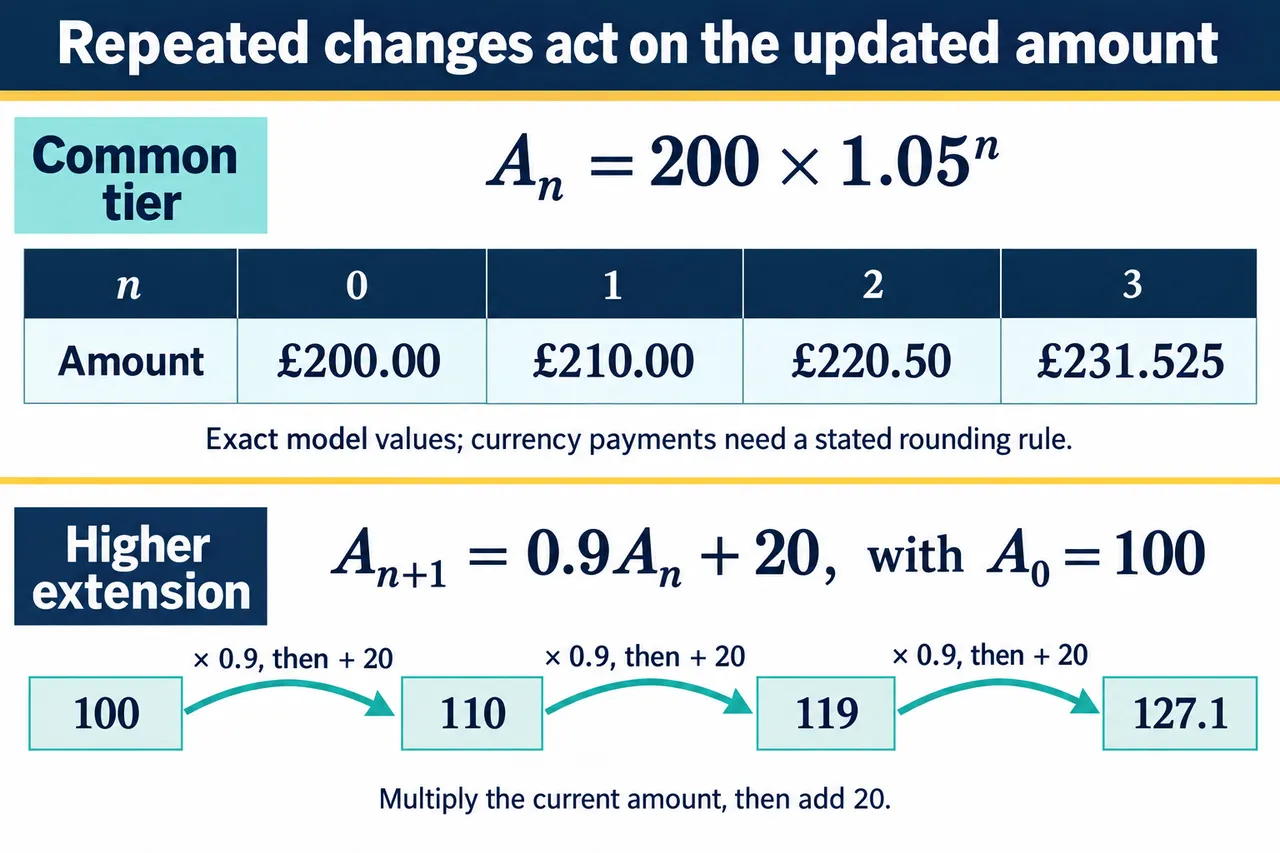
A general iterative model can combine multiplication with a fixed adjustment. The rule Aₙ₊₁ = 0.9Aₙ + 20 first retains 90% of the current amount, then adds 20. It is not the same as applying a 10% decrease to Aₙ + 20.
With A₀ = 100, the next values are 110, 119 and 127.1. Each stage uses the newly calculated value, not the original 100. State the starting value, update order and period to define the process.
A fixed value L would satisfy L = 0.9L + 20, giving L = 200. In this model Aₙ − 200 is multiplied by 0.9 each step, so the distance from 200 shrinks. That explanation applies to this particular rule; arbitrary iterative processes need not converge.
Worked example: Use Aₙ₊₁ = 0.9Aₙ + 20 from A₀ = 100 for three updates.
A₁ = 0.9 × 100 + 20 = 110.
A₂ = 0.9 × 110 + 20 = 119.
A₃ = 0.9 × 119 + 20 = 127.1.
Answer: 110, 119, 127.1.
Check your understanding: What value stays unchanged by this update?
Answer: 200.
Why: 0.9 × 200 + 20 = 200.