Read possessions and relationships
By UK GCSE French · independent study · myAudience
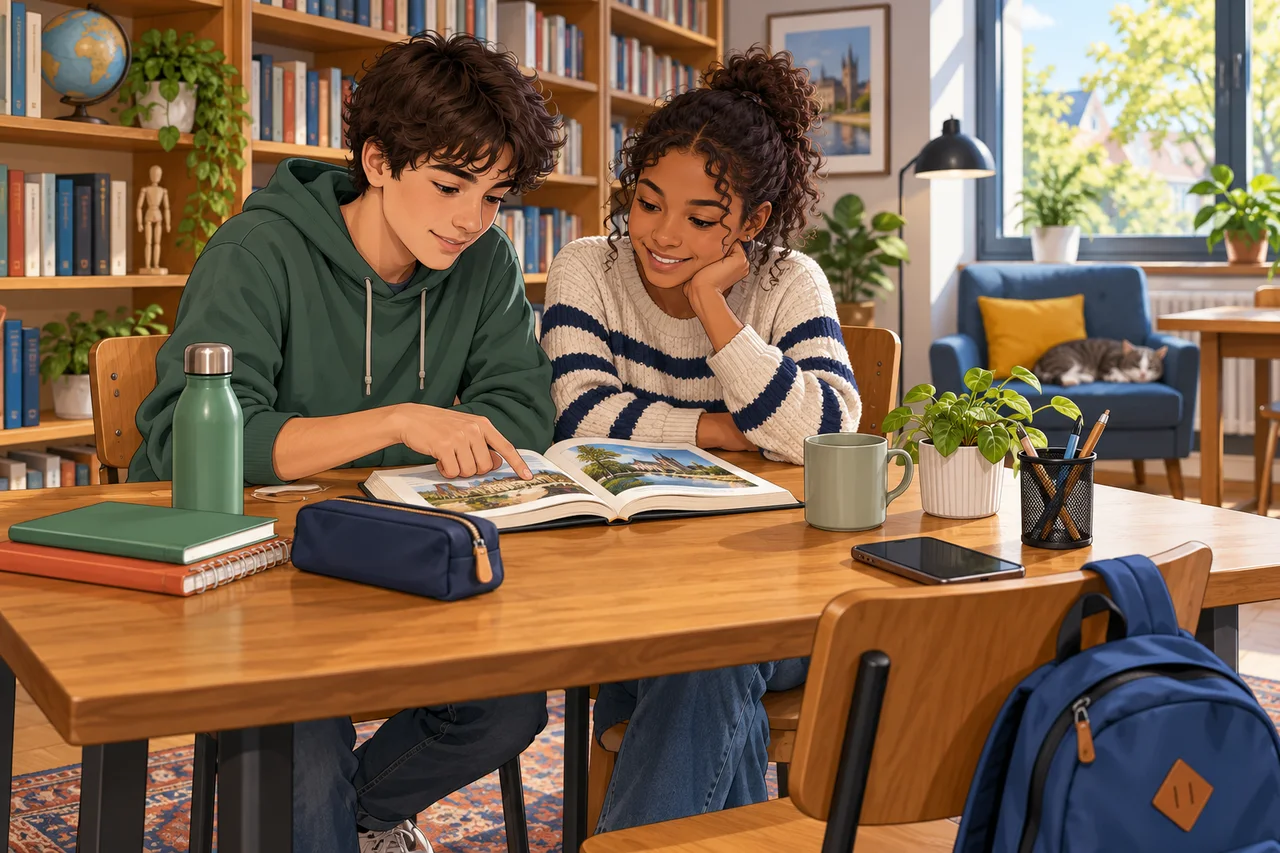
Original illustration generated with OpenAI imagegen for myAudience; fictional teaching scene. · Original generated artwork; no exam-board art or photograph reproduced.
Read possessions and relationships
A French possessive determiner points to a relationship and agrees with the noun that follows. For my, use mon with a masculine singular noun, ma with a feminine singular noun and mes with a plural noun. The choice follows the thing or person described, not the speaker’s gender. Any speaker can write « mon livre » and « ma table ».
The same agreement principle applies to ton, ta, tes for your in a familiar singular address, and son, sa, ses for his or her. « Son livre » by itself does not tell you whether the possessor is a man or a woman. Context supplies that information. Avoid inventing it in an English translation.
Before a feminine noun beginning with a vowel or silent h, mon, ton and son replace ma, ta and sa for ease of pronunciation. Thus « mon amie » contains a feminine noun. With a preceding adjective that begins with a consonant, the usual feminine form can return: « ma nouvelle amie ». This lesson practises only the simpler directly adjacent noun pattern.
Vocabulary in context: un sac is a bag; un livre is a book; une amie is a female friend. In « Voici mon sac et mes livres », voici introduces something being shown, and mes marks several books. These are original example sentences. They are useful word practice, not the complete prescribed vocabulary list.
Worked example: Choose my in « ___ sac », « ___ table » and « ___ amie ».
Sac is masculine singular: mon.
Table is feminine singular: ma.
Amie is feminine but begins with a vowel: mon.
Answer: Mon sac; ma table; mon amie.
Check your understanding: Translate « Léa cherche son livre ». Does son identify the possessor’s gender?
Answer: Léa is looking for her book is the ordinary reading; his book is possible if earlier context identifies a male possessor. Son alone does not identify the possessor’s gender.
Why: The masculine form son agrees with livre. The surrounding context supplies the possessor; the sentence alone does not encode that person’s gender in son.