Why the same hazard can cause different harm
By UK GCSE Geography · independent study · myAudience
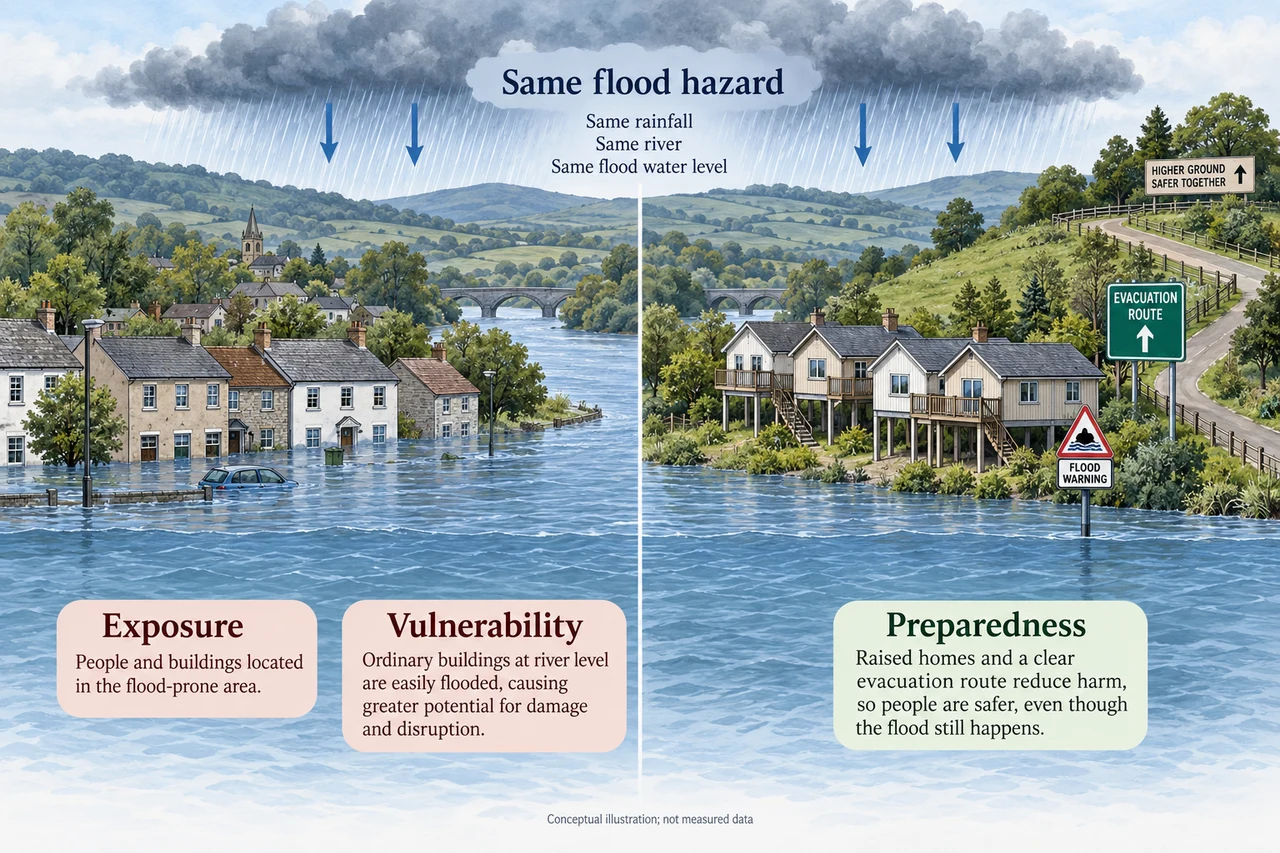
Image: illustration, not a documentary photograph. Original teaching model created for myAudience. · Original generated teaching illustration; no source textbook artwork reproduced.
Why the same hazard can cause different harm
A river rising after heavy rain is a physical process. It becomes a hazard when it could harm people, buildings or services. A hazard is the potential source of harm; a disaster describes severe disruption when an event affects a community whose ability to cope is overwhelmed. Geological hazards include earthquakes and eruptions. Atmospheric hazards include powerful storms; flooding can combine weather, river processes and human changes to a catchment.
Exposure asks what is in the affected place. A flood across an uninhabited field and an equally deep flood through a busy neighbourhood can have very different consequences. Vulnerability asks why exposed people or structures might be harmed. Low floors, weak buildings, limited mobility or interrupted access to warnings can matter. Capacity includes resources and arrangements that help people prepare, respond and recover. These categories describe conditions, not the worth or character of a community.
The illustration holds the flood broadly constant and changes the buildings and preparedness. Raised occupied floors reduce the chance that floodwater enters a home; a route to higher ground supports evacuation. Neither measure stops all floods, protects every service or guarantees safety. This is an explanatory model, not evidence that these designs are suitable for a particular real river: engineers and local authorities need information about depth, velocity, debris, access and future conditions.
To compare risk, ask about both the event and the place: how likely is damaging flooding, how severe might it be, who and what are exposed, and which protections actually work? Wealth can affect resources but is not an automatic explanation for every difference. Land-use decisions, warning access, building enforcement and the timing of an event also matter. Avoid presenting a decorative hazard-times-vulnerability formula as a precise forecast when no measured probabilities or loss model are supplied.
Worked example: In an invented flood exercise,120 households lie inside the flooded area.30 have occupied floors above the water. Is it correct to say that only 90 households are exposed?
Exposure concerns location in the hazard-prone area; all 120 households are located there.
Raised floors change one vulnerability: water entering occupied rooms.
Those 30 households may still lose road access, electricity or safe water. No loss total is given.
Answer: All 120 households are exposed; the 30 raised homes have reduced vulnerability to one effect, not zero risk.
Check your understanding: If a new warning system is installed without moving homes, which risk factor does it most directly improve?
Answer: Preparedness and response capacity.
Why: The houses remain in the same exposed location. A useful warning can help people act before harm occurs, provided it reaches them and a safe action is available.