Three boundary types, three patterns of movement
By UK GCSE Geography · independent study · myAudience
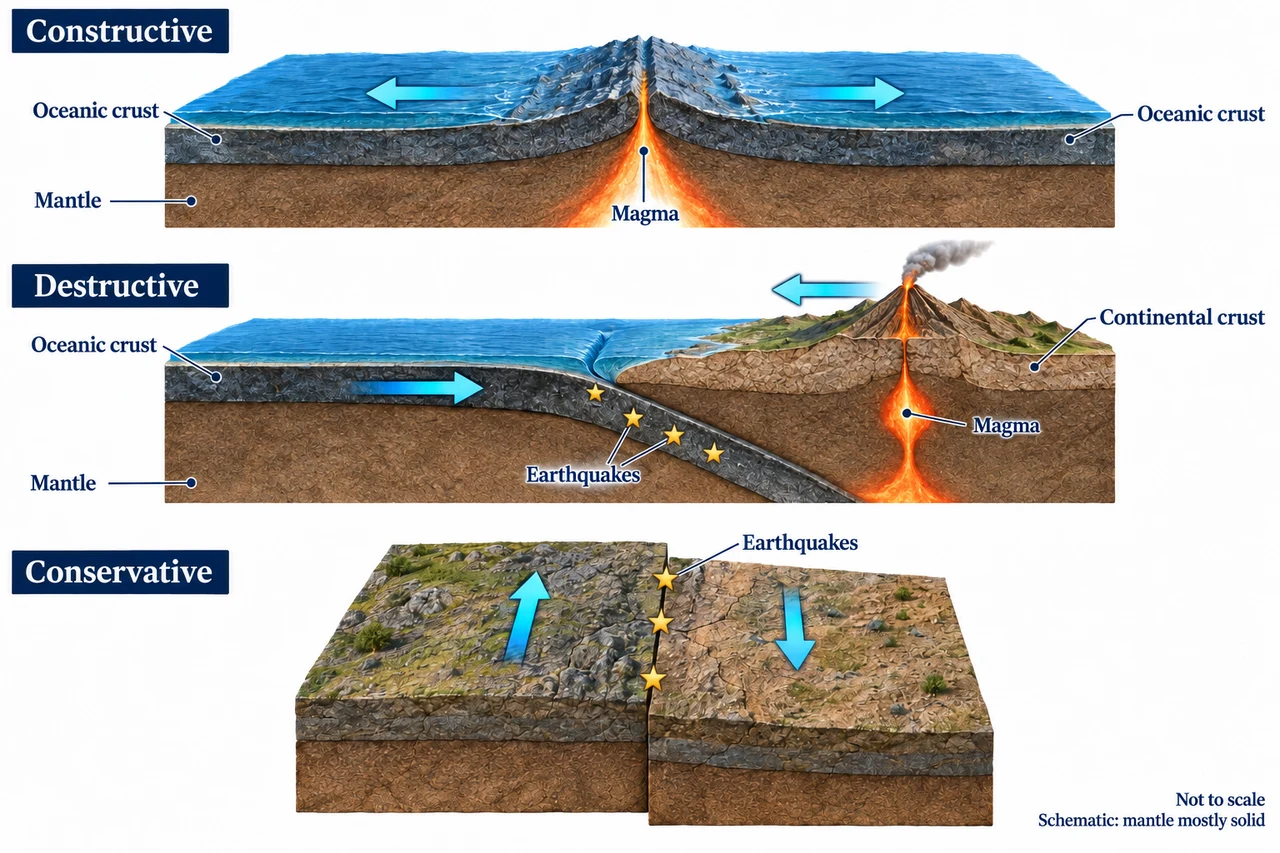
Image: illustration, not a documentary photograph. Original teaching model created for myAudience. · Original generated teaching illustration; no source textbook artwork reproduced.
Three boundary types, three patterns of movement
Earth’s outer rigid shell is divided into moving lithospheric plates. A plate includes crust and the uppermost rigid mantle, so it is not simply a piece of crust floating on an ocean of liquid rock. Most of the mantle is solid; over long times it can deform and flow. Many earthquakes and volcanoes cluster along plate boundaries, although events also occur within plates. Distribution is a pattern to investigate, not a rule that every boundary behaves identically.
At a constructive, or divergent, boundary, plates move apart. Mantle rises and some rock melts as pressure falls. Magma can reach the surface and cool to create new oceanic crust at a spreading ridge. Movement and faulting can also cause shallow earthquakes. The top panel compresses these processes into a small cross-section: its bright magma pathway does not mean that the whole mantle is molten.
At the destructive boundary shown here, denser oceanic lithosphere descends beneath a continental plate. This is subduction. Friction and changes in stress can produce earthquakes along the descending slab. Water released from the slab promotes melting in mantle above it; magma may rise to feed volcanoes on the overriding plate. Do not replace that explanation with “friction melts the entire plate”. Convergent boundaries also include continent–continent collision, so this panel is one model rather than every convergent setting.
At a conservative, or transform, boundary, plates slide past one another. Friction can temporarily hold parts of a fault while strain accumulates; sudden slip releases energy as seismic waves. Crust is not systematically created or consumed at the boundary, and this mechanism does not normally generate a line of volcanoes. The bottom panel is a plan view: its opposite arrows indicate horizontal motion along the fault, unlike the cross-sections above. None of the panels is to scale.
Worked example: An invented boundary has opposite sideways motion, repeated shallow earthquakes and no ridge creating new crust. Which model fits best, and what further evidence would you want?
Opposite motion parallel to a fault matches the conservative model.
No spreading ridge weakens the constructive explanation; no descending slab is described.
Check mapped fault geometry and measured plate motion rather than treating earthquake occurrence alone as decisive.
Answer: A conservative boundary is the best-supported model; fault geometry and plate-motion evidence would strengthen the conclusion.
Check your understanding: Does the presence of an earthquake prove that a boundary is destructive?
Answer: No.
Why: Earthquakes occur at several boundary types and inside plates. Relative movement, crustal structures and earthquake-depth patterns provide stronger discrimination.