Living with risk: protection, planning and honest warnings
By UK GCSE Geography · independent study · myAudience
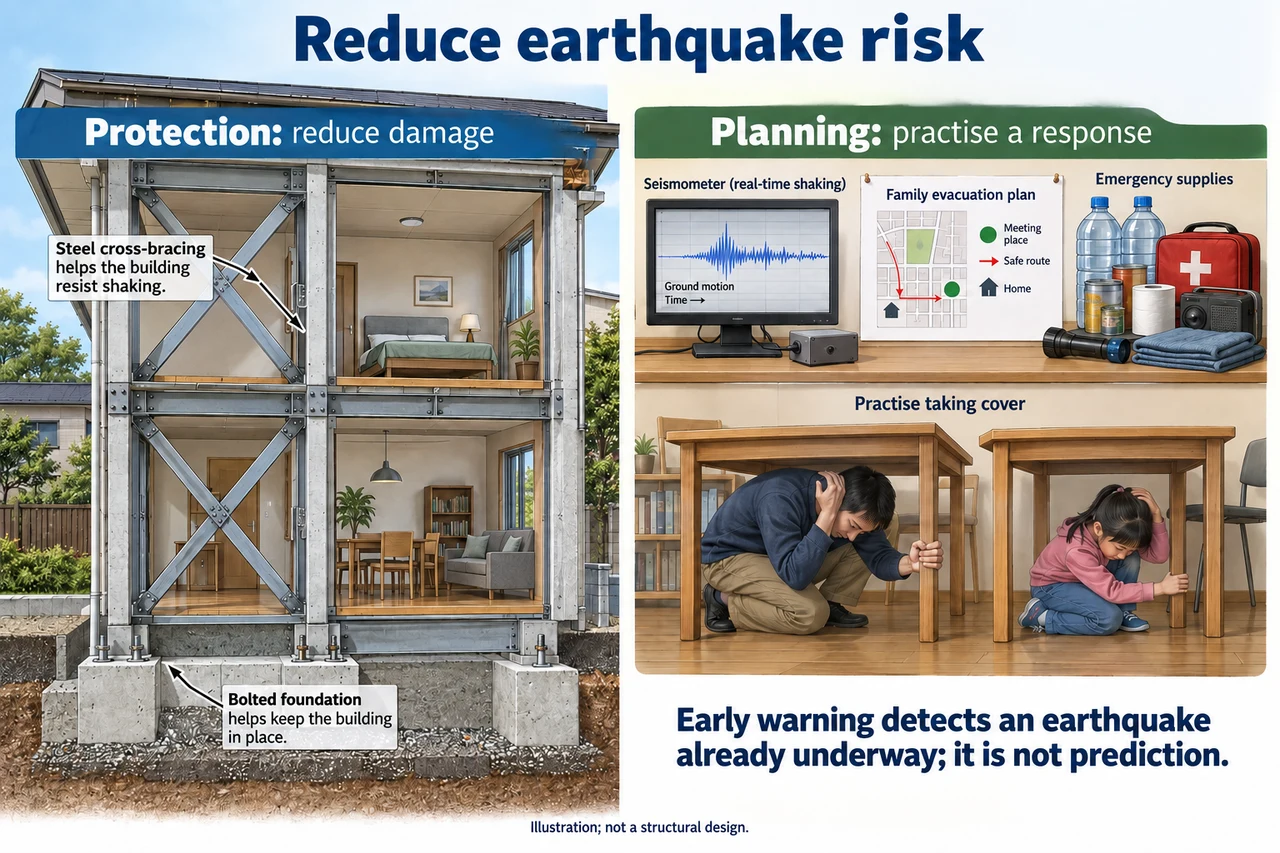
Image: illustration, not a documentary photograph. Original teaching model created for myAudience. · Original generated teaching illustration; no source textbook artwork reproduced.
Living with risk: protection, planning and honest warnings
People rarely choose a home by comparing hazards alone. Work, family, land ownership and the cost of moving can keep a community near a fault or volcano. Volcanic soils, geothermal resources and tourism may also support livelihoods. Moving is not equally available to everyone, so “they should just leave” is not a useful geographical explanation. Ask what people value, which constraints they face and which measures reduce harm in their particular setting.
Monitoring means observing conditions: seismometers record shaking, and volcano monitoring can include ground deformation, gases and seismic activity. Forecasts describe probabilities within stated places and time windows. A reliable forecast is not a promise to specify the exact date, location and magnitude of a future earthquake. USGS distinguishes prediction from early warning: an early-warning system detects a quake already underway and may alert places before damaging shaking arrives. Near the source, useful warning time can be very short or absent.
Protection reduces vulnerability. A carefully designed and maintained building can resist some expected shaking through its structure and connections; bracing in the illustration is a conceptual example, not a construction specification. Planning makes the response usable: drills, supplies, communication arrangements and accessible routes matter only if people know what to do. A warning that cannot reach someone, or a route that a wheelchair user cannot follow, leaves a gap between a system existing and a system working.
Evaluate a measure against a clear outcome. Does it reduce collapse, shorten disruption or help people respond? What are its costs, upkeep and limitations? Earthquake-resistant design does not mean earthquake-proof; a successful drill does not guarantee a successful real evacuation. Sustainable risk management combines physical measures with institutions, local knowledge and repeated review rather than depending on a single impressive technology.
Worked example: A fictional warning reaches a town after 2 seconds; damaging shaking reaches it 12 seconds after the quake starts. What is the available warning interval, and does this prove the quake was predicted?
Subtract detection-and-delivery time from shaking-arrival time:12−2=10 seconds.
The event has already begun when detection occurs.
This idealized interval excludes decision and action delays, which reduce useful time.
Answer: 10 seconds in the fictional example; this is detection after onset, not prediction.
Check your understanding: Why is a reinforced building still dependent on inspection and maintenance?
Answer: Its performance depends on the actual design, connections, materials and condition.
Why: The name of a protective measure is not evidence that it is installed correctly or remains effective. Evaluate implementation as well as the idea.