Cyclone Freddy 2023: warnings must lead to action
By UK GCSE Geography · independent study · myAudience
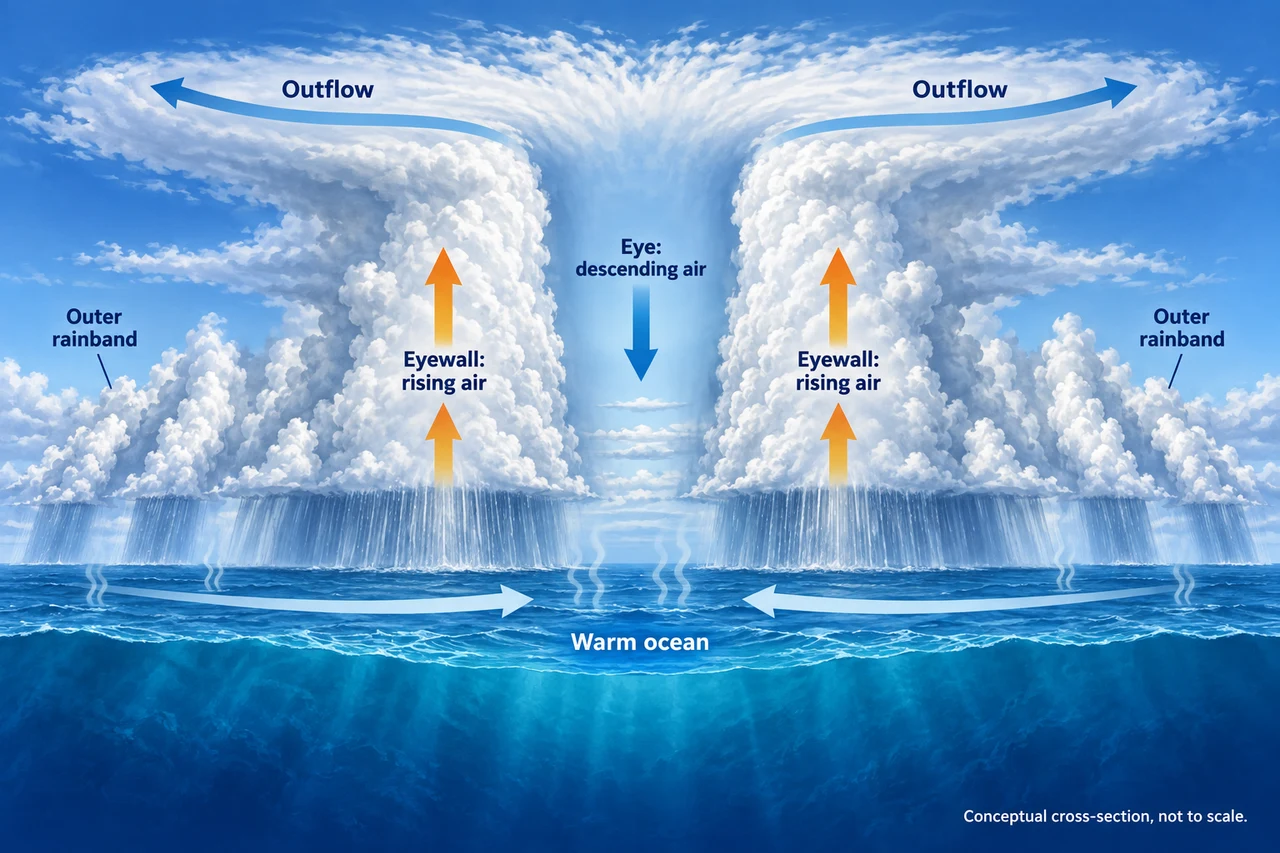
Image: illustration, not a documentary photograph. Original teaching model created for myAudience. · Original generated teaching illustration; no source textbook artwork reproduced.
Cyclone Freddy 2023: warnings must lead to action
Freddy is a named tropical-cyclone case, not the storm pictured in the conceptual cross-section. WMO’s 2024 review confirmed a cumulative 36.0 days at tropical-storm strength or above, with the system crossing the Indian Ocean and making repeated landfalls in Africa during February and March 2023. It affected Madagascar, Mozambique and Malawi. This record excludes periods below tropical-storm strength; it is not the elapsed calendar interval from first formation to final dissipation. A long qualifying duration is a record of persistence; it is not a measure of the rainfall, wind or loss at every place along the track.
Wind can damage roofs and power infrastructure; heavy rain can inundate homes, agricultural land and roads. Secondary consequences include lost crops, disrupted transport and difficulties accessing safe water or health services. Track and terrain help explain why inland communities can suffer badly even after a storm’s strongest winds diminish. To describe impacts accurately, name the location, period and measured outcome rather than assign a single continent-wide number to each country.
WMO’s account of Mozambique’s warning systems describes improved monitoring, forecasts and communication, alongside community preparation and evacuation arrangements. These connect scientific information to action. A forecast that remains inside a meteorological office cannot protect a household; residents need reachable warnings, understandable instructions and a feasible safe response. Funding, trusted local communication and accessible shelters are part of the system.
Immediate responses can include evacuations, shelter, emergency supplies and restoring safe access. Longer-term work includes repairing homes, strengthening infrastructure, improving forecasts and reviewing whether warnings reached vulnerable groups. Comparing Freddy with an earlier cyclone can inform questions, but different tracks and exposure prevent a simple before-and-after death total from proving that one programme alone caused improvement. This lesson deliberately avoids mixing provisional and later casualty totals.
Worked example: In a fictional survey,400 households received a warning and 300 knew a safe route. What percentage of warned households knew a route, and what must you still investigate?
Calculate 300÷400×100=75%.
The missing 25% may face an information or access gap.
Knowing a route does not show that it was safe, accessible or used successfully.
Answer: 75%; investigate feasibility, accessibility and actual action, not warning receipt alone.
Check your understanding: Does a cumulative 36 days at tropical-storm strength or above make Freddy the most dangerous storm for every settlement?
Answer: No.
Why: The record measures qualifying persistence and excludes weaker intervals. Local harm also depends on the conditions reaching that place and the community’s exposure and capacity.