A UK pond: living things depend on physical conditions
By UK GCSE Geography · independent study · myAudience
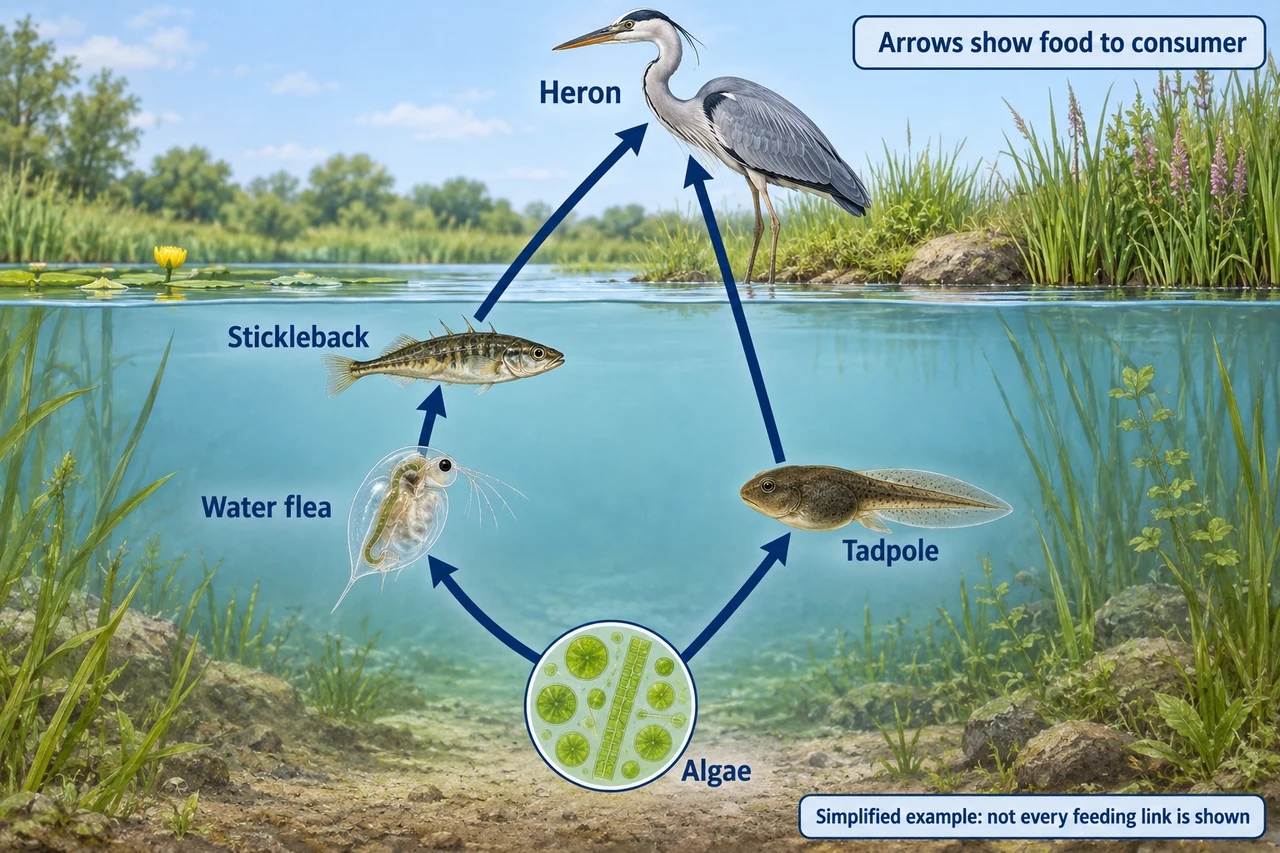
Image: illustration, not a documentary photograph. Original teaching model created for myAudience. · Original generated teaching illustration; no source textbook artwork reproduced.
A UK pond: living things depend on physical conditions
A pond is a useful small-scale UK ecosystem because its organisms and physical setting can be studied together. Producers such as algae and aquatic plants capture light energy. Consumers feed on plants or other animals; decomposers break down dead material and release nutrients. Water depth, light, temperature, oxygen and the chemistry of water and sediment are abiotic conditions. These categories describe roles and conditions, rather than separating two independent worlds.
Imagine a shallow margin with rooted plants and a deeper open-water zone. Light may penetrate differently, vegetation provides shelter, and oxygen can vary with temperature, photosynthesis and decomposition. A pond can also change between seasons. Finding fewer organisms in a winter sample than a summer sample does not by itself show that management damaged the pond: compare conditions, methods and timing before explaining a difference.
The illustration is a simplified possible feeding web, not a survey of a particular pond. It shows algae eaten by water fleas and young grazing tadpoles, water fleas eaten by a stickleback, and fish or tadpoles eaten by a grey heron. Stickleback feeding on Daphnia is supported by published laboratory research, but the relative importance of a food item varies with availability. A diagram link means a possible transfer through feeding, not that every individual eats only that food.
A real study would define a question, choose safe methods and avoid unnecessary disturbance. Students might compare plant cover and selected abiotic conditions at several accessible margins, record effort and repeat observations. The image enlarges tiny organisms so their roles can be seen; it cannot be used to estimate abundance or body size. This reading and its fictional examples do not replace the qualification’s required real fieldwork or school risk assessment.
Worked example: A fictional pond survey records 12 plant-covered quadrats out of 20 equally sized quadrats. Estimate the proportion with cover. What does this statistic leave out?
Calculate 12 ÷ 20 × 100 = 60%.
This is the share of sampled quadrats with some cover, not percentage cover across the entire pond.
Record sampling locations and how much of each quadrat is covered before estimating a different measure.
Answer: 60% of the sampled quadrats contain cover; the measure cannot establish whole-pond area covered.
Check your understanding: Is oxygen concentration a biotic factor because organisms affect it?
Answer: No. It is an abiotic condition that interacts with organisms.
Why: Living processes change physical and chemical conditions. Classification of a variable does not imply that it is independent of the living community.