Food webs: energy flows while nutrients cycle
By UK GCSE Geography · independent study · myAudience
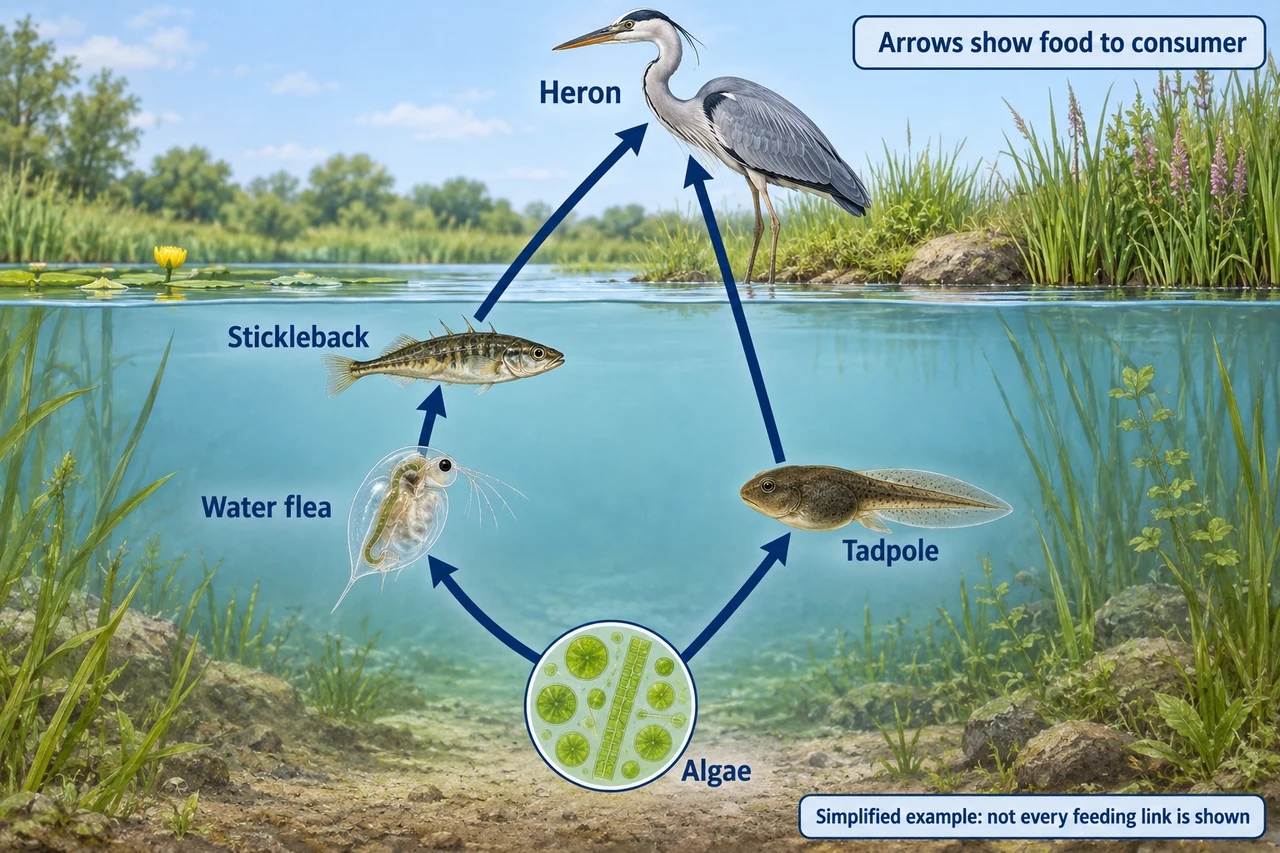
Image: illustration, not a documentary photograph. Original teaching model created for myAudience. · Original generated teaching illustration; no source textbook artwork reproduced.
Food webs: energy flows while nutrients cycle
A food chain follows one feeding route; a food web joins several routes. Read each arrow as transfer from the organism being eaten towards the consumer. In this model, algae → water flea → stickleback → heron is one chain. The algae → tadpole → heron route connects to it. Reversing the arrows would reverse the meaning, so first identify the producer and follow the arrowheads before describing trophic levels.
Producers transform some incoming light energy into chemical energy stored in organic material. Consumers gain some of that energy through feeding. At each stage, organisms respire; energy becomes less available for further biological work and is eventually dissipated as heat. Some biomass is not eaten and some ingested material is not assimilated. Therefore less energy usually reaches higher trophic levels. A convenient classroom percentage is an example, not a universal fixed transfer efficiency.
Nutrients follow a different path. Elements in living tissues return through excretion, death and decomposition, and can become available to producers again. Microorganisms matter even when the drawing does not show them. Energy is continually supplied and dissipated; nutrients can circulate between stores. Saying that both energy and nutrients cycle confuses two processes and obscures why an ecosystem needs an ongoing source of energy.
Food webs also help frame cautious predictions. If water fleas decline, grazing pressure on algae may fall and a fish may have less of this prey. Other foods, competition and physical conditions can change the outcome. Do not turn a simplified web into an exact forecast of every population. Use it to explain a plausible mechanism, then identify observations that would support or challenge that explanation.
Worked example: In a fictional food-chain model, producers contain 10,000 energy units and 800 reach primary consumers as new biomass. Calculate the transfer percentage. Is 800 necessarily the energy reaching the heron?
Calculate 800 ÷ 10,000 × 100 = 8%.
The 800 units describe one transfer into primary-consumer biomass.
Further feeding transfers and losses occur before energy reaches the heron; they are not given.
Answer: The model’s first transfer is 8%; the heron’s energy supply cannot be calculated from these values alone.
Check your understanding: Why is a decomposer important even though it is not drawn in this web?
Answer: It breaks down dead organic matter and helps release nutrients that producers can use.
Why: A simplified drawing omits components. Omitting decomposers from the picture does not remove their role from the ecosystem.