Changing one component can change a pond system
By UK GCSE Geography · independent study · myAudience
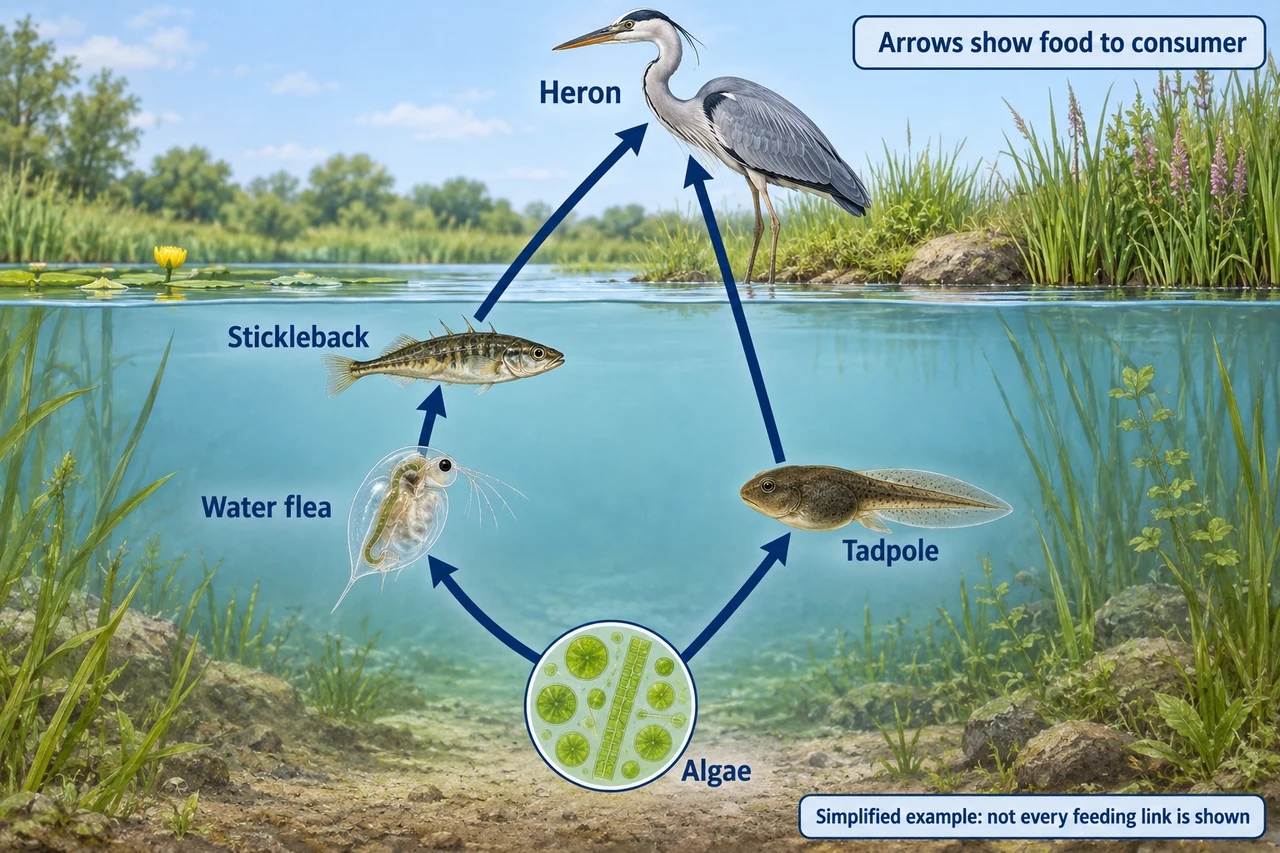
Image: illustration, not a documentary photograph. Original teaching model created for myAudience. · Original generated teaching illustration; no source textbook artwork reproduced.
Changing one component can change a pond system
An ecosystem changes when a component changes, but the effect travels through relationships. Nutrients are essential for growth; an excessive supply from runoff or wastewater can encourage rapid growth of algae or other plants. This process is called eutrophication. Its causes and severity depend on the nutrient, water movement, light and existing conditions. “More nutrients” is not automatically the same as “a healthier pond”.
Dense growth can reduce the light reaching submerged plants. As organisms die, decomposition uses oxygen through aerobic respiration. In some conditions oxygen falls enough to stress or kill aquatic animals. Oxygen can also change through the day as photosynthesis and respiration vary. A single noon reading may miss an overnight minimum. The mechanism therefore requires a sequence: nutrient input, changes in growth and shading, decomposition, then possible oxygen stress.
For a UK pond, examine where water enters, what the catchment contains and whether the suspected source reaches it. A fertilised field nearby is not proof that its runoff caused a particular bloom. Likewise, removing all plants without understanding nutrient inputs may damage habitat and leave the cause in place. Practical management should use site-specific advice, suitable monitoring and protection of the pond’s existing wildlife.
A stronger explanation compares alternatives. Warm weather may reduce dissolved oxygen and also favour growth; sewage input, fertiliser runoff, shading or changing water levels can act together. Record the timing of changes and repeat measurements at comparable places and times. The lesson’s food web offers possible consequences for animals, while chemical measurements and source investigation are needed to test the explanation.
Worked example: A fictional pond has dissolved oxygen readings of 8 mg/L on one morning and 5 mg/L on another. Calculate the reduction and identify one comparison problem.
Subtract 5 from 8 to obtain a reduction of 3 mg/L.
Calculate 3 ÷ 8 × 100 = 37.5% relative to the first reading.
Check temperature, exact time, location and instrument method before attributing the change to a nutrient source.
Answer: The recorded reduction is 3 mg/L, or 37.5%; differing sampling conditions can undermine a causal comparison.
Check your understanding: Does an algal bloom alone prove that fertiliser from the nearest field caused it?
Answer: No.
Why: It supports a question about nutrient enrichment but does not identify the source. Hydrological connections and measured inputs are needed to test that claim.