Rainforest layers: plants respond to different conditions
By UK GCSE Geography · independent study · myAudience
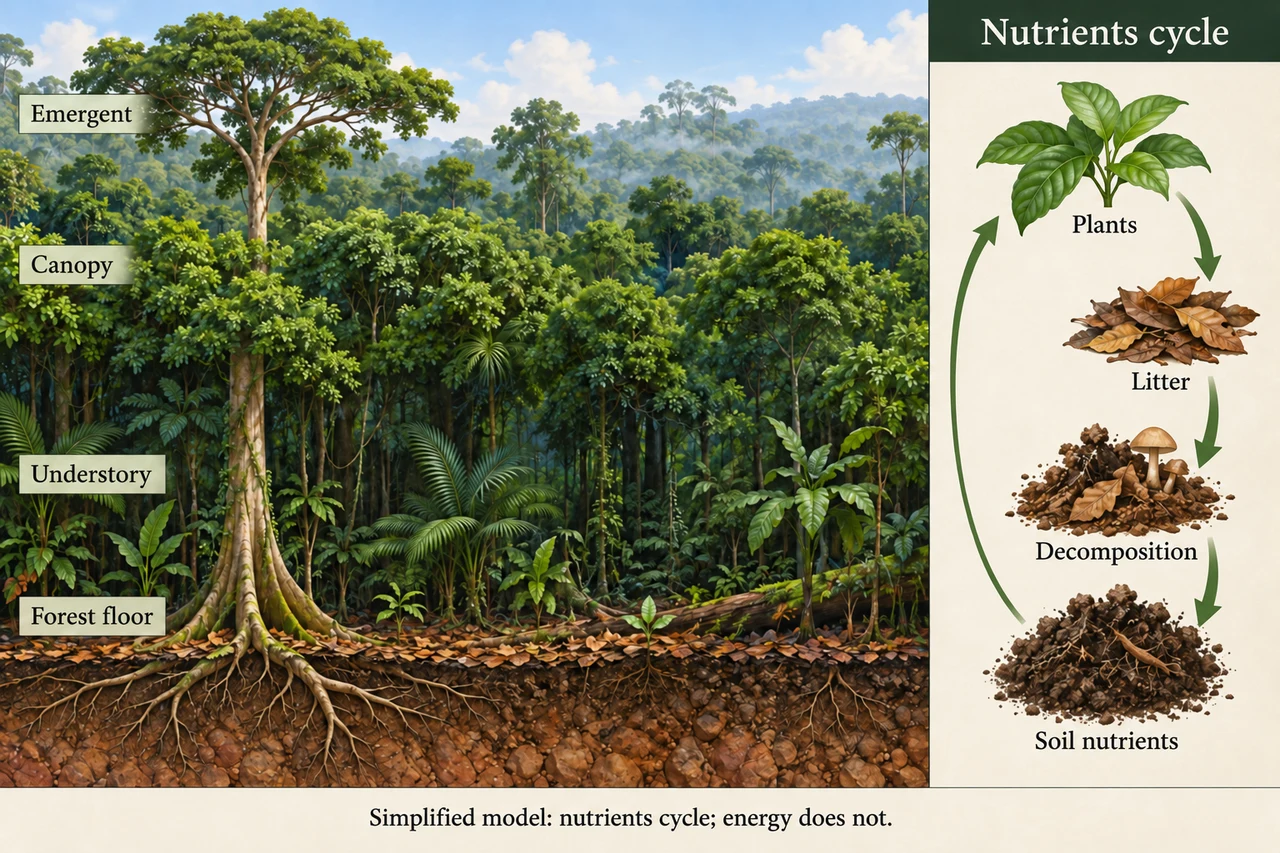
Image: illustration, not a documentary photograph. Original teaching model created for myAudience. · Original generated teaching illustration; no source textbook artwork reproduced.
Rainforest layers: plants respond to different conditions
A tropical rainforest is generally warm and wet, with a long growing season and structurally varied vegetation. Some emergent trees rise above a broad canopy; lower vegetation forms an understory, while the forest floor receives much less direct light. These layers are a useful model, not uniform floors at fixed heights. Gaps, slopes, storms and species differences make real forests more complex than a single cross-section.
Light helps explain contrasting plant forms. Some trees grow tall into brighter conditions; shade-tolerant plants function below. Lianas climb using other plants for support, and epiphytes can grow on branches without being rooted in the ground. Leaf and root traits respond to water, light, nutrients and structural demands. Drip tips can help water run off leaves, and buttress roots support some large trees. These are examples, not features of every rainforest plant.
Animal adaptations can include using branches for movement, feeding on particular resources or avoiding predators through camouflage. Explain what a trait helps an organism do in a particular setting instead of claiming that an animal deliberately chose to evolve it. Forests support many ecological niches, but a drawing of a few trees cannot measure species richness or prove that every rainforest has the same biodiversity.
The conceptual plate places the emergent, canopy, understory and floor beside a nutrient model. Use the left side to explain variation in light; use the right to examine material transfers. Do not confuse layers with trophic levels: a producer can grow on the floor or in the canopy, and consumers can move between layers. A field observation or a named species example would add evidence to the general teaching model.
Worked example: In a fictional measurement, the canopy receives 1,000 light units and the floor receives 20. Express floor light as a percentage of canopy light. Does it establish all rainforest floors receive exactly that amount?
Calculate 20 ÷ 1,000 × 100 = 2%.
The result describes this model’s two measurements.
Real values vary with gaps, time, cloud cover and the measurement method.
Answer: The model floor receives 2% of the canopy reading; it is not a universal rainforest constant.
Check your understanding: Are rainforest layers the same thing as trophic levels?
Answer: No.
Why: Layers describe positions and physical conditions. Trophic levels describe feeding roles and transfers, so organisms in the same layer can occupy different trophic levels.