Rainforest interdependence: water, plants and soil
By UK GCSE Geography · independent study · myAudience
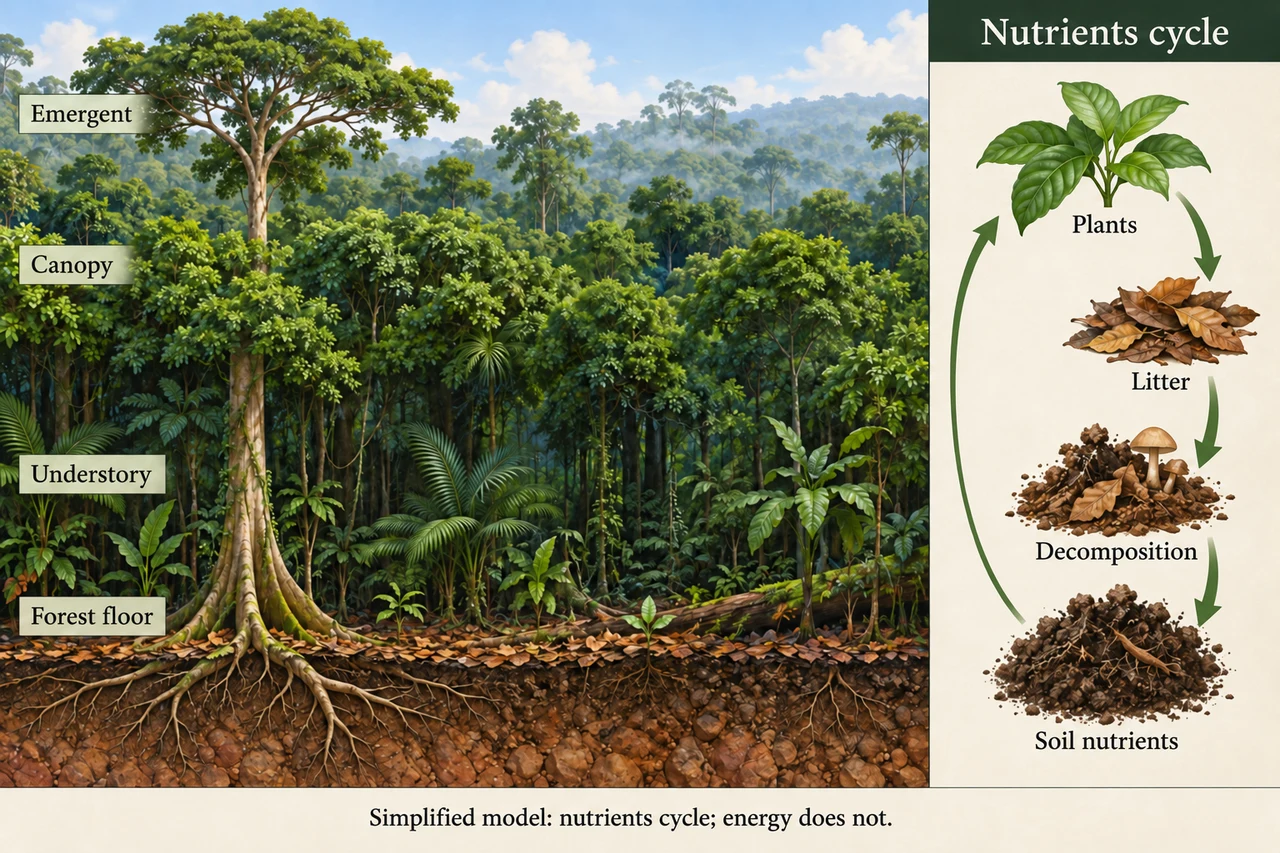
Image: illustration, not a documentary photograph. Original teaching model created for myAudience. · Original generated teaching illustration; no source textbook artwork reproduced.
Rainforest interdependence: water, plants and soil
The rainforest’s climate, vegetation and soils are connected. Warm, moist conditions can favour rapid decomposition. Nutrients released from litter may be taken up by roots, while heavy rain can move soluble materials downward or remove them from the system. In many highly weathered tropical soils, a large share of readily cycling nutrients is associated with living biomass and litter rather than a deep store of naturally fertile topsoil. Soil types vary, so avoid saying that every tropical soil is identical or contains no nutrients.
The nutrient model shows four transfers: plants shed litter; decomposers break it down; nutrients become available in soil; roots take them up again. Clearing and removing biomass can interrupt those transfers. Fire may briefly add nutrients in ash, but that does not guarantee lasting fertility. Exposed soil can be vulnerable to rainfall and erosion, and nutrient availability can decline under continued cultivation without suitable management.
Vegetation also changes water movement. Leaves intercept some rainfall, roots and litter affect infiltration, and transpiration returns water vapour to the atmosphere. Research on the Amazon links forest transpiration with regional moisture and the development of the rainy season. This is a connected regional process, not evidence that one tree creates all of its own rain. Clearing changes several pathways at once; effects depend on the scale, location and wider weather.
To explain interdependence, follow a change through the system. Less canopy may mean less interception and different surface conditions; removal of litter can alter nutrient recycling and protection of soil. A useful answer names a process and its consequence, then recognises variation. The illustration is deliberately qualitative: arrow width is not a measured flow rate and the soil cross-section does not represent a sampled Amazon site.
Worked example: A fictional nutrient budget has 40 units added through decomposition, 30 taken up by plants and 15 lost through leaching in one interval. Calculate the net change in the available soil store.
Additions are 40 units; listed removals total 30 + 15 = 45.
Calculate 40 − 45 = −5 units.
The store declines by 5 units under the stated budget; omitted transfers would change the result.
Answer: A decrease of 5 units, assuming these are the complete flows for the interval.
Check your understanding: Does fast nutrient recycling prove that clearing will leave permanently fertile farmland?
Answer: No.
Why: Removing biomass and litter alters the recycling system. Leaching, erosion, harvest removal and management affect what remains available to crops.