Forest loss changes habitats, livelihoods and climate
By UK GCSE Geography · independent study · myAudience
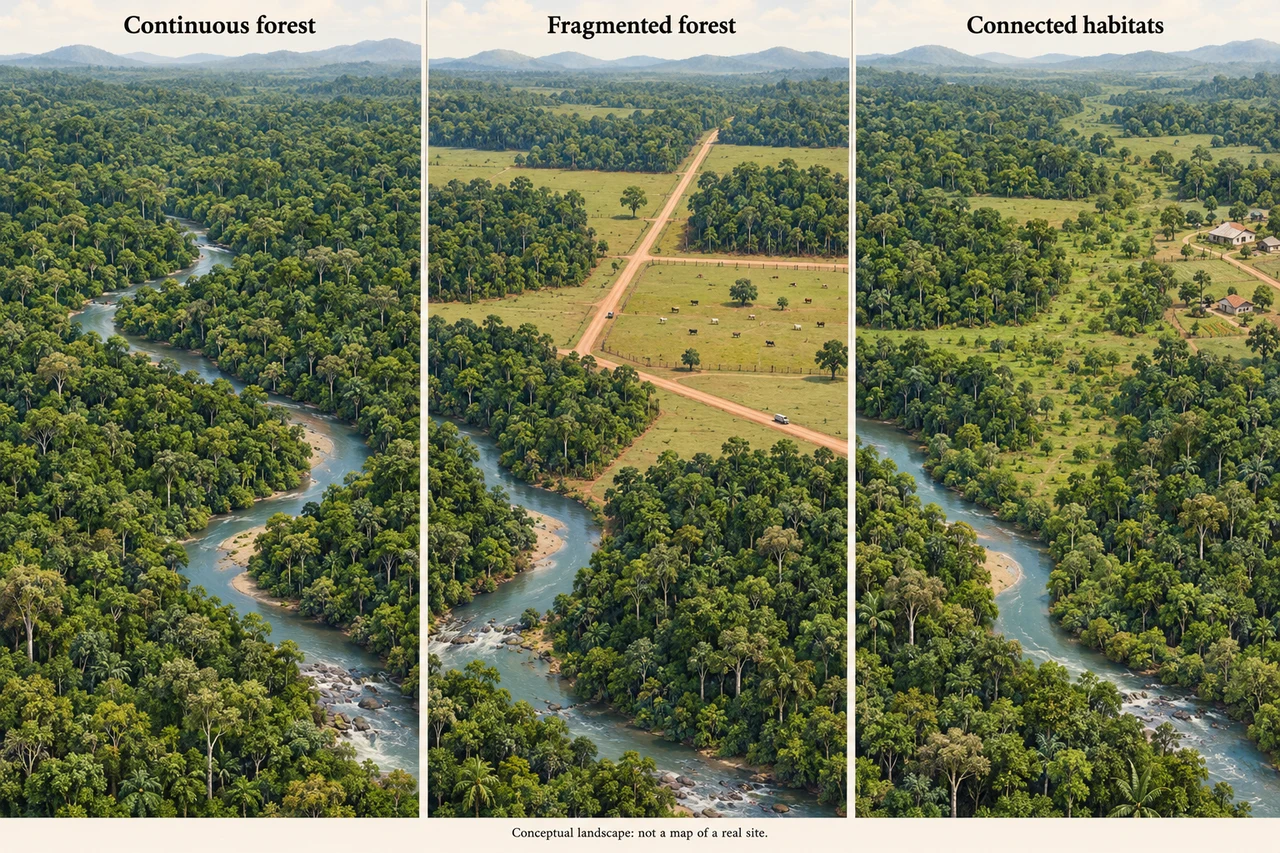
Image: illustration, not a documentary photograph. Original teaching model created for myAudience. · Original generated teaching illustration; no source textbook artwork reproduced.
Forest loss changes habitats, livelihoods and climate
Habitat loss removes part of an ecosystem; fragmentation divides what remains. A forest patch may keep many trees while becoming isolated from other patches. Edges have different exposure to light, wind and drying than the interior, and roads can alter movement or access. A corridor may help some species move, but its width, vegetation and surrounding threats matter. A narrow strip is not automatically an effective replacement for a large connected forest.
Clearing can provide income, land and transport access, so evaluate the economic motives rather than dismissing them. Benefits and costs may fall on different people: a landholder may gain from conversion while a neighbouring community loses forest resources or suffers changed water quality. Indigenous peoples and other forest communities have diverse rights, priorities and livelihoods. They are not a single passive group, and their involvement matters in decisions about land.
Environmental effects can include soil erosion where ground becomes exposed, altered nutrient transfers, biodiversity loss and release of stored carbon. Reduced vegetation also changes water exchanges with the atmosphere. The size and timing of an effect depend on clearing method, soil, regrowth and later land use. A claim that all clearing immediately creates desert is too simple; trace the actual processes and recognise where evidence is incomplete.
The rainforest has value as a habitat, a carbon store, a source of useful materials and knowledge, and a place with cultural importance. Some of these values are hard to price. A decision based only on short-term revenue can omit long-term services and unequal impacts. A balanced explanation should compare feasible options, make the time horizon clear and show whose interests and rights are included.
Worked example: A fictional plan clears 20 km² from a 100 km² forest, leaving two isolated 40 km² patches. Calculate area loss and explain what the area statistic misses.
Calculate 20 ÷ 100 × 100 = 20% area loss.
The remaining 80 km² is divided into two patches rather than one connected area.
Connectivity, edge conditions and affected species require additional indicators.
Answer: Area declines by 20%, but that percentage alone does not describe fragmentation or ecological function.
Check your understanding: Does retaining the same total number of trees prove that biodiversity has been maintained?
Answer: No.
Why: Species, ages, structure, connectivity and habitat quality matter. A tree count cannot establish the full ecological community or its functioning.