Keeping an atom account: conservation and balancing
By UK GCSE Chemistry · independent study · myAudience
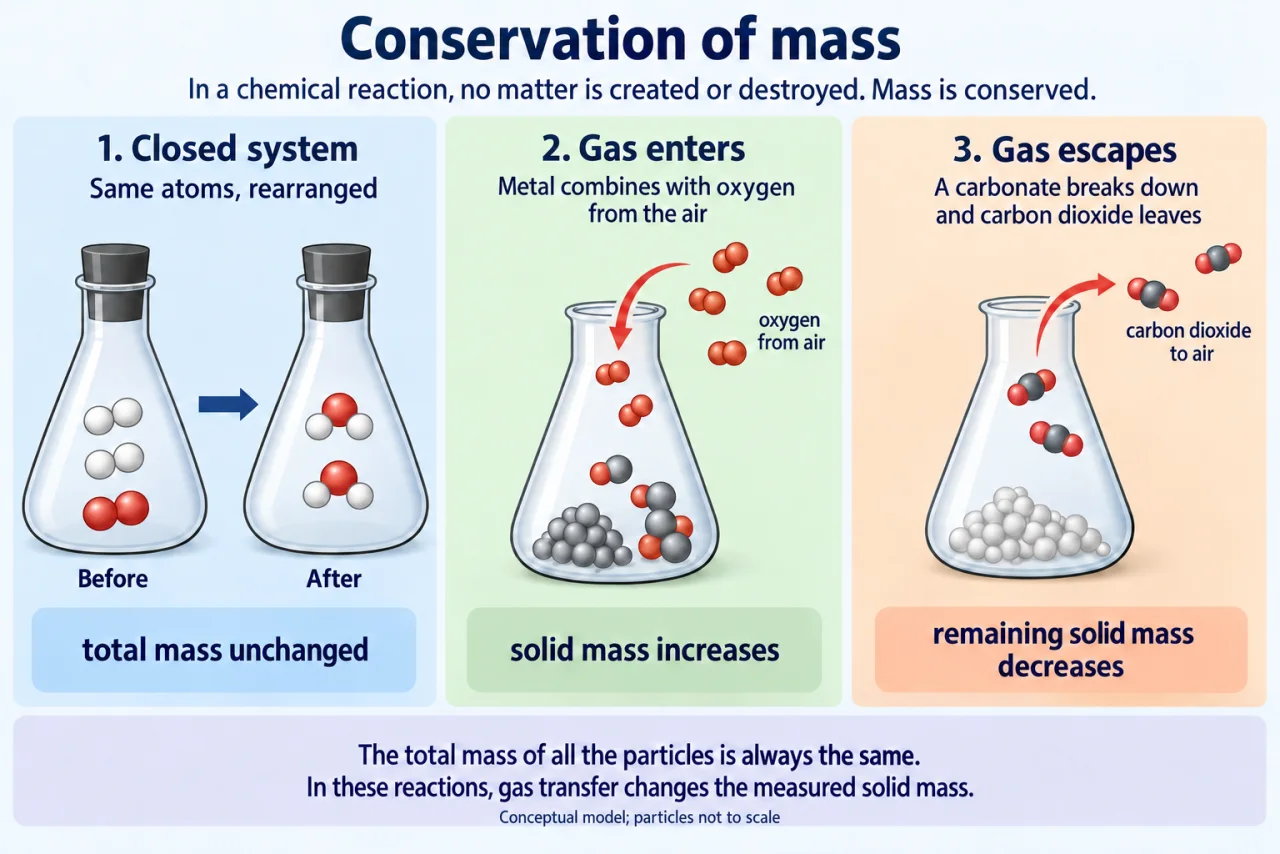
myAudience original generated teaching illustration. Image: illustration, not a documentary photograph. · Original generated teaching illustration; no exam-board or textbook artwork copied.
Keeping an atom account: conservation and balancing
A chemical reaction changes the arrangement of atoms. It can join atoms into new molecules or reorganise an ionic structure, but it does not change one element into another. Conservation of mass follows from that atom account: if all reactants and products are included, the total mass is unchanged. The word system means the material chosen for study; a closed system exchanges no matter with its surroundings. A balance reading for only part of an open system need not remain constant.
A formula and an equation answer different questions. In H2O, the subscript 2 describes two hydrogen atoms for every oxygen atom in one water molecule. In 2H2O, the coefficient 2 counts two whole water molecules, so there are four hydrogen atoms and two oxygen atoms. In a larger sample the same coefficient expresses a ratio of amounts. Changing H2O to H2O2 would change the substance to hydrogen peroxide; it would not balance a water-forming reaction.
To balance an equation, begin with correct formulae for the known substances and count each element separately. Put whole-number coefficients before formulae until each count agrees across the arrow, then reduce coefficients to the simplest whole-number ratio. Oxygen gas is O2, not O, so apparently convenient single oxygen atoms cannot be introduced just to make the arithmetic easier. State symbols describe physical states and do not multiply atom counts.
Consider aluminium oxide formation, written initially as Al + O2 → Al2O3. Oxygen occurs in groups of two on the left and three on the right. Six oxygen atoms can be represented on both sides by 3O2 and 2Al2O3. Those two oxide units contain four aluminium atoms, requiring 4Al. The resulting account is 4Al + 3O2 → 2Al2O3. It predicts ratios of reacting particles without claiming that four atoms alone constitute a laboratory sample.
An explanation should connect the symbolic account with the physical claim. Saying merely that an equation is balanced gives no reason why mass is conserved; saying that equal numbers of each type of atom occur on both sides supplies the reason. The familiar particle model is a representation, with coloured spheres standing for atoms rather than showing their actual sizes. Its useful invariant is the inventory of each element, not the number of molecules, which can change.
The closed-system panel represents two H2 molecules and one O2 molecule forming two H2O molecules: four hydrogen and two oxygen atoms occur on each side. The gas-entry and gas-exit panels are conceptual examples, not complete counted equations. Neither flask is an instruction to heat a sealed vessel.
Worked example: Balance hydrogen burning to form water: H2 + O2 → H2O. Explain the coefficient and subscript roles.
Two oxygen atoms enter in each O2 molecule; place 2 before H2O to represent two oxygen atoms in the products.
2H2O contains four hydrogen atoms, so place 2 before H2.
Audit H: 4 on each side; O: 2 on each side. Coefficients are 2:1:2 and the formulae are unchanged.
Answer: 2H2 + O2 → 2H2O. The coefficients count whole entities; the subscripts specify each entity's composition.
Check your understanding: Is 2Na + Cl2 → 2NaCl balanced, and how many chlorine atoms are represented on each side?
Answer: Yes; two chlorine atoms on each side.
Why: Cl2 contains two Cl atoms and 2NaCl contains two formula units, each with one Cl. Sodium also has a count of two on both sides.