Reading formulae to calculate relative mass and mass percentage
By UK GCSE Chemistry · independent study · myAudience
myAudience original generated teaching illustration. Image: illustration, not a documentary photograph. · Original generated teaching illustration; no exam-board or textbook artwork copied.
Reading formulae to calculate relative mass and mass percentage
Relative atomic mass, Ar, compares an element's mean atomic mass with the atomic mass reference. Relative formula mass, Mr, adds those relative masses according to the numbers in a chemical formula. Both are ratios and have no unit. Mr is useful for ionic substances as well as molecules: an ionic crystal has formula units expressing its composition, not isolated salt molecules. In this lesson use the stated GCSE values rather than silently replacing them with more precise atomic weights.
Brackets need the same careful reading as subscripts. Ca(OH)2 contains one calcium atom, two oxygen atoms and two hydrogen atoms per formula unit. With Ar values Ca = 40, O = 16 and H = 1, Mr = 40 + 2(16 + 1) = 74. Multiplying only the hydrogen by two misses the role of the bracket. A useful routine is to write an atom-count table first and then multiply each count by its Ar value.
Percentage by mass asks what fraction of the total formula mass comes from the element of interest. The numerator must include all atoms of that element in the formula. Oxygen therefore contributes 32 to the 74 for Ca(OH)2, giving 32/74 × 100 = 43.2% to three significant figures. Counting two oxygen atoms out of five atoms would instead produce an atom-count fraction; atoms of different elements do not have equal masses, so that is a different quantity.
The coefficient-weighted formula masses also give a mass audit of a balanced equation. For 2H2 + O2 → 2H2O, use Mr(H2) = 2, Mr(O2) = 32 and Mr(H2O) = 18. The reactant total is 2 × 2 + 32 = 36 and the product total is 2 × 18 = 36. This equality depends on including the coefficients. An unweighted sum would falsely suggest that the masses did not agree.
Mass percentage describes a pure compound's composition; it does not by itself tell you how much of that compound occurs in a mixed sample. If a material is impure, first establish how much pure compound is present before applying its elemental mass fraction. Keep the scientific vocabulary distinct: a formula unit is a composition count, Mr is a relative mass, and a percentage is a dimensionless comparison expressed per hundred.
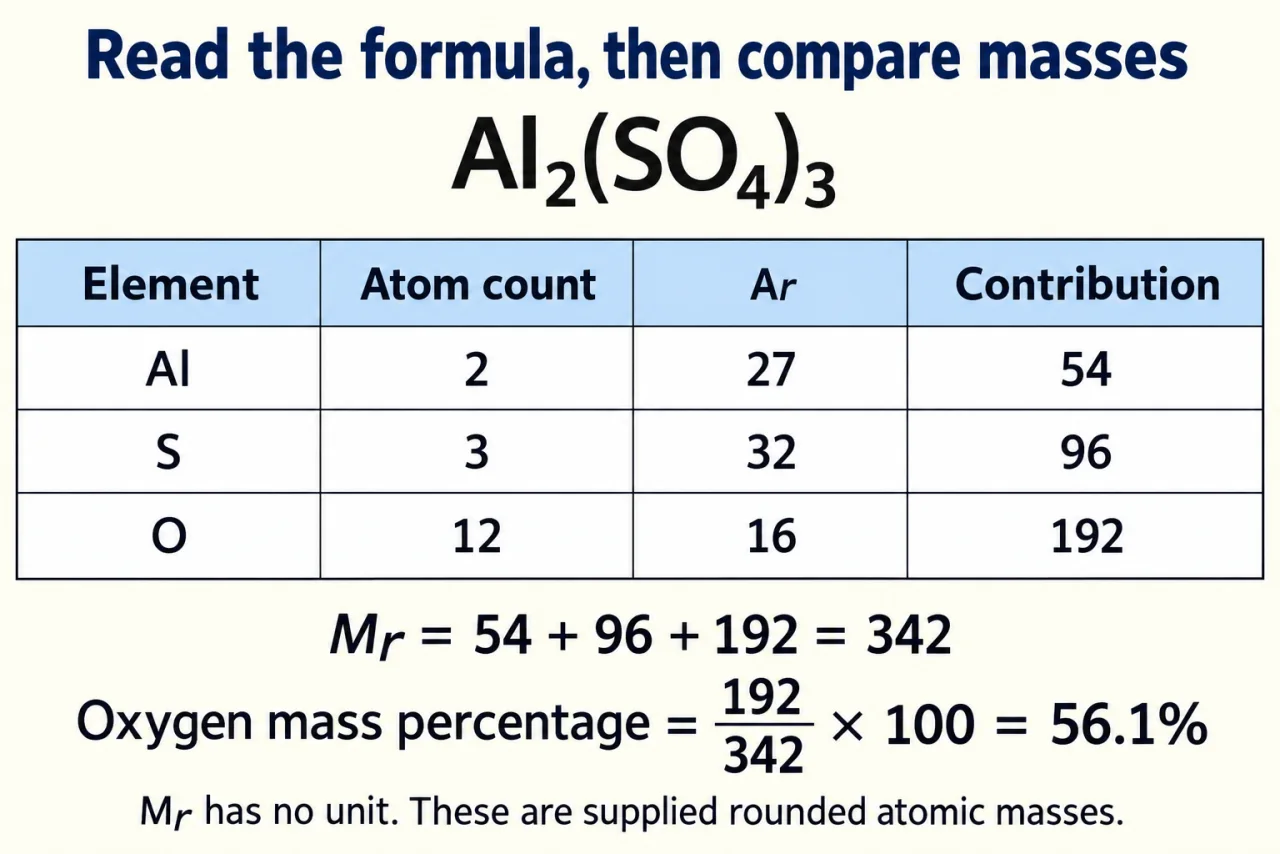
The formula plate reads the bracket before doing arithmetic: three sulfate groups give three sulfur and twelve oxygen atoms. Its contribution column totals 342, and the oxygen share uses 192 as the numerator. This is a mass fraction, so a ratio of atom counts would answer a different question.
Worked example: Calculate Mr of Al2(SO4)3 and its oxygen mass percentage. Use Al = 27, S = 32 and O = 16.
The formula contains 2 Al, 3 S and 12 O atoms.
Mr = 2 × 27 + 3 × 32 + 12 × 16 = 342.
Oxygen contributes 192; its mass percentage is 192/342 × 100 = 56.140...%.
Answer: Mr = 342, with no unit; oxygen = 56.1% by mass to three significant figures.
Check your understanding: For CO2, using C = 12 and O = 16, what percentage of its mass is carbon?
Answer: 27.3% to three significant figures.
Why: Mr is 44 and carbon contributes 12. The mass fraction is 12/44, not one atom out of three.