Why an open balance can gain or lose mass
By UK GCSE Chemistry · independent study · myAudience
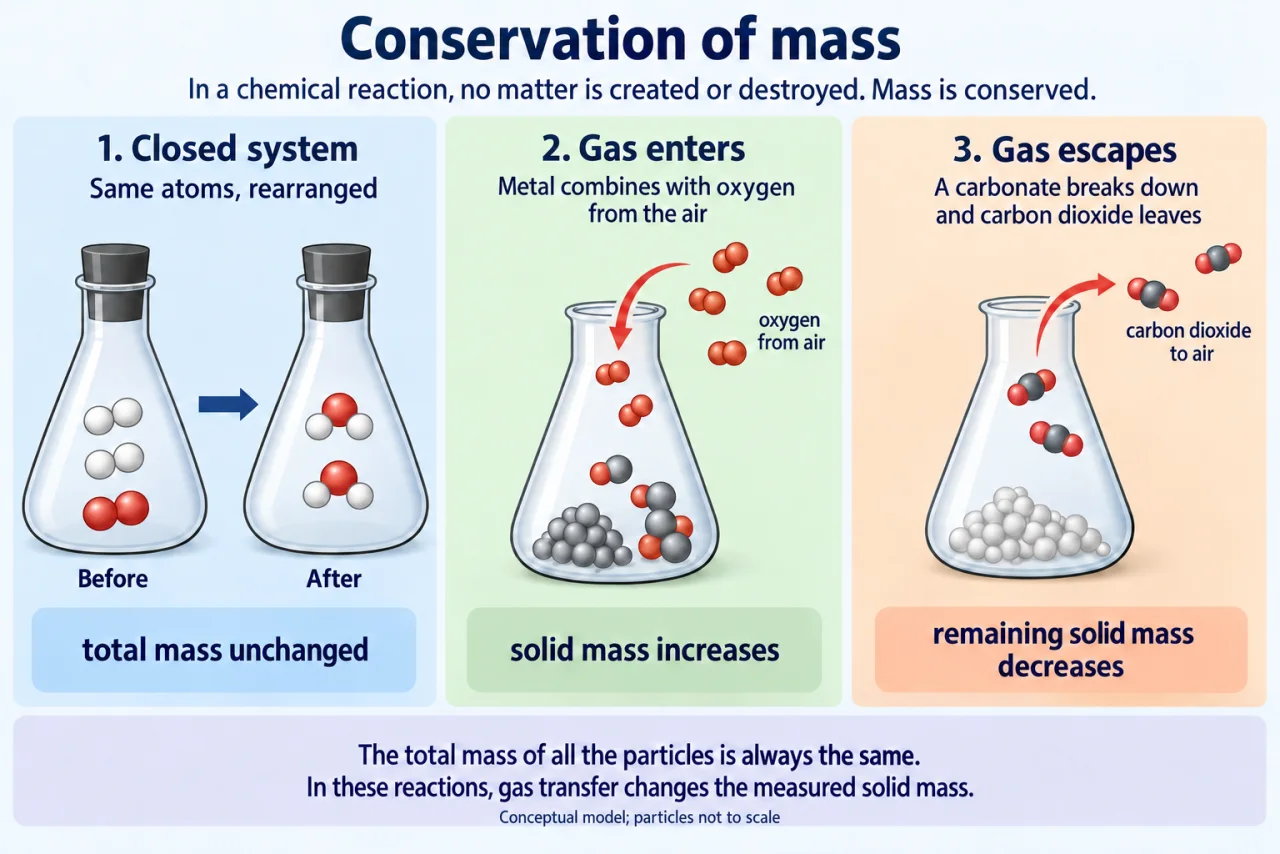
myAudience original generated teaching illustration. Image: illustration, not a documentary photograph. · Original generated teaching illustration; no exam-board or textbook artwork copied.
Why an open balance can gain or lose mass
A balance measures the objects supported on its pan, not every substance involved in a reaction. When a metal combines with oxygen from the surrounding air, the final solid includes oxygen that was absent from the initial metal measurement. A larger solid mass is therefore consistent with conservation. The missing part of the initial account is the mass of oxygen that entered from outside the measured system.
Thermal decomposition provides the opposite example. In CaCO3(s) → CaO(s) + CO2(g), carbon and some oxygen leave the solid as carbon dioxide. The mass of remaining solid falls because gas crosses the boundary into the surroundings. Nothing has disappeared from the full atom account. The difference between the initial solid mass and final solid mass represents released gas only if there are no other losses or gains.
For 2Mg + O2 → 2MgO, the balanced equation identifies oxygen from the air as material that becomes part of the oxide. Suppose a supervised investigation starts with a measured 3.00 g metal sample and later collects 5.00 g of oxide. The observed increase is 2.00 g. If oxygen uptake is the only change and the whole solid is collected, that difference represents oxygen added from outside the initially weighed sample. Predicting a product mass from a reactant mass and the equation is a separate Higher-tier calculation, developed in the later reaction-masses lesson.
A school investigation should identify what is weighed and hold that choice constant. A crucible, lid and sample should be accounted for together when interpreting repeated masses; cooling before weighing avoids misleading hot-object readings and protects apparatus. Heating to a stable mass can support a claim of completion, but a stable reading alone does not prove chemical purity. Practical heating and reagent handling require a teacher's risk assessment and appropriate equipment; never heat a sealed vessel to imitate the closed-system picture.
Good reasoning compares alternative causes of a changed reading. A loss could arise from escaped gas, spilled solid or evaporated water; the equation and observations decide which explanation is plausible. A gain could reflect oxygen uptake or contamination. Use particle language to explain the chosen cause: identify which atoms cross the measured boundary, rather than saying that heat created or destroyed mass. This lesson supports AT 1, 2 and 6 reasoning without recording that you have performed those techniques.
The conservation plate contrasts material that crosses an open measured boundary with an unchanged closed atom inventory. Oxygen uptake adds material to the metal; carbonate decomposition transfers some material into escaping carbon dioxide. The particle drawings in the open panels are qualitative and do not specify a literal laboratory sample.
Worked example: In a constructed open-system investigation, the initial solid sample mass is 5.00 g and the measured remaining solid mass after decomposition is 2.80 g. The supplied reaction is CaCO3(s) → CaO(s) + CO2(g). Assuming no spilled solid, water loss or other reaction, explain the mass change and calculate how much gas escaped.
The measured solid mass decreases by 5.00 − 2.80 = 2.20 g.
The supplied equation identifies carbon dioxide as the gaseous product that crosses the measured boundary.
Including the escaped gas restores the material account: 2.80 + 2.20 = 5.00 g. This uses observed masses, not a predicted reacting-mass ratio.
Answer: 2.20 g of carbon dioxide escapes under the stated assumptions; the total mass of the full material account is conserved.
Check your understanding: A metal's mass rises from 1.80 g to 2.40 g after reacting with oxygen. Assuming complete collection and no other change, what entered the solid?
Answer: 0.60 g of oxygen.
Why: The increase is 2.40 − 1.80 g. It is added material from the surroundings, not newly created atoms.