A mole counts a stated kind of entity — Higher
By UK GCSE Chemistry · independent study · myAudience
myAudience original generated teaching illustration. Image: illustration, not a documentary photograph. · Original generated teaching illustration; no exam-board or textbook artwork copied.
A mole counts a stated kind of entity — Higher
Amount of substance is a counting quantity used when individual chemical particles are too numerous to count directly. Its unit is the mole, symbol mol. A mole is not a particular mass and not a fixed volume in every state. It describes a stated number of specified entities. You must say what is being counted: atoms, molecules, ions, electrons or formula units. That qualification prevents ambiguous statements such as a mole of particles in an ionic compound.
The modern SI definition fixes one mole at exactly 6.02214076 × 10^23 specified entities. uses the rounded Avogadro constant 6.02 × 10^23 per mole for this level. Use the value supplied in a question, and identify the rounding when explaining it. Standard form writes a number as a factor between 1 and 10 multiplied by a power of ten; the large exponent reflects the enormous count, not a large particle size.
The relation N = n × NA connects entity count N, amount n in mol, and Avogadro constant NA in mol−1. The units cancel to give a count. Rearranging gives n = N/NA. For 0.250 mol of helium atoms, the value gives 1.505 × 10^23 atoms before rounding, or 1.51 × 10^23 to three significant figures. Naming helium atoms is appropriate because helium is monatomic under ordinary conditions.
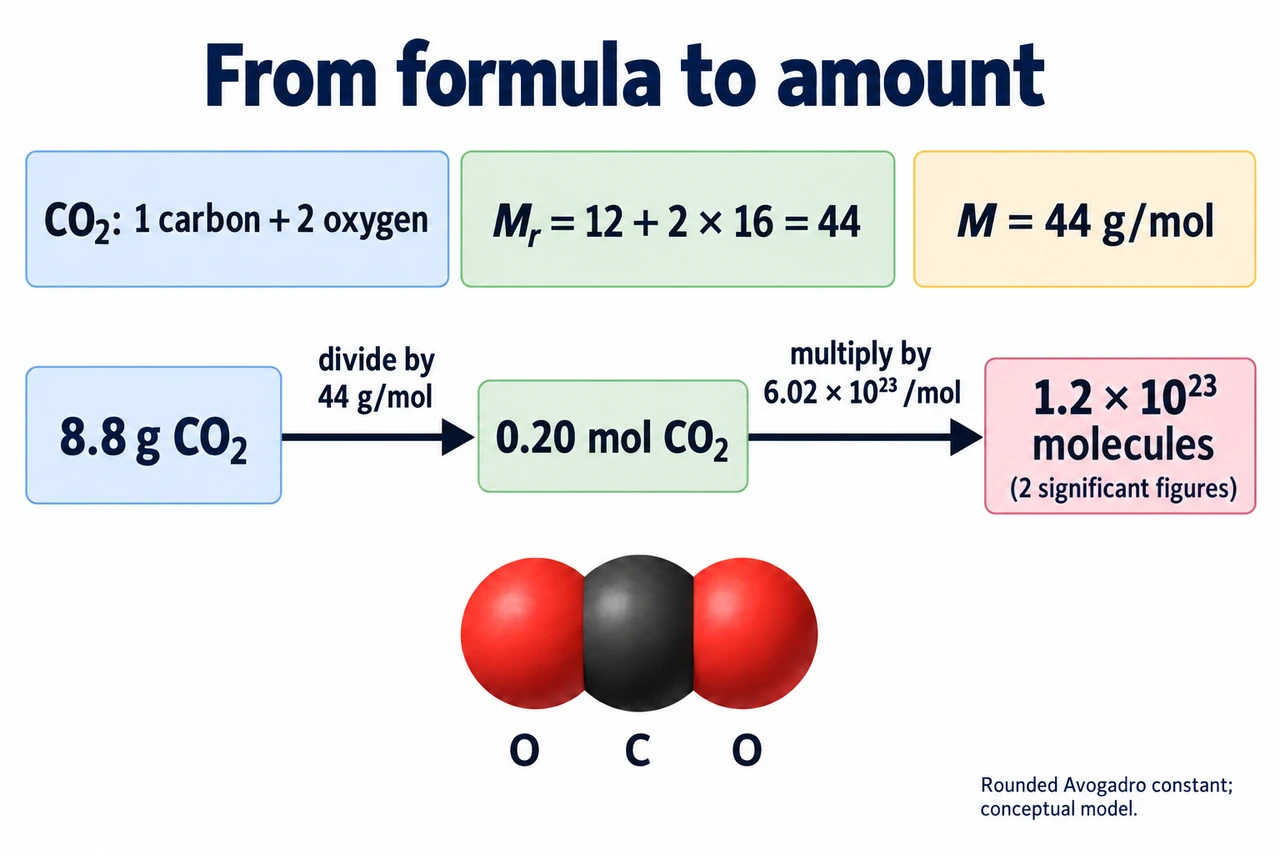
One mole of CO2 molecules contains one mole of carbon atoms and two moles of oxygen atoms bound within those molecules. It therefore contains three moles of atoms in total, but still only one mole of molecules. In a mole of NaCl formula units there is one mole of Na+ ions and one mole of Cl− ions in the lattice, not a mole of isolated NaCl molecules. In a redox account the same counting unit can be applied to transferred electrons; those electrons are not a new element.
Equal mole amounts of different substances contain equal numbers of the stated entities, even when their masses differ. One mole of helium atoms has far less mass than one mole of carbon dioxide molecules. Keep the word amount for n, mass for a balance measurement, and number for the entity count. A drawing of a few spheres illustrates proportions; it cannot literally show 10^23 entities and must not be read as a scaled picture of a mole.
The mole plate follows a different sample from the worked question: 8.8 g CO2 gives 0.20 mol CO2. Multiplying by the supplied rounded Avogadro constant gives 1.204 × 10^23 before rounding, reported as 1.2 × 10^23 molecules to two significant figures. The O–C–O model identifies composition, not particle size.
Worked example: How many oxygen atoms are present in 0.150 mol of CO2 molecules? Use NA = 6.02 × 10^23 mol−1.
Each CO2 molecule contains two oxygen atoms, so n(oxygen atoms) = 2 × 0.150 = 0.300 mol.
N(oxygen atoms) = 0.300 × 6.02 × 10^23 = 1.806 × 10^23.
Round to three significant figures, retaining the named entity.
Answer: 1.81 × 10^23 oxygen atoms.
Check your understanding: How many moles of ions in total are represented by 0.20 mol of MgCl2 formula units?
Answer: 0.60 mol of ions: 0.20 mol Mg2+ and 0.40 mol Cl−.
Why: Each formula unit accounts for one magnesium ion and two chloride ions. The total is three times the formula-unit amount.