Converting mass and amount without confusing Mr with grams — Higher
By UK GCSE Chemistry · independent study · myAudience
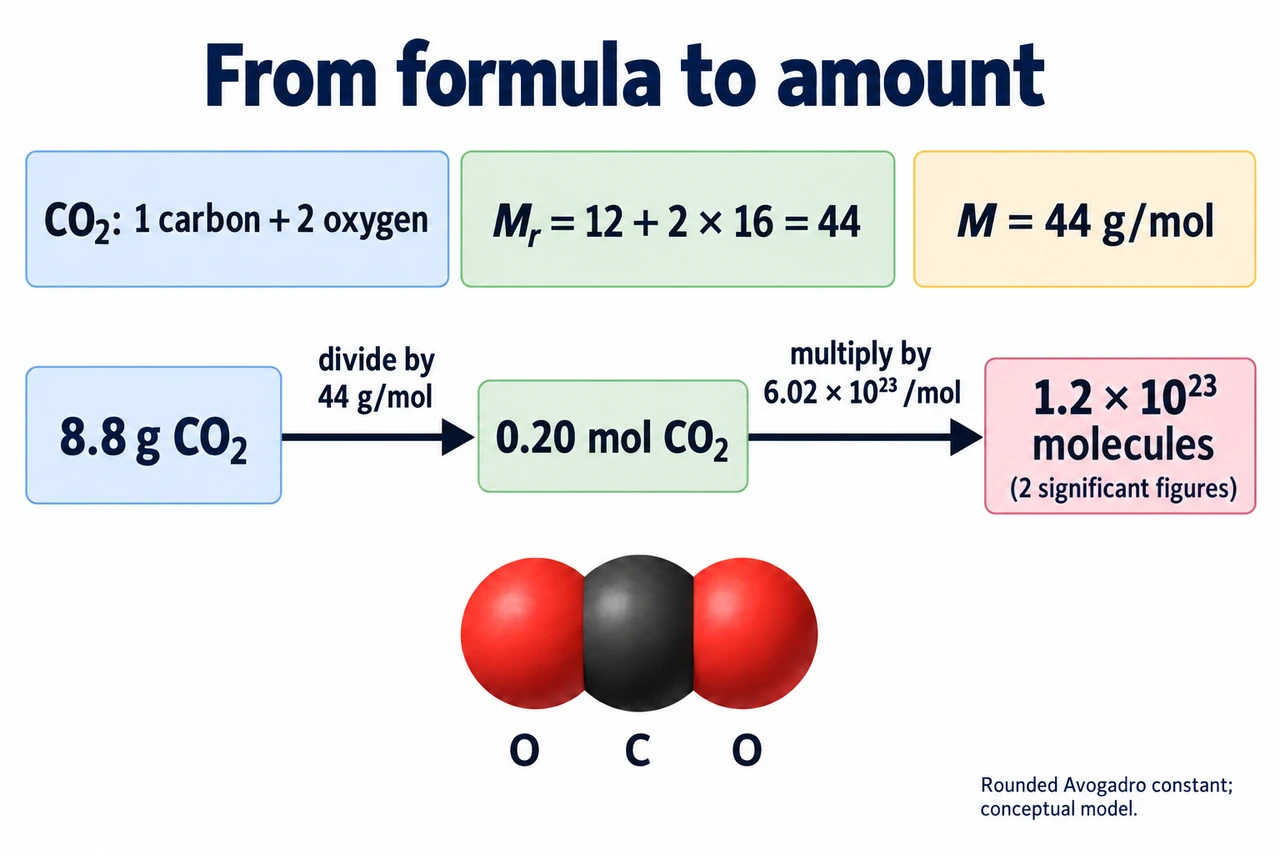
myAudience original generated teaching illustration. Image: illustration, not a documentary photograph. · Original generated teaching illustration; no exam-board or textbook artwork copied.
Converting mass and amount without confusing Mr with grams — Higher
Molar mass, M, is mass divided by amount of substance. When expressed in g/mol, its numerical value at this level matches the relative formula mass Mr. For CO2 with Mr = 44, use M = 44 g/mol. Mr itself remains unitless. The shorthand statement that one mole has a mass numerically equal to Mr is useful only when the mass is in grams; it does not make a mole and a gram interchangeable units.
Write m = nM to express how many grams belong to n moles. Dividing both sides by M gives n = m/M, while dividing by n gives M = m/n. The units help check the operation: g divided by g/mol produces mol. If a sample mass is supplied in milligrams, convert it to grams before substituting a molar mass in g/mol. Unit conversion should precede arithmetic rather than being guessed from the size of the answer.
For 8.8 g of CO2, n = 8.8/44 = 0.20 mol. The amount is a fifth of a mole because the mass is a fifth of 44 g. That estimate catches a mistaken multiplication giving hundreds of moles. The reverse calculation is equally important: 0.30 mol of CO2 has mass 0.30 × 44 = 13.2 g. A formula rearrangement is a reversible relationship between measured quantities, not a rule to memorise in only one direction.
The calculation assumes the mass refers to the named pure substance. If 10.0 g of a sample is 80.0% pure calcium carbonate, only 8.00 g belongs in the CaCO3 mole calculation. With M = 100 g/mol, the amount is 0.0800 mol. Unknown impurities cannot be included as if they had the same formula mass. Purity data are an input, not something the mole calculation independently establishes.
Carry adequate working digits through a multistep calculation and round the reported result appropriately. Atomic masses given as rounded teaching values should be used consistently throughout. A useful written solution names the substance beside each amount so that a later reaction ratio connects the correct pair. The symbol n(CO2) prevents an amount of carbon dioxide being mistaken for its oxygen-atom amount, which is twice as large.
The mole plate distinguishes a unitless Mr of 44 from a molar mass of 44 g/mol. Follow the division arrow from mass to amount before following the separate multiplication arrow to an entity count. Neither arrow means that grams, moles and numbers of molecules are interchangeable units.
Worked example: Find the amount in 750 mg (given to three significant figures) of pure MgO, and the mass of 0.125 mol MgO. Use Mg = 24 and O = 16.
M(MgO) = 40 g/mol; 750 mg = 0.750 g.
Amount = 0.750/40 = 0.01875 mol, reported as 0.0188 mol at three significant figures.
For the reverse calculation, m = 0.125 × 40 = 5.00 g.
Answer: 0.0188 mol in 750 mg; 5.00 g for 0.125 mol.
Check your understanding: A pure compound has mass 7.50 g and amount 0.0500 mol. What is its molar mass?
Answer: 150 g/mol.
Why: Rearrange m = nM to M = m/n; 7.50/0.0500 = 150. The result is a mass per mole, not a unitless Mr label.