Using a balanced ratio to predict reacting masses — Higher
By UK GCSE Chemistry · independent study · myAudience
myAudience original generated teaching illustration. Image: illustration, not a documentary photograph. · Original generated teaching illustration; no exam-board or textbook artwork copied.
Using a balanced ratio to predict reacting masses — Higher
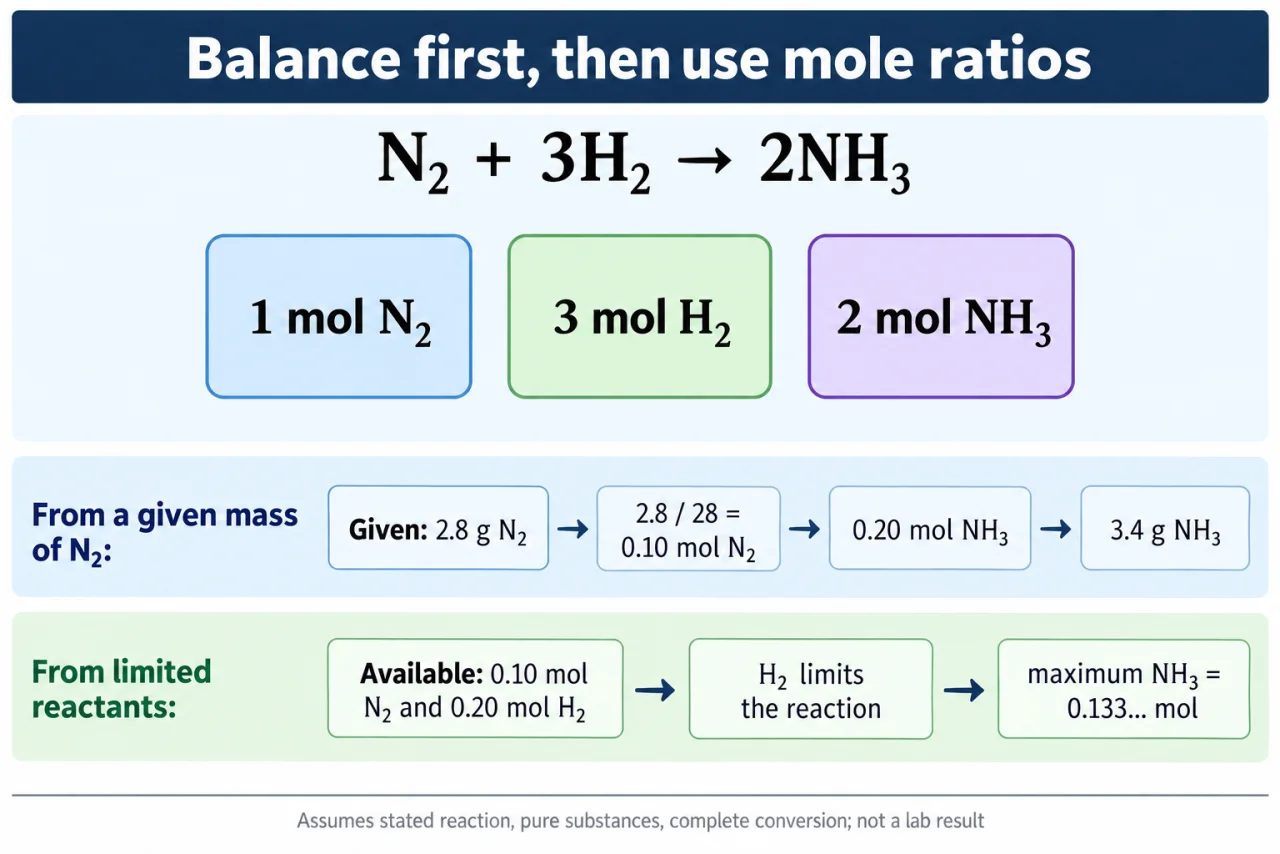
Stoichiometry uses a balanced equation to relate amounts of substances. The coefficients give mole ratios, not gram ratios. In N2 + 3H2 → 2NH3, one mole of nitrogen reacts with three moles of hydrogen to form two moles of ammonia. With N = 14 and H = 1, the corresponding mass account is 28 g + 6 g → 34 g. Equal mass on both sides coexists with unequal masses of the individual reactants.
The dependable route is mass of known substance → its amount → amount of target substance → target mass. For 2.80 g N2 reacting completely with sufficient hydrogen, n(N2) = 2.80/28 = 0.100 mol. The equation gives twice that amount of NH3, or 0.200 mol. Multiplying by M(NH3) = 17 g/mol gives 3.40 g. Each step states which substance its number describes.
The same chain works backwards from a product requirement. To form 6.80 g NH3 in the ideal account, n(NH3) = 0.400 mol and n(N2) = 0.200 mol, requiring 5.60 g nitrogen. Hydrogen amount would be 0.600 mol, requiring 1.20 g. Adding those two reactant masses reproduces 6.80 g. A reverse problem changes the direction of the ratio, not the balanced equation.
A numerical prediction needs explicit assumptions. The given reactant must have the stated purity; other reactants must be available in at least the required amounts; and the reaction must follow the written equation. Complete conversion and complete collection are different assumptions. Ammonia synthesis is reversible in practice, so this ideal calculation is a theoretical maximum under the stoichiometric account, not a claim about a real factory's measured output.
The formula n(target) = n(known) × coefficient(target)/coefficient(known) explains which ratio to use. A unit check then confirms the final multiplication by g/mol. Multiplying a mass directly by coefficient ratios skips different molar masses and generally fails. The method is useful in unfamiliar reactions because it starts from the supplied formulae and balanced relationship, rather than relying on memorised examples.
A Higher-tier link to open-system observations can predict the remaining solid in an ideal decomposition. For CaCO3 → CaO + CO2 with molar masses 100, 56 and 44 g/mol, 5.00 g pure CaCO3 is 0.0500 mol. The 1:1 ratio gives 0.0500 mol CaO, or 2.80 g, and 0.0500 mol CO2, or 2.20 g. This theoretical reacting-mass calculation assumes complete decomposition and no other losses. It is distinct from subtracting two observed balance readings in the shared-tier mass-change lesson.
The ratio plate begins with the balanced ammonia equation. Its 1:3:2 entries are amounts in moles, while the lower mass route separately uses nitrogen and ammonia molar masses. In that example the mass increase from 2.8 g nitrogen to 3.4 g ammonia includes hydrogen supplied by the other reactant.
Worked example: 2Al + 3Cl2 → 2AlCl3. What ideal mass of AlCl3 forms from 5.40 g Al with excess chlorine? Use Al = 27 and Cl = 35.5.
n(Al) = 5.40/27 = 0.200 mol.
The Al:AlCl3 ratio is 2:2, so n(AlCl3) = 0.200 mol.
M(AlCl3) = 27 + 3 × 35.5 = 133.5 g/mol; m = 0.200 × 133.5 = 26.7 g.
Answer: 26.7 g AlCl3 as the ideal product mass.
Check your understanding: How much Al is needed for an ideal 13.35 g AlCl3 product with excess chlorine? Use the same atomic masses.
Answer: 2.70 g Al.
Why: 13.35/133.5 = 0.100 mol AlCl3, requiring 0.100 mol Al by the 2:2 ratio; multiply by 27 g/mol.