Recovering an equation from measured masses — Higher
By UK GCSE Chemistry · independent study · myAudience
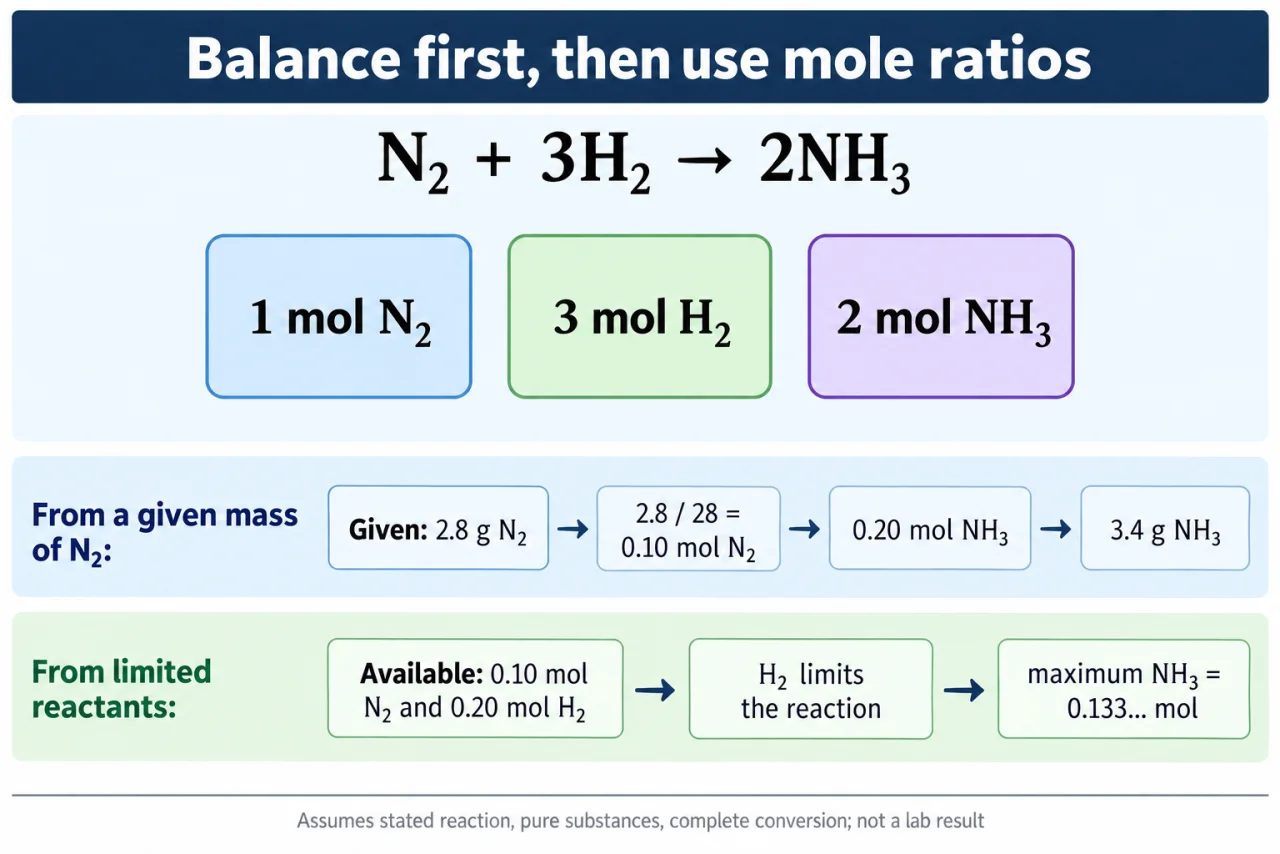
myAudience original generated teaching illustration. Image: illustration, not a documentary photograph. · Original generated teaching illustration; no exam-board or textbook artwork copied.
Recovering an equation from measured masses — Higher
A balanced equation can be inferred from reacting masses when the identities and formulae of reactants and products are known. The mass ratio itself does not give coefficients because different substances have different molar masses. Convert each mass to moles, then compare the amounts. This is the inverse of using an equation to predict mass, and it makes the evidential role of quantitative chemistry clear.
Suppose an ideal complete reaction uses 4.80 g magnesium and 3.20 g oxygen gas to form 8.00 g MgO. With molar masses 24, 32 and 40 g/mol, the corresponding amounts are 0.200, 0.100 and 0.200 mol. Divide all three by the smallest, 0.100, to obtain 2:1:2. Therefore the equation is 2Mg + O2 → 2MgO. The oxygen-gas molar mass is 32 because the measured substance is O2.
A ratio need not become whole numbers immediately. If division by the smallest amount produces 1:1.5:1, multiply every value by two to get 2:3:2. Do not round 1.5 to 2; that would change the atom account. Experimental ratios may be slightly displaced by uncertainty, so state a justified simple ratio and check the element counts. Rounding should reflect evidence and chemical consistency, not force an expected answer.
Mass conservation supplies a second check. In the magnesium example the initial masses sum to 8.00 g, equal to the stated product mass. In an open-system experiment the oxygen mass might instead be inferred from the product mass minus metal mass, but that inference requires complete reaction and no other gains or losses. If unreacted excess reagent is included as if it all reacted, the deduced coefficient ratio will be wrong.
Balancing from masses does not identify unknown products by itself. Formulae need separate chemical evidence, and an equation inferred from a small data set remains conditional on that evidence. The vocabulary distinguishes reacting amount from initial amount and inferred ratio from directly measured mass. When your coefficients are proposed, independently count each element on both sides; the arithmetic route and the atom audit should agree.
The shared ratio plate shows how coefficients relate known substances; it is not the iron mass-to-coefficient worked example. To connect the representation to that example, first obtain 0.200, 0.150 and 0.100 mol, then scale the entire ratio to 4:3:2 and audit four iron and six oxygen atoms on each side.
Worked example: Known substances react as Fe + O2 → Fe2O3. Complete reaction consumes 11.2 g Fe and 4.80 g O2 and forms 16.0 g Fe2O3. Use Fe = 56 and O = 16. Deduce coefficients.
M values are 56, 32 and 160 g/mol. Amounts are 0.200, 0.150 and 0.100 mol.
Divide by 0.100: Fe:O2:Fe2O3 = 2:1.5:1. Multiply all entries by two.
Audit 4 Fe atoms and 6 O atoms on each side; 11.2 + 4.80 = 16.0 g.
Answer: 4Fe + 3O2 → 2Fe2O3.
Check your understanding: Amounts of Al, O2 and Al2O3 reacting/forming are 0.40, 0.30 and 0.20 mol. What are the simplest coefficients?
Answer: 4:3:2, giving 4Al + 3O2 → 2Al2O3.
Why: Dividing by 0.20 gives 2:1.5:1; multiplying all three by two preserves the ratio and balances each element.