Which reactant sets the maximum product? — Higher
By UK GCSE Chemistry · independent study · myAudience
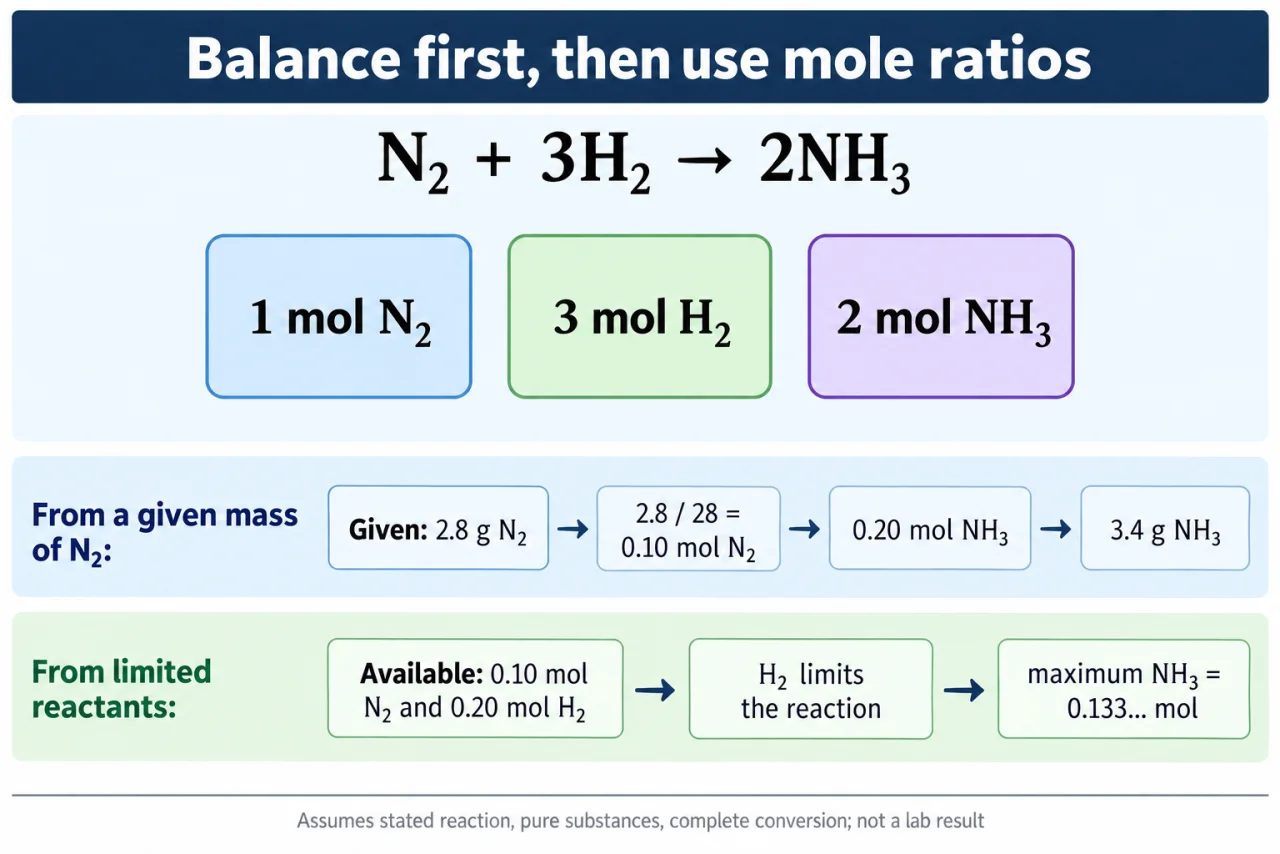
myAudience original generated teaching illustration. Image: illustration, not a documentary photograph. · Original generated teaching illustration; no exam-board or textbook artwork copied.
Which reactant sets the maximum product? — Higher
The limiting reactant is used up first in the ideal complete reaction and sets the maximum amount of product. An excess reactant is supplied in more than the equation requires for that limiting amount. Excess can help ensure another reagent is used, but it cannot create product once the limiting reagent is exhausted. The word limiting refers to the reacting ratio, not whichever initial mass or mole number looks smaller.
For N2 + 3H2 → 2NH3, 0.100 mol N2 requires 0.300 mol H2. If only 0.200 mol H2 is available, hydrogen limits the ideal reaction even though its mole number is larger than nitrogen's. Each mole of H2 supports 2/3 mol NH3, so the maximum is 0.200 × 2/3 = 0.1333... mol NH3. Nitrogen consumed is 0.200/3 = 0.0667 mol, leaving about 0.0333 mol nitrogen.
A general method compares n/coefficient for each reactant, or calculates possible product independently from each. The smaller reaction capacity identifies the limit. These are equivalent approaches because the balanced equation defines a fixed recipe. If both capacities are equal, the quantities are stoichiometric: neither is initially in excess. This special case should be recognised rather than inventing an excess reagent where none exists.
When masses are given, convert each to its own amount before comparing capacities. A heavy molar mass can make a large gram quantity chemically small. For 2Mg + O2 → 2MgO, 4.80 g Mg is 0.200 mol and 6.40 g O2 is 0.200 mol. Magnesium capacity is 0.100, oxygen capacity 0.200, so magnesium limits and 0.100 mol oxygen remains. Use that limit, not the larger oxygen supply, to predict the oxide mass.
The maximum is theoretical. Actual conversion may be lower in reversible reactions, and isolated product may be reduced by side reactions or collection losses. Stating a limiting reactant therefore does not promise that its theoretical product mass will be collected. A clear solution separates initial quantities, consumed quantities, leftovers and maximum product; checking their combined masses tests whether your bookkeeping conserves matter.
The limiting branch of the ratio plate supplies 0.10 mol nitrogen and 0.20 mol hydrogen. Nitrogen would need 0.30 mol hydrogen, so hydrogen limits even though its initial amount is numerically larger. The 0.133... mol ammonia value is a theoretical maximum, not a measured factory yield.
Worked example: For 2Mg + O2 → 2MgO, use 4.80 g Mg and 6.40 g O2. Find the limiting reagent, theoretical MgO mass and excess mass left. Use Mg = 24, O = 16.
Amounts: Mg = 0.200 mol, O2 = 0.200 mol. Compare 0.200/2 with 0.200/1; Mg limits.
0.200 mol Mg produces 0.200 mol MgO; M(MgO) = 40 g/mol, so product mass = 8.00 g.
O2 consumed = 0.100 mol; leftover = 0.100 mol = 3.20 g. Product plus leftover = 11.20 g, equal to the initial total.
Answer: Mg limits; maximum MgO is 8.00 g; 3.20 g O2 remains.
Check your understanding: In N2 + 3H2 → 2NH3, compare 0.20 mol N2 and 0.30 mol H2. What limits and what maximum NH3 amount forms?
Answer: H2 limits; maximum NH3 is 0.20 mol.
Why: The capacities are 0.20 and 0.30/3 = 0.10. The smaller capacity multiplied by coefficient 2 gives 0.20 mol product.