Mass concentration: an amount of solute per solution volume
By UK GCSE Chemistry · independent study · myAudience
myAudience original generated teaching illustration. Image: illustration, not a documentary photograph. · Original generated teaching illustration; no exam-board or textbook artwork copied.
Mass concentration: an amount of solute per solution volume
A solution contains a solute distributed through a solvent. Mass concentration compares solute mass with final solution volume, commonly in g/dm3 at GCSE. It tells you how much solute corresponds to each cubic decimetre of solution, not how much solute is present in every container. A small and a large sample of the same well-mixed solution share the same concentration while containing different total solute masses.
The relation c = m/V uses mass m in grams and solution volume V in dm3. Rearranging gives m = cV, the shared-tier calculation of solute mass in a specified volume. A solution labelled 24.0 g/dm3 contains 24.0 g per dm3, so 0.250 dm3 contains 6.00 g. Multiplication by a quarter of a dm3 gives a quarter of that mass; the reasoning explains the formula instead of treating the label as a decoration.
Volume units must agree before substitution. One dm3 equals 1000 cm3; therefore 250 cm3 is 0.250 dm3. A cubic centimetre is also a millilitre. Dividing a cm3 reading by 1000 converts it to dm3, while multiplying converts back. Using 250 in a formula expecting dm3 would introduce a factor-of-1000 error. Write the conversion visibly so someone else can check the units.
Higher extension: at fixed final volume, doubling solute mass doubles mass concentration. At fixed solute mass, doubling final solution volume halves it. These statements follow from the numerator and denominator in c = m/V. Dilution adds solvent without changing the solute mass, provided no solute is lost or chemically changed. Evaporation can increase concentration, but only if solute is retained and the relevant solution volume decreases.
The denominator is final solution volume, not the volume of solvent originally poured in. Dissolving a solid in 250 cm3 of water does not guarantee a final solution volume of exactly 250 cm3. In a supervised preparation, dissolving the solute and making the solution up to a stated final mark addresses that distinction. Concentration is also different from acid strength, which concerns ionisation; a concentration label alone cannot classify an acid as strong or weak.
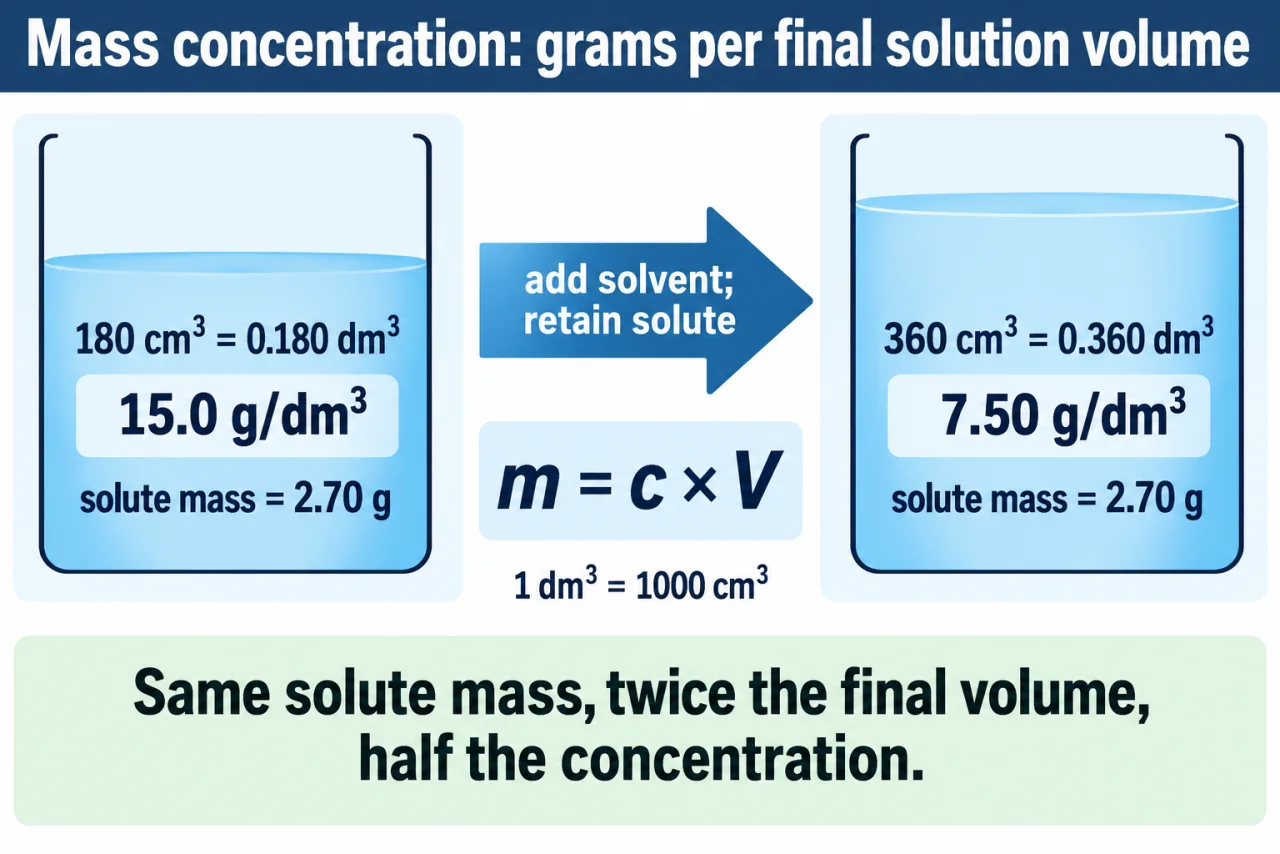
The dilution plate labels final volumes and solute masses explicitly. Both vessels contain the same 2.70 g solute, while the labelled final volume doubles and concentration halves. The artwork is schematic: liquid heights and vessel dimensions are not a calibrated volumetric scale, so read the stated quantities.
Worked example: How much solute is present in 180 cm3 of a solution at 15.0 g/dm3? Higher extension: what concentration results if that sample is diluted to 360 cm3 without solute loss?
Convert 180 cm3 to 0.180 dm3.
Mass = 15.0 × 0.180 = 2.70 g.
Higher extension: final volume is 0.360 dm3, so new concentration = 2.70/0.360 = 7.50 g/dm3.
Answer: 2.70 g solute; after the stated dilution, 7.50 g/dm3.
Check your understanding: A 32.0 g/dm3 solution has volume 125 cm3. What mass of solute does it contain?
Answer: 4.00 g.
Why: 125 cm3 = 0.125 dm3; m = cV = 32.0 × 0.125. The volume is one eighth of a dm3, so the mass is one eighth of 32.0 g.