Yield compares collected product with a theoretical maximum
By UK GCSE Chemistry · independent study · myAudience
myAudience original generated teaching illustration. Image: illustration, not a documentary photograph. · Original generated teaching illustration; no exam-board or textbook artwork copied.
Yield compares collected product with a theoretical maximum
Yield is the amount of the desired product obtained. Percentage yield compares that actual amount with the maximum theoretical amount for the reaction account: percentage yield = actual yield/theoretical yield × 100. The two amounts must refer to the same product and use the same units. At Foundation the theoretical amount can be supplied; deriving it from a reactant mass and equation is the Higher extension, which uses earlier mole-ratio lessons.
Conservation of atoms does not guarantee complete collection of the desired product. A reversible reaction may not proceed fully towards products. Some reactant may follow a side reaction that makes a different substance. Product may also be lost during separation, transfer or purification. Each explanation places the atoms somewhere; none requires matter to disappear. It is useful to distinguish incomplete chemical formation from loss of product that did form.
If the theoretical yield is 7.50 g and 6.00 g of pure dry product is collected, percentage yield is 6.00/7.50 × 100 = 80.0%. Reversing the fraction gives an implausible result above 100%. A measured mass above the predicted maximum can reflect retained water, impurities or incorrect assumptions. It is a reason to examine the method and calculation, not evidence that more atoms have been made than were present initially.
Higher extension: identify the limiting reactant and use the balanced equation to calculate theoretical product amount. For CaCO3 → CaO + CO2, 12.5 g pure CaCO3 with M = 100 g/mol corresponds to 0.125 mol. The CaO ratio is 1:1 and M(CaO) = 56 g/mol, so the theoretical solid yield is 7.00 g. This branch assumes complete conversion and names CaO as the desired product; it does not use the combined masses of all products as its denominator.
A yield figure is informative only with its experimental context. A high yield of contaminated material may be less useful than a smaller amount of pure product. Repeating a separation and improving transfers can reduce loss, while changing reaction conditions may affect conversion or side reactions. The constructed examples here explain the reasoning but are not evidence of an actual experiment or a recommended unsupervised preparation.
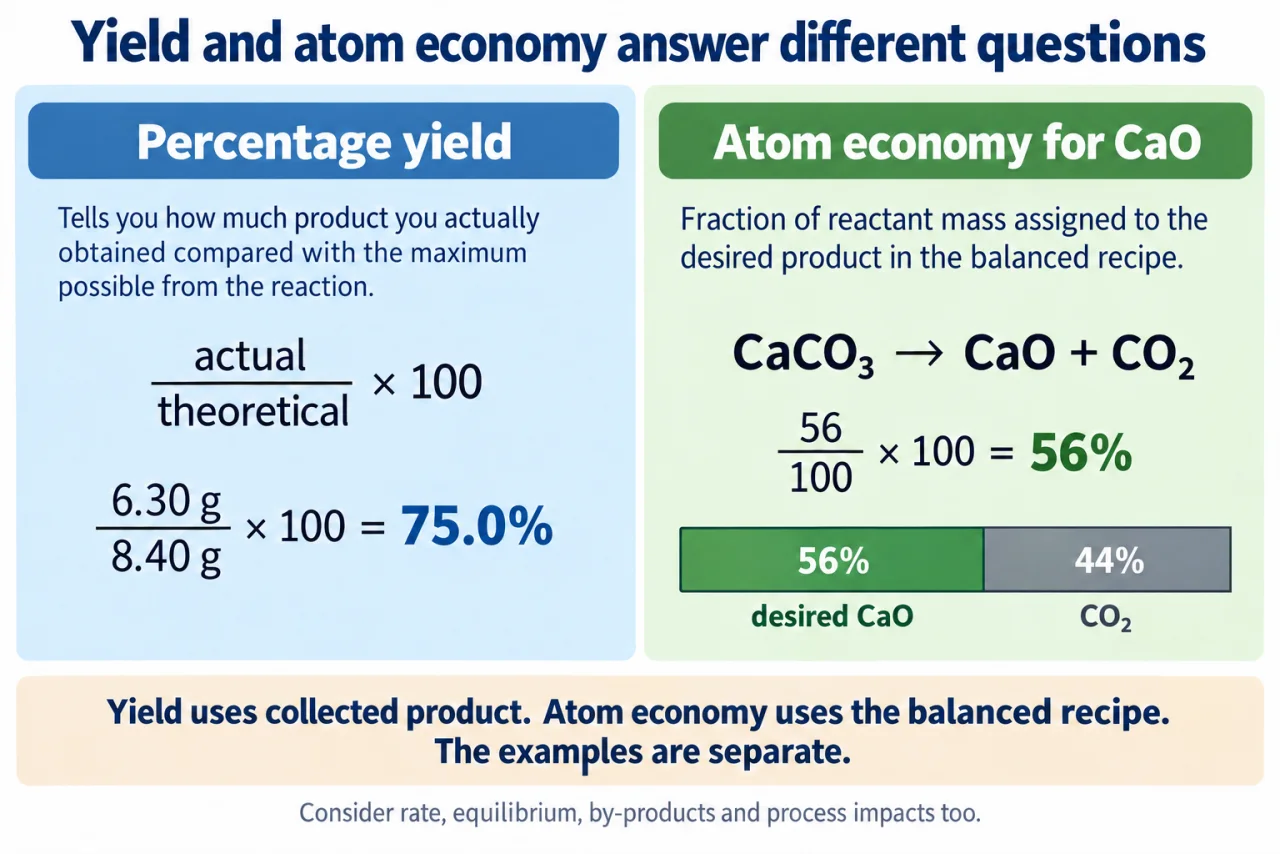
The left efficiency panel uses 6.30 g actually collected and a supplied 8.40 g theoretical maximum to give 75.0% yield. The right panel is a separate calcium-oxide atom-economy example. Combining those two unrelated percentages into one result would silently combine different reaction accounts.
Worked example: A process has a supplied theoretical product yield of 8.40 g and collects 6.30 g pure dry product. Calculate percentage yield. Higher extension: for 12.5 g CaCO3 giving 5.60 g CaO, use the theoretical calculation in the prose.
Shared-tier calculation: 6.30/8.40 × 100 = 75.0%.
Higher branch: the theoretical CaO yield is 7.00 g from the stated 1:1 mole ratio.
Higher branch percentage = 5.60/7.00 × 100 = 80.0%.
Answer: 75.0% for the supplied-yield example; Higher branch 80.0%.
Check your understanding: A theoretical 5.00 g dry product is weighed as 5.40 g. Name a plausible reason and explain why 108% is not proof of extra atoms.
Answer: Retained water or contamination could add measured mass.
Why: 5.40/5.00 × 100 = 108%, but the measurement may include substances other than the intended pure dry product. Review the material and theoretical assumptions.