Atom economy follows the balanced recipe, not the collected yield
By UK GCSE Chemistry · independent study · myAudience
myAudience original generated teaching illustration. Image: illustration, not a documentary photograph. · Original generated teaching illustration; no exam-board or textbook artwork copied.
Atom economy follows the balanced recipe, not the collected yield
Atom economy measures how much of the balanced reaction's input mass is assigned to the desired product. It is calculated as the coefficient-weighted relative formula mass of that product divided by the sum of coefficient-weighted relative formula masses of all reactants, multiplied by 100. Coefficient-weighted means that a formula preceded by 2 contributes twice its Mr. This is a theoretical reaction-design metric, not a measurement of how much product was collected.
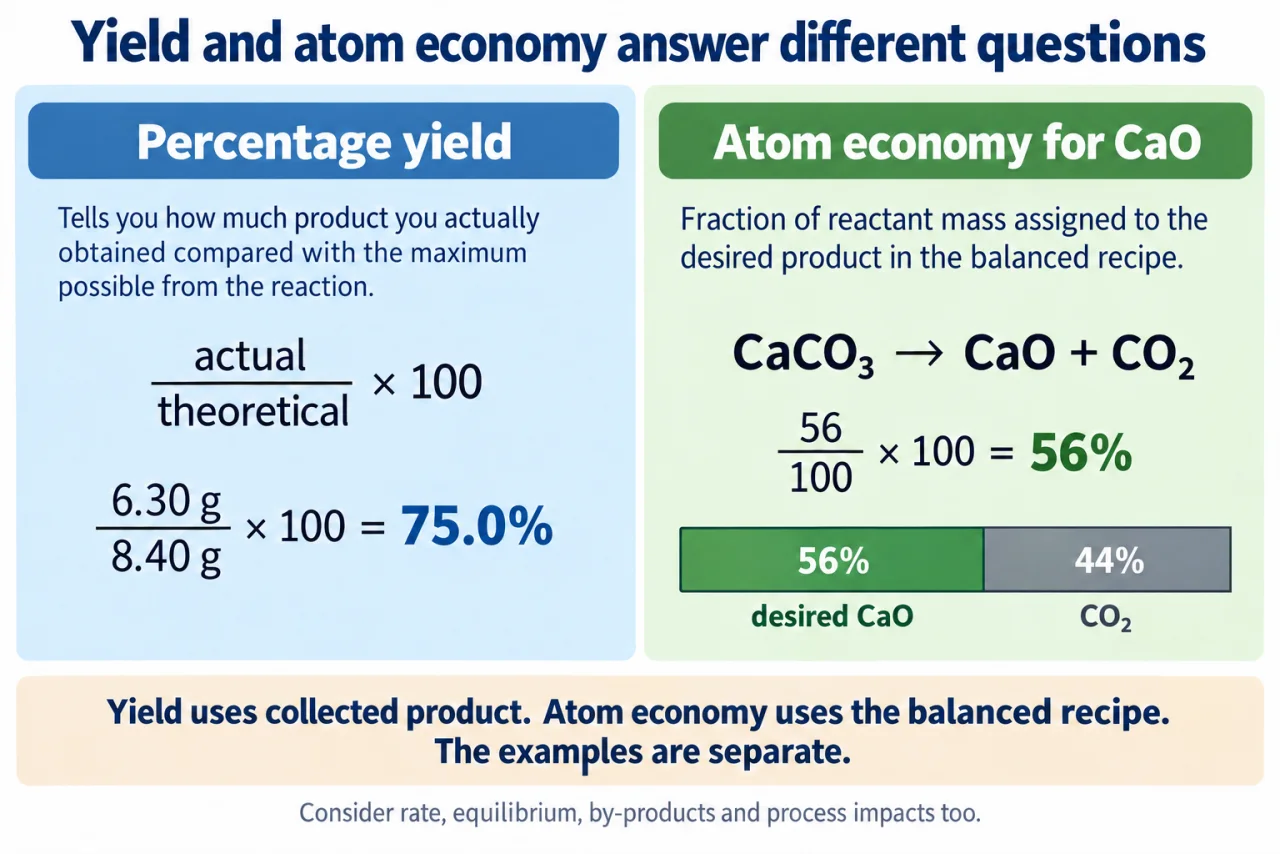
For CaCO3 → CaO + CO2, suppose CaO is the desired product. Using Ca = 40, C = 12 and O = 16 gives Mr values 100, 56 and 44. The atom economy is 56/100 × 100 = 56%. The carbon dioxide is still present in the atom account but is not counted as the chosen desired product. If the question instead seeks carbon dioxide, its numerator changes to 44 and the atom economy becomes 44%. Naming the target matters.
Yield and atom economy answer different questions. The same decomposition might have an 80% yield of CaO while its atom economy remains 56%. Conversely, an ideal addition reaction with one product can have 100% atom economy even when practical collection is poor. Changing the collected mass does not change the balanced recipe, so it cannot alone change the equation-based atom economy. Side reactions affect actual efficiency and need separate evidence.
For 2NaHCO3 → Na2CO3 + CO2 + H2O, choosing Na2CO3 gives a numerator of 106 and a denominator of 2 × 84 = 168. The result is 63.1% to three significant figures. Forgetting the reactant coefficient would incorrectly produce a value above 100%. The denominator can also be audited against all coefficient-weighted product masses: 106 + 44 + 18 = 168, confirming that no product has been omitted from the full mass account.
Higher extension: atom economy contributes to pathway choice but is not a complete sustainability judgement. A process with higher atom economy may need more energy, hazardous solvents, costly purification or have an unfavourable equilibrium and low yield. Useful by-products can alter commercial decisions even though the specified GCSE numerator remains the named desired product. The ACS discussion and Trost's research connect this metric to reaction design; the next lesson practices weighing several supplied criteria.
The right efficiency panel names CaO as the desired product in the carbonate decomposition. Its 56% and 44% bar partitions the balanced input mass between CaO and CO2; it is not a measured yield. Choosing CO2 as the desired product would change the numerator, while total mass remains conserved.
Worked example: Calculate atom economy for producing Na2CO3 via 2NaHCO3 → Na2CO3 + CO2 + H2O. Use Na = 23, H = 1, C = 12 and O = 16.
Mr(NaHCO3) = 84; Mr(Na2CO3) = 106.
Weight the reactant by its coefficient: denominator = 2 × 84 = 168.
Atom economy = 106/168 × 100 = 63.095...%; audit all product masses: 106 + 44 + 18 = 168.
Answer: 63.1% for the specified sodium carbonate product.
Check your understanding: If 90% of theoretical Na2CO3 is collected, does its atom economy become 90%?
Answer: No; it remains 63.1% for this equation and desired product.
Why: The 90% describes collected yield. Atom economy uses the balanced stoichiometric recipe and target formula mass.